Ottawa’s Jobs-Loss Ledger Starts With 42,000 Missing Jobs
The August labour report is not a messaging problem. It is a results problem.
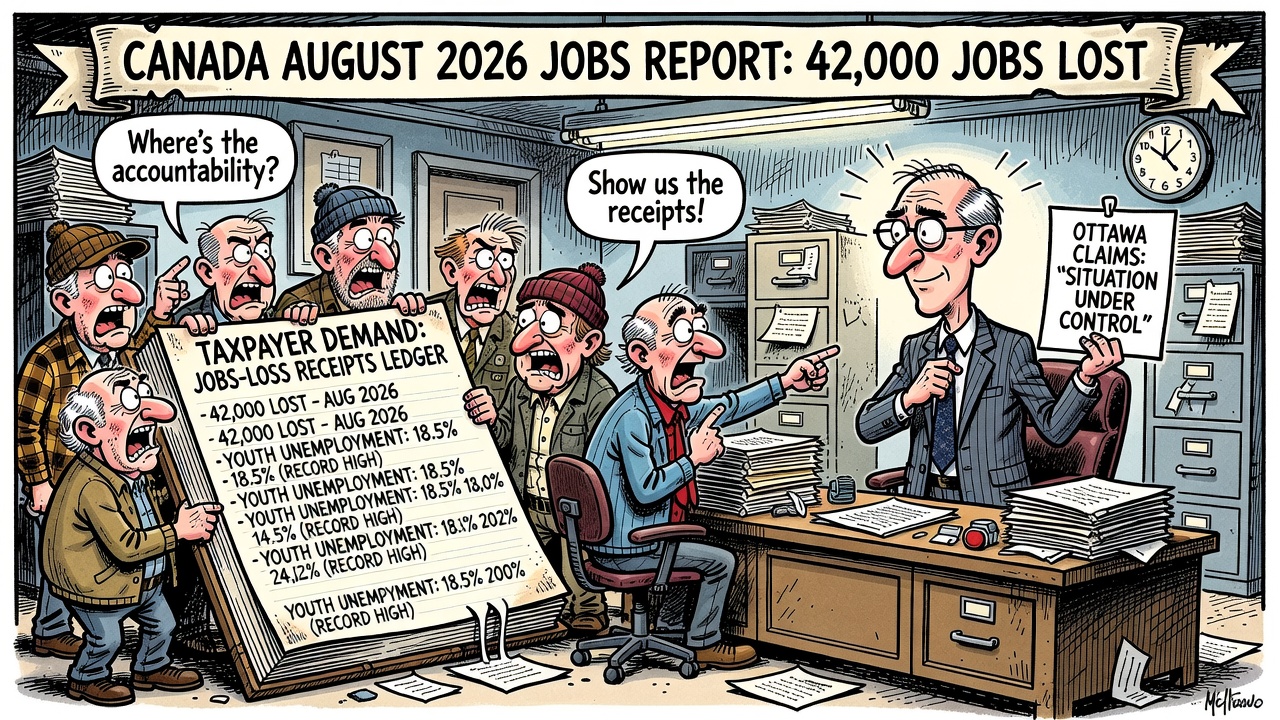
Statistics Canada’s August Labour Force Survey should end the habit of treating every weak economic number as a communications challenge. Employment fell by 42,000 in August. The employment rate slipped to 60.8%. The unemployment rate stayed at 6.4%, which sounds stable only until Canadians notice that roughly 1.5 million people were still unemployed.
That is the number Ottawa should have to answer for before the next round of slogans about “building,” “resilience” or “control.” A government cannot claim the economy is under command while the official jobs report shows a month of losses and a labour market that still leaves too many families waiting for work.
The details are worse than the headline. Statistics Canada reported that 24.0% of unemployed Canadians were in long-term unemployment, meaning they had been searching for work for 27 weeks or more. That share remains well above the 2017-to-2019 pre-pandemic average of 17.1%. For young Canadians, employment fell by 19,000 in August, and the youth unemployment rate sat at 12.9%, still above the pre-pandemic average of 10.8%.
Those are not abstractions. They are graduates sending resumes into silence, apprentices watching worksites slow down, parents carrying adult children longer than planned, and small businesses wondering whether Ottawa understands the cost of uncertainty.
Global News, citing The Canadian Press, noted that August’s loss missed economists’ expectations for a 15,000-job gain and ended a four-month run that had added 181,000 jobs from April through July. Statistics Canada also reported job declines in business, building and other support services, public administration, natural resources and utilities, while manufacturing rose by 22,000. Average hourly wage growth cooled to 2.0% year over year, down from 2.8% in July.
Conservatives should say this plainly: Canada needs a jobs plan measured by outcomes, not ministerial adjectives. If the Carney government believes its policies are working, it should publish a monthly jobs-loss ledger showing where employment is being lost, which sectors are tariff-exposed, what youth-employment programs are actually producing, how wage growth is tracking against living costs, and which ministers are responsible for recovery targets.
That ledger should include regional breakdowns, timelines for job recovery, program spending tied to measurable hiring, and a plain-language explanation of whether federal tax, regulatory, immigration, trade and procurement decisions are helping or hurting hiring. It should also separate private-sector job creation from public-sector payroll changes, because Canadians need to know whether prosperity is being built in the productive economy or padded by government headcount.
Ottawa’s answer to job losses cannot be another press conference. The answer is evidence: targets, deadlines, ministerial accountability and public receipts.
- Statistics Canada: Labour Force Survey, August 2026 — released September 4, 2026
- Global News / The Canadian Press: Economy sheds 42,000 jobs, unemployment rate steady in August, says StatCan — September 4, 2026
This article relies on Statistics Canada’s Labour Force Survey and mainstream reporting. It argues for public jobs, wage, youth-employment and sector-by-sector accountability receipts; it does not allege that any individual manipulated labour-market data.