Ottawa Lost the Nazi-Files Secrecy Fight. Publish the Clock.
A Federal Court order on the Rodal Report should trigger a public appeal clock, a redaction inventory and a full declassification ledger.
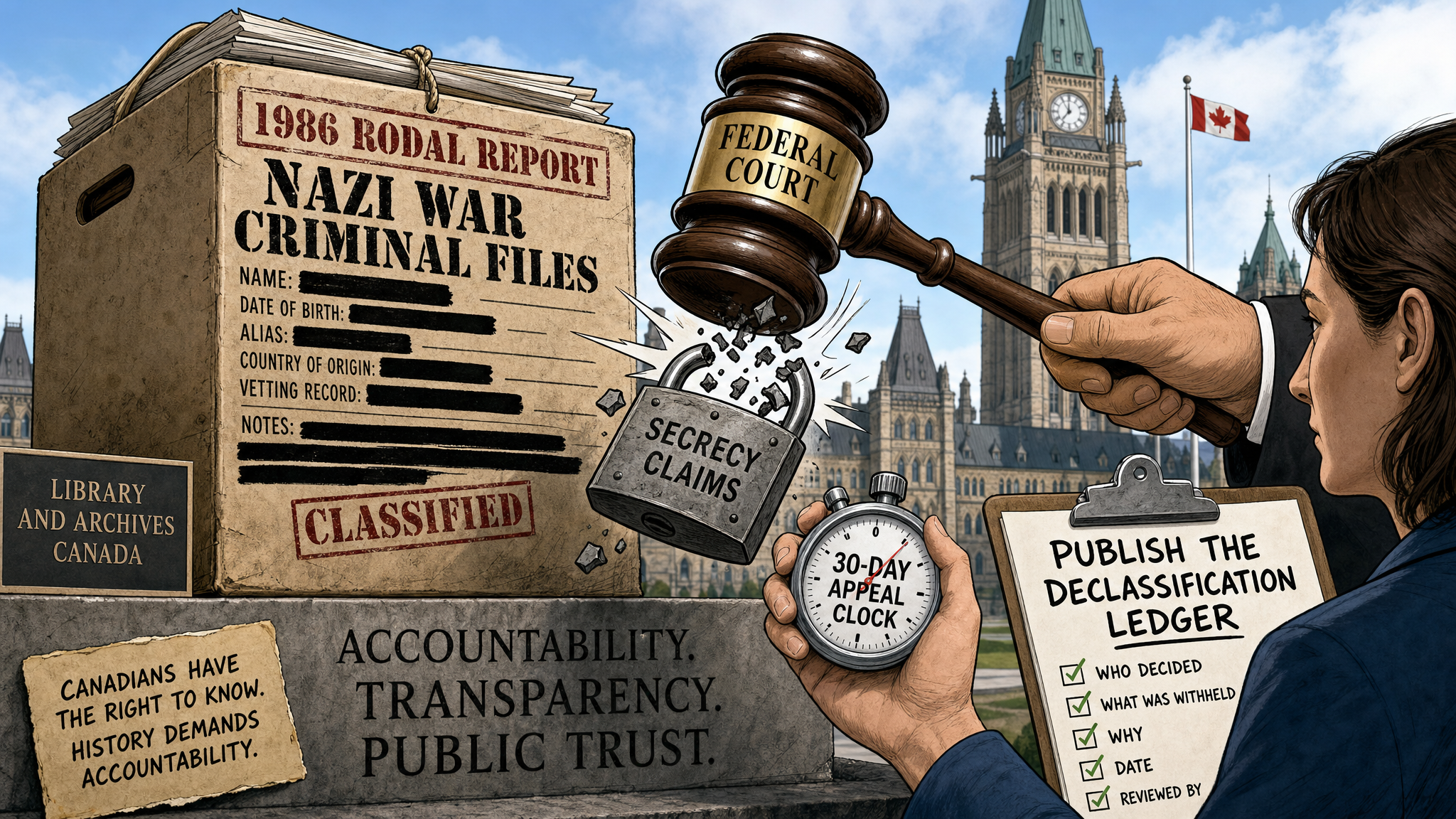
When a federal court has to order Ottawa to release more of a 40-year-old report on Nazi war criminals in Canada, the scandal is no longer only historical. It is current government secrecy.
B’nai Brith Canada reported September 3 that the Federal Court ordered the Government of Canada to disclose previously redacted material from historian Alti Rodal’s 1986 report, Nazi War Criminals in Canada: The Historical and Policy Setting from the 1940s to the Present. The report was prepared for the Deschênes Commission, which examined how alleged Nazi war criminals and collaborators entered and settled in Canada after the Second World War.
The immediate issue is not abstract. Library and Archives Canada released a fuller version of the Rodal Report in February 2024 after an Access to Information request, but kept redactions in seven pages of one section and removed RCMP file numbers from 14 endnotes. According to B’nai Brith, the disputed section concerns Canadian officials’ 1954 discovery of a U.S. intelligence-linked program to resettle Nazis and Nazi collaborators in Canada while avoiding proper security screening.
Justice Simon Fothergill rejected most of Ottawa’s claimed exemptions. B’nai Brith says the court found the government had not met its burden to show that releasing historically significant information would now injure international affairs or national security. The court left one U.S.-supplied quote protected under the Access to Information Act’s confidential foreign-government information exemption, while urging Canada to keep seeking U.S. consent for disclosure.
That is a devastating accountability lesson. Governments love permanent redaction. Citizens live with permanent suspicion. Conservatives should be clear: national security exemptions are sometimes legitimate, but they are not supposed to become an inheritance shield for bureaucratic embarrassment. If the evidence is old, historically central and already mostly known, Ottawa should have to explain — in public — why any line still stays blacked out.
The Carney government now has a simple test. B’nai Brith says Ottawa has 30 days to appeal the September 1 decision. Publish the appeal deadline. Say whether the government will comply or fight. Release the exact redaction inventory. Disclose the legal costs taxpayers have already paid to defend secrecy. Identify every remaining Deschênes Commission, Rodal-related and Nazi-war-criminal file still withheld or partially withheld.
This should not require another court fight, another access request or another decade of delay. Canada’s historical record belongs to Canadians, including Jewish Canadians whose families were denied safety while alleged perpetrators found ways into this country. The public has a right to know how that happened, who knew, what officials did, and why federal institutions kept hiding pieces of the record long after the original security moment had passed.
Ottawa lost the censorship fight. Now it should stop treating disclosure like a concession. Publish the clock, publish the ledger, and release the files.
- B’nai Brith Canada: Federal Court orders release of redacted material from Nazi war criminal report following B’nai Brith advocacy — September 3, 2026
- Blacklock’s Reporter: “Lose Bid To Hide Nazi Files” listed among September 2026 recent posts
- Library and Archives Canada: Alti Rodal report collection record
This article relies on the public B’nai Brith summary of the Federal Court decision and uses the Blacklock’s listing only to confirm the current news hook. It calls for disclosure of records, costs and appeal decisions; it does not assert guilt by any person not identified in the cited record.