The Eighth Trade Advisory Meeting Needs a Receipts Ledger
If Ottawa is taking strategic trade advice while tariffs and subsidy costs mount, Canadians deserve to see who asked for what, who benefits, and what taxpayers are buying.
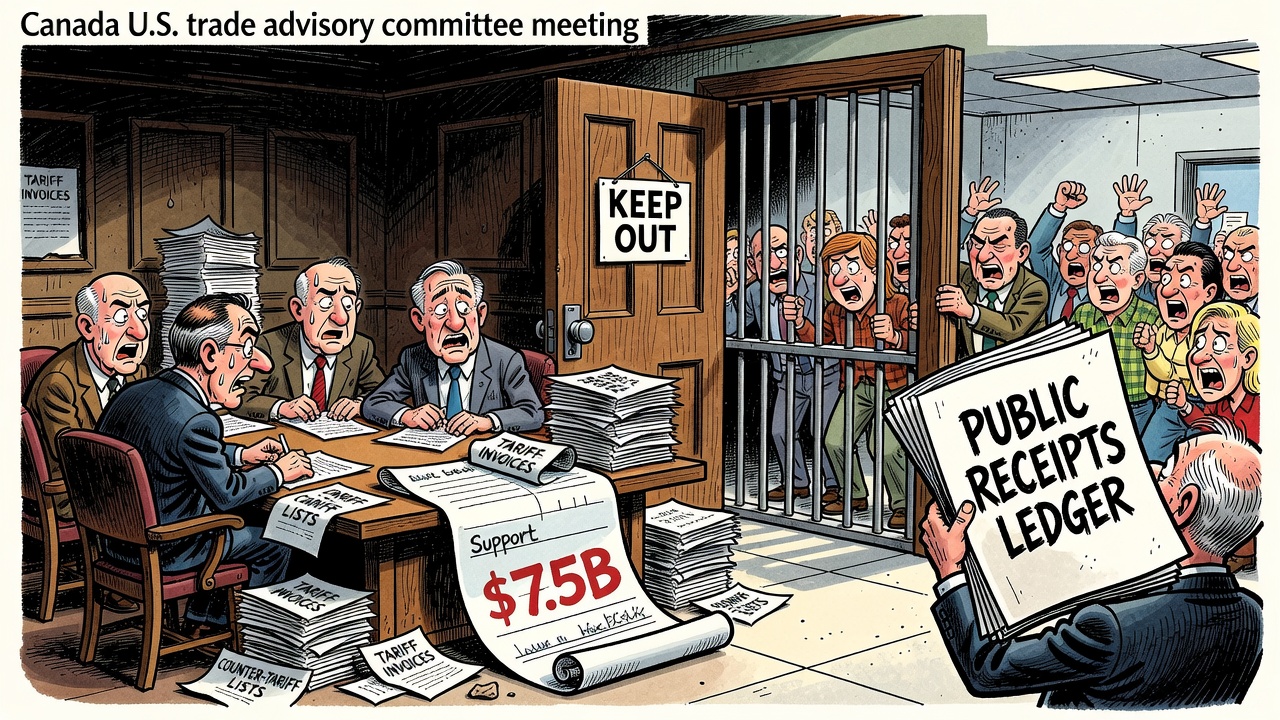
Ottawa’s Canada-U.S. trade response is now being shaped through a recurring advisory loop that deserves more sunlight than another polite government readout.
On September 4, Global Affairs Canada said Dominic LeBlanc chaired a meeting of the Advisory Committee on Canada-U.S. Economic Relations with Mélanie Joly, François-Philippe Champagne and chief trade negotiator Janice Charette participating. The department said the meeting followed an August 22 session and marked the eighth time committee members had convened since April.
The committee is not imaginary and the concept is not automatically improper. Ottawa describes it as a group of leaders from key sectors of the Canadian economy who provide strategic advice on the bilateral economic relationship with the United States. Its published page lists representatives from business, investors, trade organizations and organized labour. In a trade war, governments should listen widely.
But listening privately is not the same as governing transparently. The September 4 readout says ministers updated members on Canada’s response to new U.S. tariffs and on measures for affected workers and businesses. It says committee members exchanged views on Canada’s response, economic resilience, affected sectors, competitive industries and market opportunities. What Canadians do not get is the actual advice, attendance record, agendas, minutes, conflict screens, sector asks, rejected options, cost modelling or follow-up decisions.
That matters because this is not a symbolic file. Prime Minister Mark Carney said on August 21 that trade negotiations with the United States had been suspended after last-minute U.S. terms were judged unfair and uneconomic. Finance Canada then announced counter-tariffs effective September 8 at 15, 25 and 50 percent rates, covering $27.6 billion in U.S. imports. The same announcement added a $7.5 billion package of new and enhanced support for workers and businesses.
Those are large choices with real winners, losers and consumer costs. A product put on a counter-tariff list can protect one domestic producer while raising costs for another Canadian business that relies on that input. A support program can rescue a viable employer, or quietly become political triage for well-connected sectors. A remission decision can relieve a genuine hardship, or create a special door for insiders. That is why the ledger matters.
Conservatives should be clear: Canada must defend its workers, farmers and businesses against unfair U.S. tariffs. But a serious defence of the national interest does not require a black box. It requires proof that decisions are being made for Canadians as a whole, not for the loudest interests in the room.
Publish the roster and attendance for every meeting since April. Publish agendas, non-confidential minutes, conflict-of-interest declarations, recusal records and a summary of advice received by sector. Publish the tariff-impact modelling, the rationale for each counter-tariff product category, the remission criteria and the delivery ledger for the $7.5 billion support package.
If the Carney government’s trade plan is disciplined, evidence-based and fair, receipts will strengthen it. If the receipts are too awkward to publish, Canadians have a bigger problem than tariffs.
- Global Affairs Canada: Minister LeBlanc chairs meeting of Advisory Committee on Canada-U.S. Economic Relations — September 4, 2026
- Global Affairs Canada: Advisory Committee on Canada–U.S. Economic Relations — background and member list
- Prime Minister of Canada: Statement by Prime Minister Carney on Canada-U.S. trade negotiations — August 21, 2026
- Finance Canada: Canada announces targeted countermeasures and support for workers and businesses — August 25, 2026
This article relies on official federal readouts and releases. It argues for disclosure of advice, conflict screens, tariff modelling and spending results; it does not allege wrongdoing by committee members.