Control Means Confirmed Exits, Not Immigration Slogans
Carney says Ottawa has taken back control of temporary immigration. The exit-tracking evidence says Canadians still need the receipts.
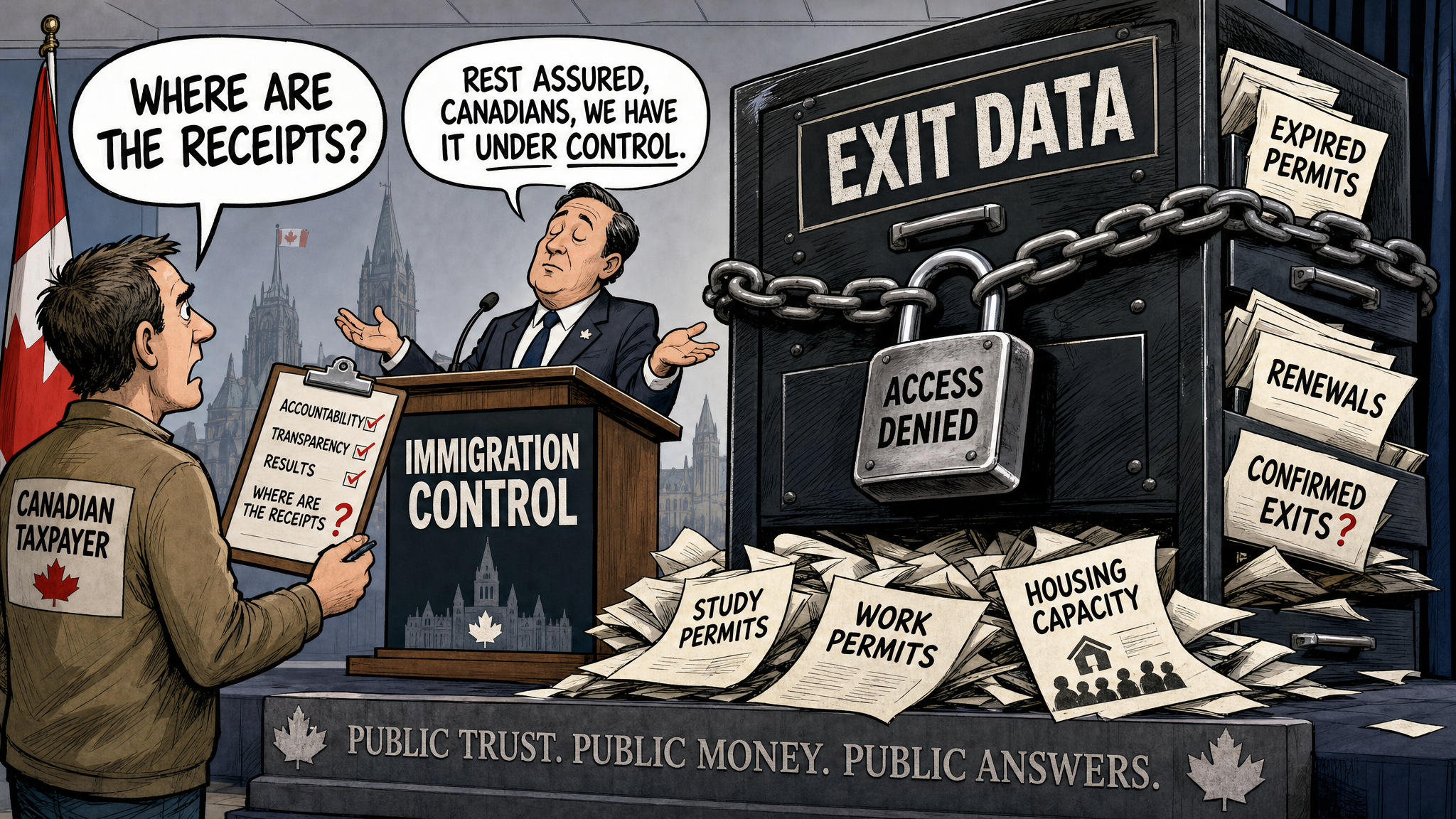
Prime Minister Mark Carney says Ottawa has “taken back control” of immigration. That claim now has a simple test: can the federal government prove who actually leaves when a temporary permit expires?
Canadian Press reported August 30 that Parisa Mahboubi, chair of the C.D. Howe Institute’s Immigration Targets Council, is warning that Canada needs deeper temporary-resident reductions and better data on departures. Her diagnosis should trouble anyone who cares about competent government. She said Canada is “flying in the dark” when it comes to tracking temporary residents after they arrive.
The problem is not that every temporary resident is doing something wrong. The problem is that Ottawa built a massive temporary-student and temporary-worker system, watched it strain housing and services, and now wants credit for controlling it without publishing the basic exit ledger.
The numbers show why slogans are not enough. As of June 30, immigration data cited by Canadian Press showed 632,000 study permit holders and 1.5 million temporary work permit holders in Canada. New inflows are down sharply: 22,410 new foreign students arrived from January through June 2026, compared with 124,930 in the same period in 2024; temporary-worker arrivals fell to 98,130 from 244,985 over the same comparison.
Lower inflows matter. They do not answer the management question. If Ottawa does not have clear public data on renewals, expired permits, confirmed exits, unresolved status and conversions into other streams, it cannot honestly tell Canadians that the total temporary population is under control.
That is especially important because the government target remains to reduce temporary residents below five percent of the population by the end of 2027. Statistics Canada’s spring estimate cited in the same report put non-permanent residents around 2.5 million people, or about 6.2 percent of the population. Mahboubi argued five percent should be a ceiling, not a floor, and said three to four percent would be closer to historical averages.
Carney’s July 29 statement acknowledged that immigration was “far too high” when he took office and that Canada had “lost control” of foreign-student and temporary-worker levels. He also said Ottawa was now “on top of the numbers.” If so, release them.
A real control ledger would publish, monthly, the active permits by category, new arrivals, renewals, expired permits, confirmed exits, pending extensions, asylum claims by former temporary residents, removals, one-time permanent-residence admissions outside the levels plan, and the housing and service-capacity assumptions used to set targets.
That disclosure would not attack newcomers. It would protect public trust. Canadians can support lawful immigration and still demand a system that counts people accurately, plans honestly and tells the truth about capacity.
The Liberal government does not get to repair a loss of control with a press-conference line. Control means measured exits, public dashboards and consequences when targets are missed. Until Ottawa publishes the temporary-resident exit ledger, the responsible conclusion is simple: the receipts are still missing.
- CityNews / The Canadian Press: Immigration board asks feds to better track temporary residents — August 30, 2026
- CityNews / The Canadian Press: Carney says government has “taken back control” of immigration — July 29, 2026
- C.D. Howe Institute: Immigration Targets Council
This article criticizes federal immigration-system management, data disclosure and capacity planning. It does not allege misconduct by any temporary resident or permit holder.