Ottawa’s Political Tariff Targeting Needs a Public Ledger
If the Carney government is using counter-tariffs to create pressure in U.S. states, Canadians deserve to see the political-targeting memo and the Canadian cost table before the bills arrive.
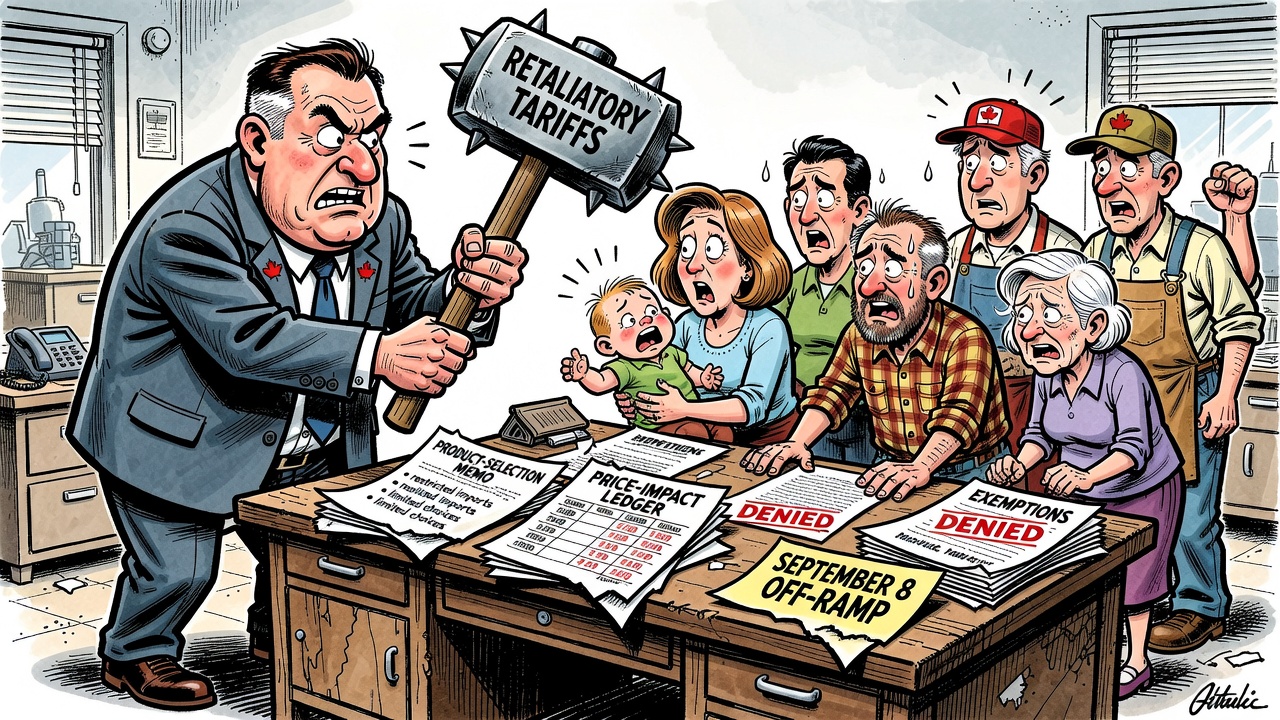
Counter-tariffs are not magic. They are taxes that move through importers, wholesalers, retailers, contractors and consumers. Sometimes they are justified as leverage. But if Ottawa’s leverage strategy includes choosing products partly to put pressure on particular U.S. states, Canadians should not be asked to pay on faith.
The Associated Press reported on August 25 that Canada announced retaliatory tariffs on more than 700 U.S.-made products, with duties as high as 50%. The list reportedly covers steel, dairy products, appliances, farm equipment, pulp and paper, electronics and everyday consumer goods, with rates of 15%, 25% and 50% scheduled to take effect September 8, 2026.
Ottawa says the purpose is to protect Canadian companies and reduce reliance on U.S. imports. That may be the public policy argument. But AP also reported Industry Minister Mélanie Joly saying the tariffs would put pressure on particular U.S. states, while a senior Canadian official described state-level political effects as a secondary consideration. That is exactly where Parliament should draw a line: if politics helped shape the product list, the public gets to see the ledger.
This is not a demand to unilaterally disarm Canada in a trade fight. It is a demand that the government prove its strategy is disciplined, time-limited and worth the cost. Canadians need the product-selection rationale: why these goods, why these rates, why these states, and why these Canadian households and businesses should absorb the blow.
The timing makes transparency urgent. Canadian Press reporting carried by CityNews said U.S. trade officials denied making last-minute demands after Canada-U.S. talks faltered, while Global News reported that officials were still facing a hard list of unresolved trade irritants. If negotiations are stuck and retaliation is about to broaden, then Canadians deserve more than slogans about being “strategic.” They deserve numbers.
A conservative accountability test is simple. Publish the estimated price impact by product category. Publish the expected effect on farms, builders, manufacturers, restaurants, retailers and families. Publish the exemption process before businesses discover it by losing money. Publish the legal authority, the review date, the revenue forecast and the exact conditions for lifting the tariffs.
And if the government has a state-by-state political pressure map, release the non-sensitive version to Parliament. Canadians should know whether they are paying higher prices for a clear negotiating objective or for a political theatre exercise aimed at someone else’s voters.
Tariffs may be sold as toughness. Without receipts, they become another Ottawa cost downloaded onto people who did not design the strategy, did not see the memo and will still pay the invoice.
- Associated Press: Canada announces retaliatory tariffs on U.S.-made products
- Global News: United States-Canada trade talks and unresolved issues
- CityNews / The Canadian Press: U.S. trade czar says U.S. didn’t make last-minute trade demands
- Blacklock’s Reporter: August 2026 issue archive and public tariff-story excerpt
This article argues for disclosure of tariff strategy, costs and exemption rules. It does not allege unlawful conduct by any public servant, elected official or foreign government.