Carney’s Invest in Canada Shakeup Needs an Insider Access Ledger
Dominic Barton will chair Invest in Canada as Ottawa courts global capital, routes major-project ambition through public incentives, and replaces a CEO early. Canadians deserve the receipts before insiders shape the next subsidy pipeline.
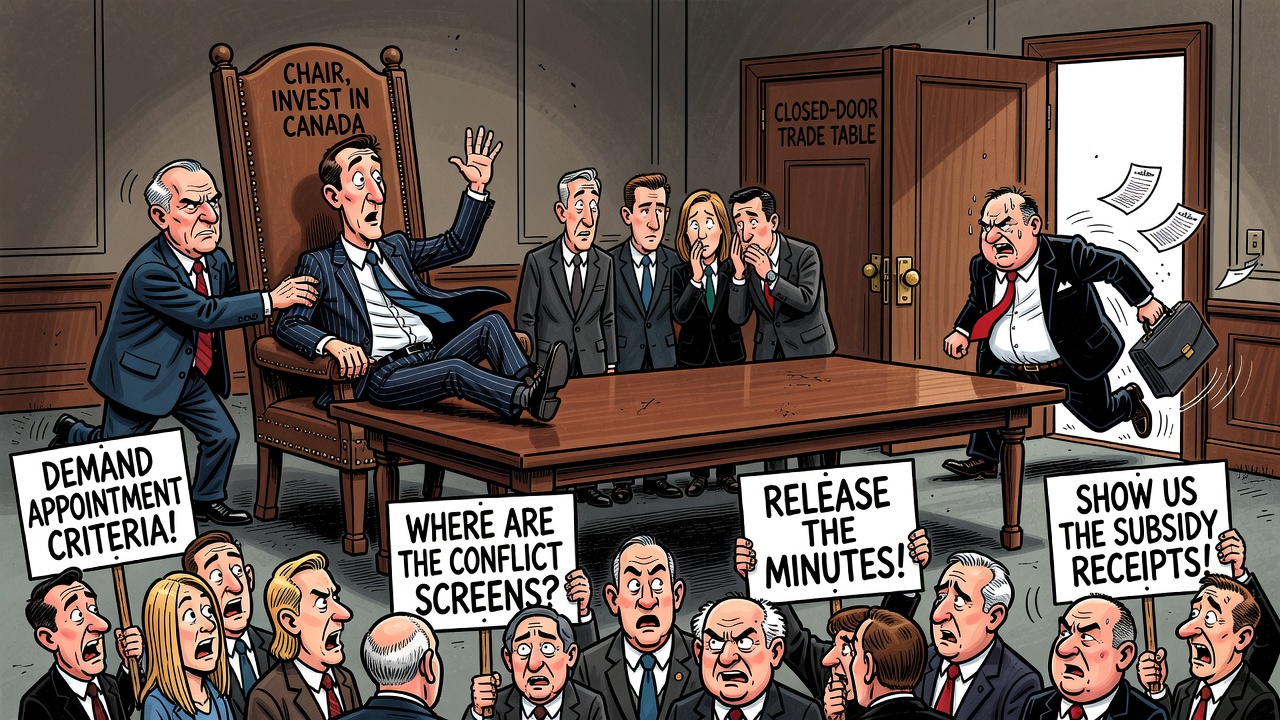
Prime Minister Mark Carney has put a familiar Liberal insider at the centre of Canada’s investment machine. On August 31, the PMO announced Dominic Barton as part-time chair of Invest in Canada for three years and Gurinder Grewal as full-time CEO for five years.
Ottawa’s pitch is that this is competence: global business experience, more foreign capital, more major projects, and less dependence on a single trading partner. The PMO says Invest in Canada will work closely with the Major Projects Office and the world’s largest investors in energy, critical minerals, artificial intelligence and infrastructure. It also says roughly $280 billion in federal capital investments and incentives are expected to enable more than $1 trillion in total investment over five years.
That is exactly why the disclosure standard must be higher, not lower. When government is using public incentives to attract private and institutional capital, appointments are not ceremonial. They help determine who gets meetings, whose project is fast-tracked, which risks are socialized, and which benefits are advertised as national strategy.
Barton is not just another board chair. He spent more than 30 years at McKinsey, including nine as global managing partner; chaired Trudeau’s Advisory Council on Economic Growth; served as Canada’s ambassador to China; and now chairs Rio Tinto and LeapFrog Investments. None of that proves wrongdoing. It does prove the need for a visible conflict screen, a recusal list, and clear rules for any file touching mining, China exposure, consulting networks, foreign capital, pension funds or firms with business before Ottawa.
The public context matters too. The Auditor General’s 2024 review of federal McKinsey contracts found frequent disregard for procurement rules and urged proactive conflict-of-interest checks with declarations kept on file. That is the minimum standard here.
The governance questions do not stop there. Canadian Press reporting carried by CityNews says outgoing CEO Laurel Broten leaves almost four years into what is usually a five-year term, with no explanation provided Monday and no answers from spokespeople for Minister Dominic LeBlanc’s office or the Privy Council Office. If this was a routine transition, publish the transition note. If it was a strategic reset before Carney’s investment summit, say that plainly.
The same day, Canadian Press reported that Carney met business leaders from 23 companies, including RBC, Enbridge, Bell Canada and Bombardier, to discuss Canada-U.S. trade and invite industry perspectives. Again, consultation is not a scandal. But closed-door consultation plus a leadership shakeup plus a trillion-dollar investment narrative is a recipe for public suspicion unless the paper trail is made public.
A conservative accountability standard is simple: publish the appointment criteria, conflict screens, recusals, Broten departure documents, summit invite list, meeting minutes, corporate asks, projected subsidies, tax concessions, loan guarantees, pension-fund roles and foreign-investor due-diligence safeguards.
If Barton and Grewal deliver real investment on disciplined terms, the ledger will help prove it. If Ottawa is building another insider-directed corporate welfare pipeline, Canadians should not learn that only after the cheques clear.
- Prime Minister of Canada: Prime Minister Carney announces the appointments of new Chair of the Board and CEO of Invest in Canada
- CityNews Halifax / The Canadian Press: Carney names Dominic Barton as chair of Invest in Canada, replaces CEO
- NanaimoNewsNOW / The Canadian Press: Carney meets business leaders to discuss U.S. trade, says PM’s office
- Office of the Auditor General of Canada: Report 5 — Professional Services Contracts
This article argues for public disclosure around appointments, meetings and investment incentives. It does not allege unlawful conduct by any public servant, business, investor or elected official.