Carney’s Europe Speech Needs a Trade-Diversification Results Ledger
A European Parliament address is not a deliverable. Before Ottawa sells another foreign-stage moment as strategy, Canadians deserve the cost, export, procurement and results ledger.
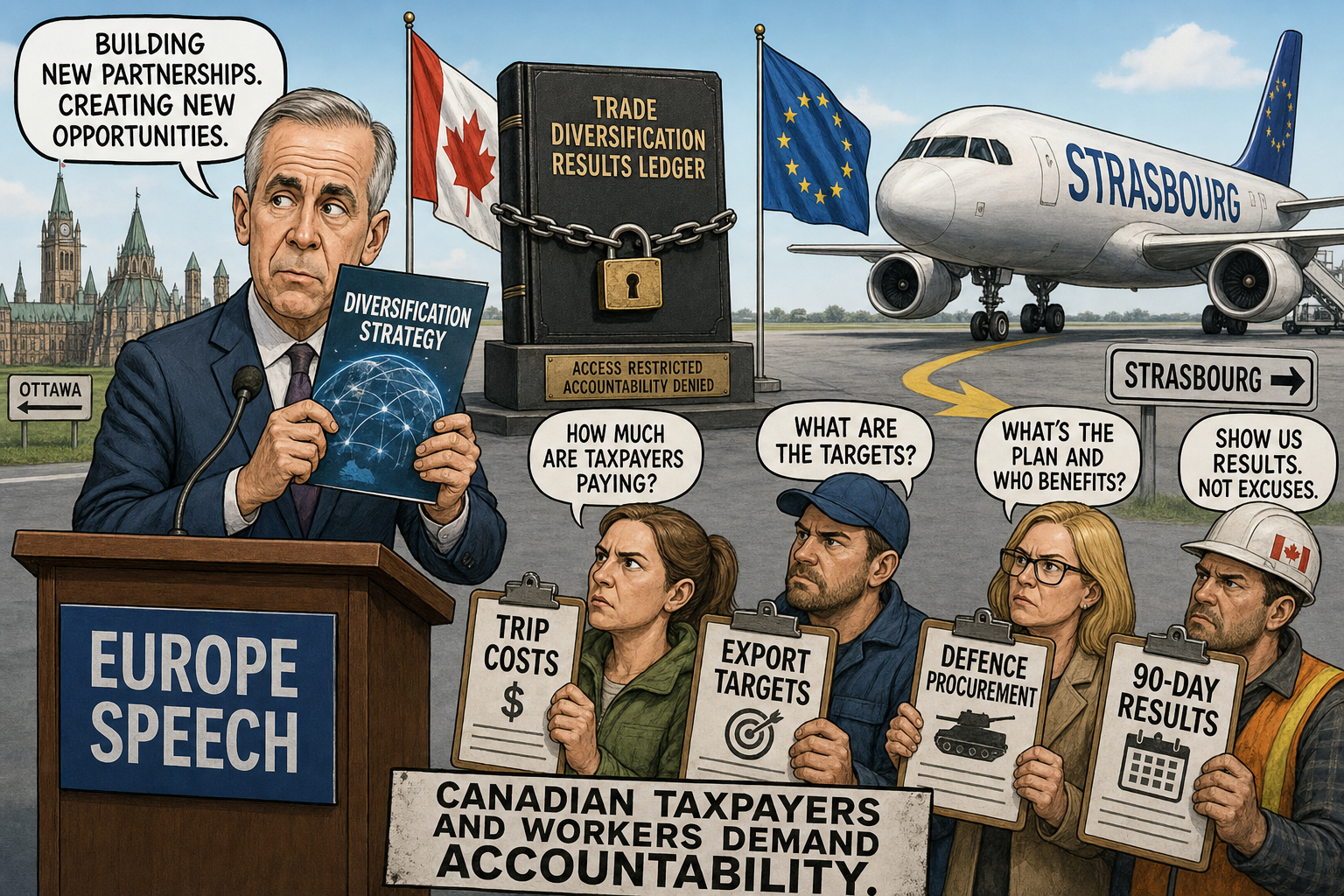
Prime Minister Mark Carney is headed to Strasbourg with a big message and a bigger accountability gap.
The Associated Press reported on August 26 that Carney will attend European Commission President Ursula von der Leyen’s State of the Union address on September 16, then address the European Parliament on September 17. AP framed the visit as part of Canada’s push to deepen ties with Europe after Canada-U.S. trade talks collapsed and new 50% U.S. tariffs hit about $20 billion worth of Canadian goods.
That makes the trip politically important. It does not make it automatically successful. The Carney government has set a goal of doubling Canada’s non-U.S. exports over the next decade. It has also made Europe central to its trade-diversification argument, with AP reporting at least 12 Carney trips to Europe since he took office in March 2025. If those trips are the strategy, taxpayers deserve to see the scoreboard.
Ottawa already has talking points. Global Affairs Canada says Canada-EU merchandise trade reached a record $134 billion last year, that CETA-era merchandise trade has grown more than 75%, and that the government is pursuing the goal of doubling non-U.S. exports over the next decade. AP reports that Canada is the first non-European country in the EU’s Security Action for Europe initiative, and Canada’s published agreement text lays out conditions for Canadian legal entities and products to participate in SAFE-supported procurement.
Those are real items. They are not enough. A trade-diversification plan should be measured by contracts, export volumes, market access, timelines, Canadian jobs, procurement rules and risk exposure — not by applause in a foreign chamber.
Before Carney boards the plane, Ottawa should publish the mission ledger: the full trip cost; the delegation list; the security, hospitality and communications costs; the meetings scheduled; the Canadian industries represented; the asks made of EU institutions; and the deliverables expected by sector. If defence procurement is part of the pitch, publish the Canadian-content rules, eligible firms, conflict screens, and whether participation in EU procurement creates new subsidy, guarantee, or purchasing obligations for Canadian taxpayers.
The government should also publish a 90-day report after the speech. How many buyer meetings became contracts? Which export targets changed? Which barriers were removed? Which projects received public financing? Which Canadian firms gained access to EU defence, energy, critical-minerals, digital, agriculture or infrastructure opportunities? How much of the promised non-U.S. export growth is actually booked revenue, and how much is still political branding?
None of this argues against diversification. Canada should reduce overdependence on any single market. But conservative accountability starts with a simple rule: when a prime minister sells disruption as opportunity, he must show the receipts.
Carney wants Canadians to believe Europe is the alternative path after the failed U.S. negotiation. Fine. Then put the numbers beside the speech. If the trip delivers, the ledger will prove it. If it does not, taxpayers should not be asked to confuse diplomatic theatre with trade results.
- Associated Press: Carney to address European Parliament as Canada deepens ties after break with Trump
- Euronews: Mark Carney to address European Parliament as Canada turns to Brussels amid Trump’s tariff hammer
- Global Affairs Canada: Agreement between Canada and the European Union on procurement under the SAFE Instrument
- Global Affairs Canada: Remarks on CETA and trade diversification
- Prime Minister of Canada: Remarks on Canada-U.S. trade negotiations
This article argues for public accounting of foreign travel, trade targets and procurement commitments. It does not allege unlawful conduct by any public servant, business or elected official.