Carney’s Digital-Tax Concession Needs a Lost-Revenue Ledger
Ottawa rescinded the digital services tax to advance U.S. negotiations. After those talks collapsed, Canadians deserve a public accounting of the revenue surrendered, refunded and supposedly traded away.
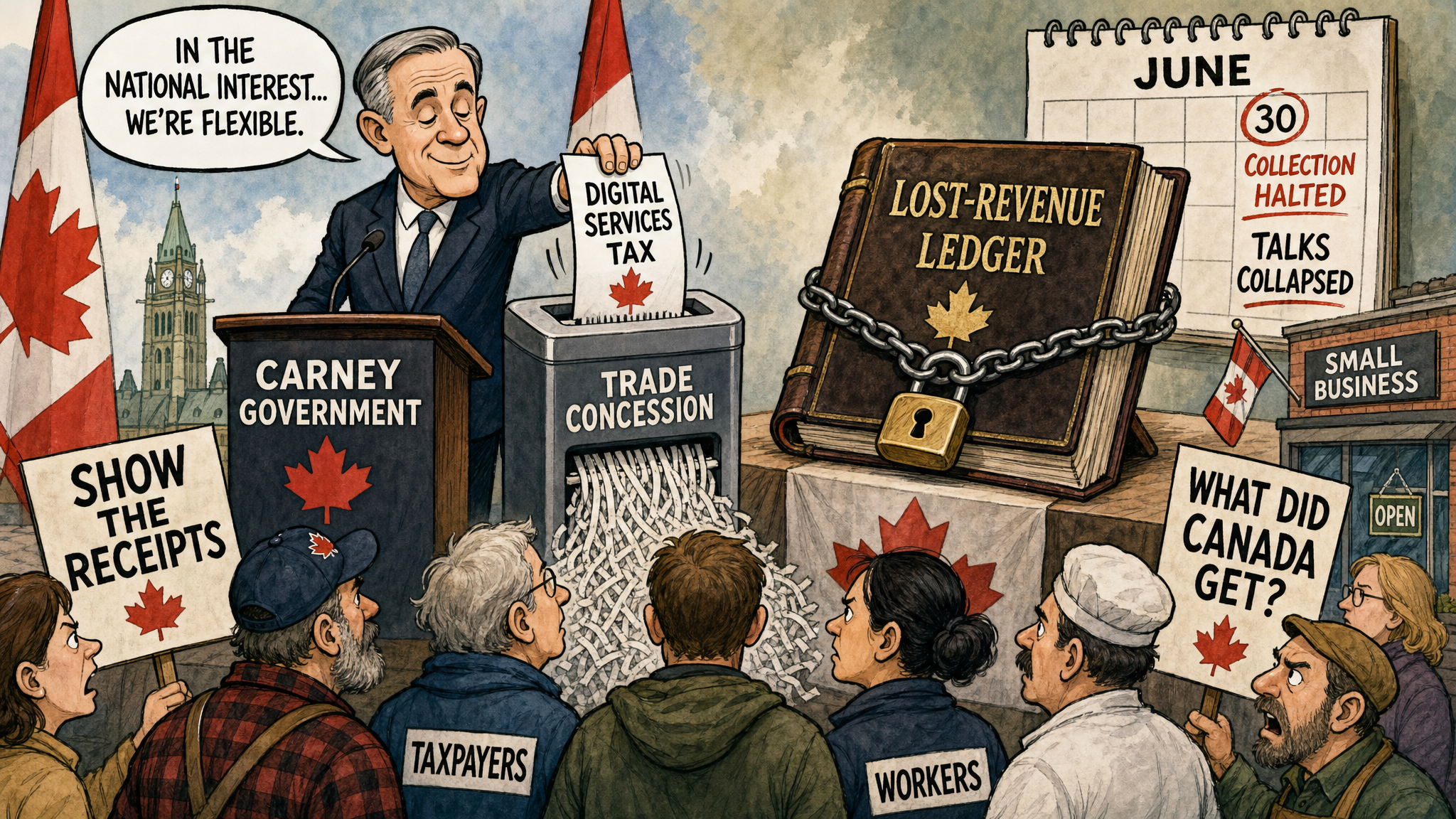
Ottawa now has a simple accountability problem: it gave up a tax tool in the name of a bigger Canada-U.S. negotiation, and Canadians still do not have the receipt.
The House of Commons petition system now lists e-7664, a taxation petition on the digital services tax, open from August 26 to December 24, 2026. The petition asks Parliament to reinstate the 2024 digital services tax and publish a public report on revenue foregone since repeal. That is a reasonable demand no matter where one stands on the tax itself.
The record is not complicated. On June 29, 2025, Finance Canada announced that Canada would rescind the digital services tax “in anticipation” of a broader trade arrangement with the United States. It said the June 30 collection would be halted and legislation would follow. Global News reported the same sequence: President Trump had terminated talks over the levy, and Prime Minister Mark Carney described dropping it as part of a “bigger negotiation.”
Then came the legal cleanup. Bill C-15 received royal assent on March 26, 2026 and repealed the Digital Services Tax Act retroactively to June 20, 2024, while requiring payments already received to be refunded with interest. Finance officials later told Parliament the tax had been projected to raise $2.3 billion in 2024-25 and $900 million in each of the next four years — roughly $5.9 billion over that five-year window.
That is why the ledger matters. If the government surrendered projected revenue, halted collection, refunded payments with interest, and treated the concession as the price of a larger bargain, then Parliament should see the bargain. What commitments did Washington make? Were any binding? How much tax was actually paid, refunded and paid out in interest? How much revenue did Ottawa give up by year? Which companies were registered, which sectors benefited, and what did Canadian workers or taxpayers receive in return?
The question has become sharper after the trade talks deteriorated. The Associated Press reported in late August 2026 that new U.S. tariffs were expected to affect about $20 billion in Canadian goods after talks broke down. A concession that buys durable relief is one debate. A concession that buys no durable relief is a very different one.
Conservatives should not let this become an abstract fight over whether a “Google tax” is good or bad policy. The accountability issue is narrower and harder for Ottawa to dodge: a duly enacted tax was sacrificed for negotiations, then erased retroactively. Publish the decision memo, the revenue table, the refund table, the foregone-revenue forecast, the U.S. assurances, and the post-collapse policy plan.
If Carney’s concession was strategic, the ledger will show the strategy. If it was a surrender dressed up as negotiation, Canadians deserve to know before the next revenue tool is traded away behind closed doors.
- House of Commons: Petition e-7664 — Digital services tax
- Department of Finance Canada: Canada rescinds digital services tax to advance broader trade negotiations with the United States
- Department of Finance Canada: Bill C-15 briefing material — repeal of the Digital Services Tax Act
- Parliament of Canada: Bill C-15 royal assent text
- Global News / The Canadian Press: Canada rescinds digital services tax after Trump ends trade talks
- Associated Press: Trump’s trade war with Canada hikes tariffs on a long list of goods
- Juno News: $3.7B concession backfires: Carney pressed
- Western Standard: Petition calls on Carney government to restore $3.7 billion Google tax
This article argues for public accounting of a tax-policy concession and its fiscal effects. It does not allege unlawful conduct by any taxpayer, public servant or elected official.