Carney’s Growth Downgrade Needs an Economic Receipts Ledger
Moody’s trimmed Canada’s growth outlook as tariff uncertainty and weak data tested Ottawa’s competence pitch. Canadians deserve a quarterly ledger showing what is actually improving.
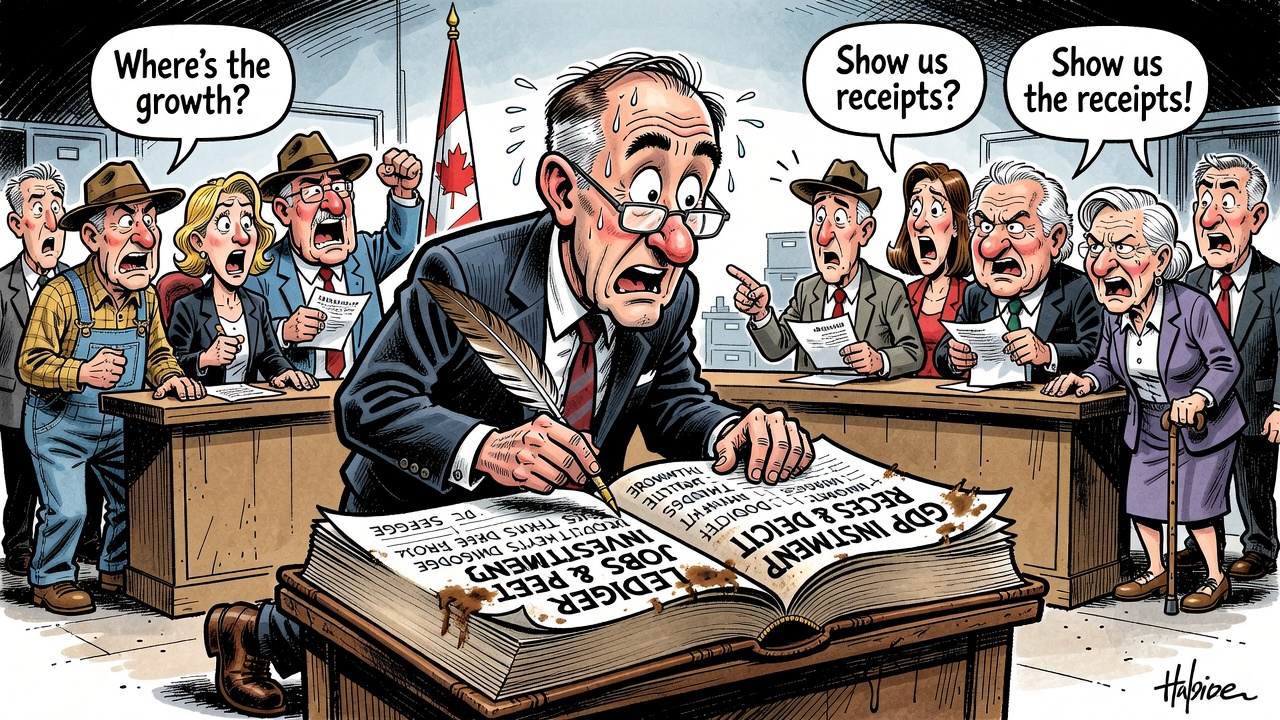
Mark Carney sold Canadians a familiar promise: less theatre, more competence. The test is no longer whether Ottawa can announce an economic plan. The test is whether the plan is producing growth, private investment, hiring and productivity after the trade shock.
That is why Moody’s latest Canada outlook matters. Investment Executive reported August 28 that Moody’s Ratings trimmed its Canadian growth forecast, now projecting 1.0% growth in 2026 and 1.8% in 2027. The reason was not mysterious: weak recent data and U.S. tariff uncertainty, which Moody’s said can delay investment, expansion and hiring.
Ottawa will point to Statistics Canada’s latest GDP release, and it should. StatCan said real GDP rose 0.8% in the second quarter of 2026 after a 0.1% increase in the first quarter, with earlier data revised upward. That is better than the recession scare from preliminary numbers earlier in the year. But it is not a permission slip to declare victory. A small rebound alongside a downgraded forecast still leaves Canadians asking whether the government’s spending restraint, tariff supports, immigration cuts, industrial subsidies and trade-diversification trips are building a stronger economy or just managing headlines.
The Prime Minister’s own language raised the stakes. A June Canadian Press report said Carney described the government’s economic plan as “settling in” after weak data, while acknowledging pressure from immigration and spending cuts. If that plan is settling in, publish the dashboard. What was promised for GDP, business investment, private-sector capital formation, productivity, hiring, wages, deficits and debt service? What actually happened by quarter?
A conservative accountability standard is simple: no more press-release economics. If Ottawa is using taxpayer money to cushion tariffs, subsidize favored sectors and sell Canada as an investment destination, the public should see the inputs and outputs in one place. List every tariff-support program, cost, recipient category, job-retention condition, repayment term and sunset date. Show whether federal approvals, tax credits and infrastructure promises are crowding in private money or replacing it. Separate new capital from reannouncements. Separate real job creation from jobs “supported.”
Carney’s defenders will argue Canada is being hit by external forces. Fair enough. U.S. tariff chaos is real. Global bond, energy and AI-investment risks are real. But competent government is not measured by the quality of its excuses. It is measured by the quality of its receipts.
If the economy strengthens, a public ledger will help prove it. If growth stays soft while debt, subsidies and trade uncertainty rise, Canadians should not have to wait for another ratings note to find out. Publish the growth receipts now.
- Investment Executive: Canada’s forecast gets gloomier: Moody’s
- Statistics Canada: Gross domestic product, income and expenditure, second quarter 2026
- Yahoo Finance / The Canadian Press: Carney says economic plan ‘settling in’ after Canada’s economy shrinks
- Moody’s: Credit risk outlooks
- Global Affairs Canada: Impact on the Canadian economy of changing U.S. tariffs
This article argues for public economic performance disclosure. It does not allege unlawful conduct by any taxpayer, public servant or elected official.