PHAC’s Six-Year Quarantine Records Delay Needs a Public Clock
If Ottawa can impose sweeping quarantine rules, it can publish the records clock for old quarantine-site files.
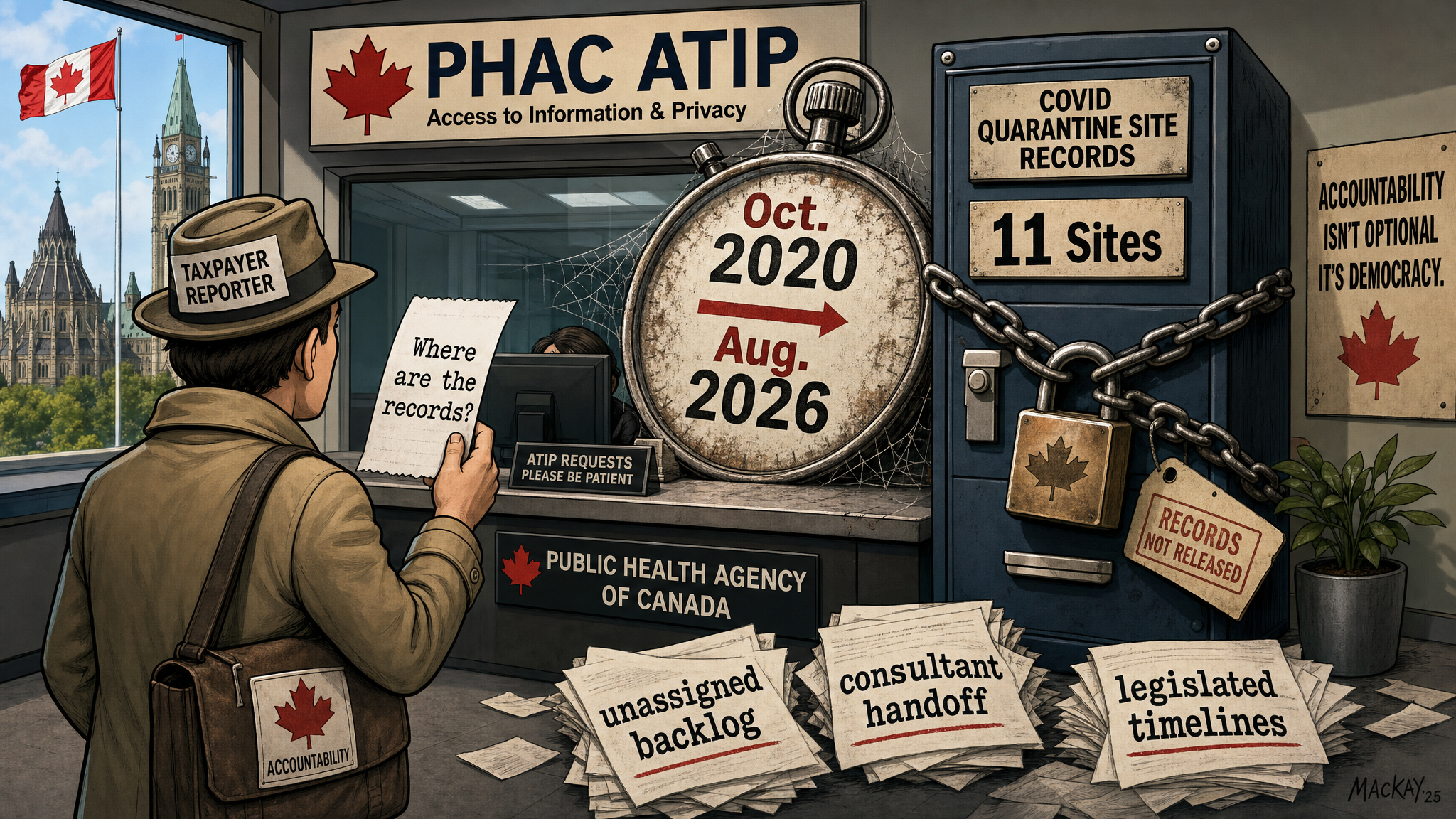
The issue is not whether every COVID-era decision can be replayed from the cheap seats. The issue is whether the federal government can keep basic records about its own quarantine-site operations out of public view for nearly six years and still call that accountability.
Rebel News reported on August 23 that an Access to Information request filed with the Public Health Agency of Canada in October 2020 remains outstanding. The request sought records concerning the operations and locations of 11 federal COVID quarantine sites. According to Rebel, PHAC acknowledged the request on October 26, 2020, later said it needed at least 45 days to retrieve the records, and still had not provided the records as of the report.
That is not a normal delay. It is an access-system failure with names, dates and public consequences. Rebel says PHAC acting deputy director of ATIP Services Andrea Burrows acknowledged the file had been with a consultant, then moved into an “unassigned backlog,” and later assigned to an analyst while the department struggled with workforce pressures. Ottawa can dispute the characterization if it wants, but the clean answer is not a press line. It is a release schedule.
PHAC’s own annual report makes the concern bigger than one media request. In 2024-25, PHAC closed 268 access-to-information requests. Only 63 — 23.5% — were closed within legislated timelines. The other 205, or 76.5%, were late. PHAC also carried 483 access files into 2025-26, with 422 already beyond legislated timelines.
The Office of the Information Commissioner has already warned PHAC on access discipline. In a 2024 decision, the Commissioner found PHAC had not justified a 255-day extension in another file, deemed the extension invalid, and ordered a complete response. In a 2023 PHAC case involving mask-related records, the Commissioner found complaints well founded after PHAC initially identified no responsive records and later found records during the investigation.
This is why conservatives should insist on a quarantine-records clock, not another vague promise to modernize ATIP. Publish the request status, page count, search locations, consultant handoff timeline, current analyst assignment date, exemption claims, consultation steps and expected release date. Then publish a dashboard of every COVID-era PHAC access file still open more than three years after filing.
Canadians were told to accept extraordinary public-health powers in an emergency. Years later, the minimum democratic tradeoff is ordinary transparency. If PHAC cannot release old quarantine-site records after nearly six years, Parliament should demand the receipt for every day of delay.
- Rebel News: PHAC admits it left Rebel News COVID records request in backlog for nearly six years
- Public Health Agency of Canada: Annual report on the Access to Information Act and the Privacy Act 2024-2025
- Office of the Information Commissioner: Public Health Agency of Canada (Re), 2024 OIC 48
- Office of the Information Commissioner: Public Health Agency of Canada (Re), 2023 OIC 06
This article treats Rebel’s report about its own outstanding request as an attributed media claim and relies on official PHAC/OIC records for broader access-system performance and prior findings.