Bill C-22 Needs an Encryption Red-Line Ledger Before the Senate Moves
After Bill C-22 was rushed through the House, the Senate should publish clear red lines on encryption, metadata, secrecy and review before expanding lawful-access powers.
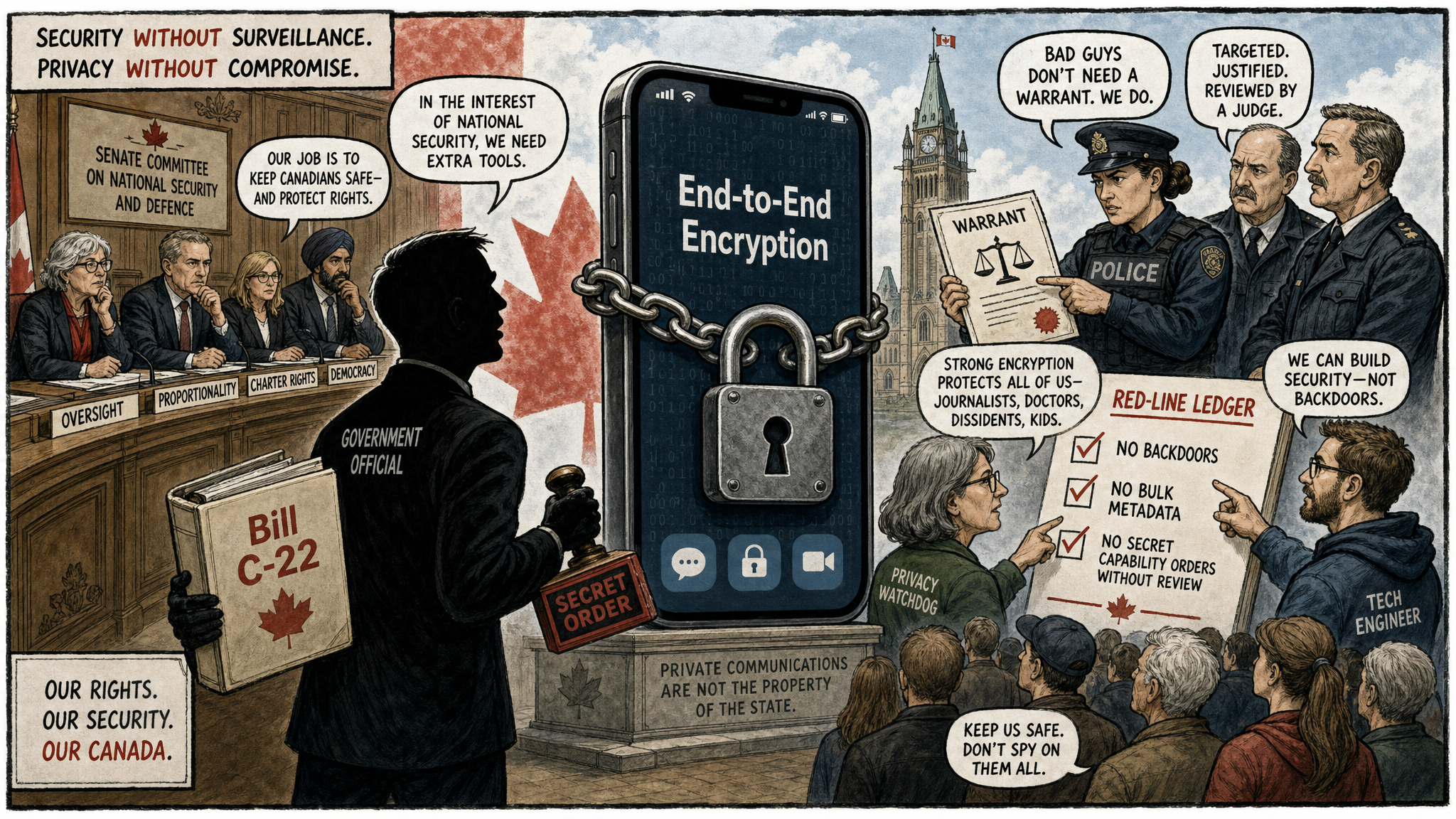
Bill C-22 is now a Senate test of whether the Carney Liberals can separate public safety from blank-cheque surveillance. Police need lawful tools that work online. Canadians also need a government that does not answer privacy objections by insulting the people raising them.
Global News reported that the House passed the lawful-access bill after the government fast-tracked it, ended public-safety committee debate and left dozens of amendments unscrutinized. Government House Leader Steven MacKinnon then dismissed Conservative concerns as “tinfoil hat” and “paranoid” politics. That is not accountability. It is exactly the attitude that should worry anyone asked to trust secret technical orders.
The police case deserves to be heard clearly. The National Police Federation, Canadian Police Association and Canadian Association of Chiefs of Police urged passage of C-22, arguing it would make existing court-authorized tools technologically meaningful and would not require companies to weaken or break end-to-end encryption. Conservatives should not pretend online crime is imaginary. Missing children, exploitation, fraud, extortion and terrorism investigations all require real lawful access to evidence when a judge authorizes it.
But the watchdog record also matters. Privacy Commissioner Philippe Dufresne told MPs that C-22 improved on Bill C-2 in some respects, including a narrower confirmation-of-service demand and added consideration of privacy and cybersecurity impacts. He still recommended further amendments: a closed list for subscriber information, necessity and proportionality limits, stronger language around systemic vulnerabilities, and an exemption so providers can disclose information to regulators such as his office.
Apple’s warning at committee should be treated as engineering evidence, not partisan theatre. Its witness said there is no known way to build encryption access only for “good guys” without creating paths for bad actors. Google also warned that ministerial orders could secretly force product redesigns without sufficient safeguards. If Ottawa’s true position is “no backdoors,” then write that protection into the statute in words the courts, companies and Canadians can read.
Before the Senate moves another clause, it should publish a red-line ledger. It should show which House amendments were skipped, which encryption protections are binding, who can receive secret technical-capability orders, what independent review occurs and when, how metadata retention is limited, what notice or reporting follows, and how ordinary Canadians can challenge abuse after the fact. The ledger should also identify which safeguards are in the bill itself and which are being deferred to future regulations Canadians cannot yet inspect.
Law and order is not a slogan for giving ministers secret leverage over digital systems. Real law and order means warrants, tight definitions, auditable powers, judicial control and consequences for misuse. If Bill C-22 is as balanced as the Liberals claim, they should have no fear of putting every red line on paper before the Senate signs off.
- Global News: Liberals dismiss privacy fears as lawful-access bill passes
- Office of the Privacy Commissioner of Canada: Statement to the public-safety committee on Bill C-22
- Global News: Apple and Google warning on lawful access and encryption
- Canadian Police Association: NPF, CPA and CACP call for passage of Bill C-22
- Canadian Association of Chiefs of Police: Bill C-22 position statements and parliamentary brief list
This article does not oppose court-authorized investigations. It argues that lawful-access powers must be explicit, reviewable and technically safe before Parliament expands them.