CMHC’s Housing Starts Gap Needs a Delivery Ledger
Ottawa’s own housing math says Canada needs far more construction. CMHC now forecasts fewer starts, not more.
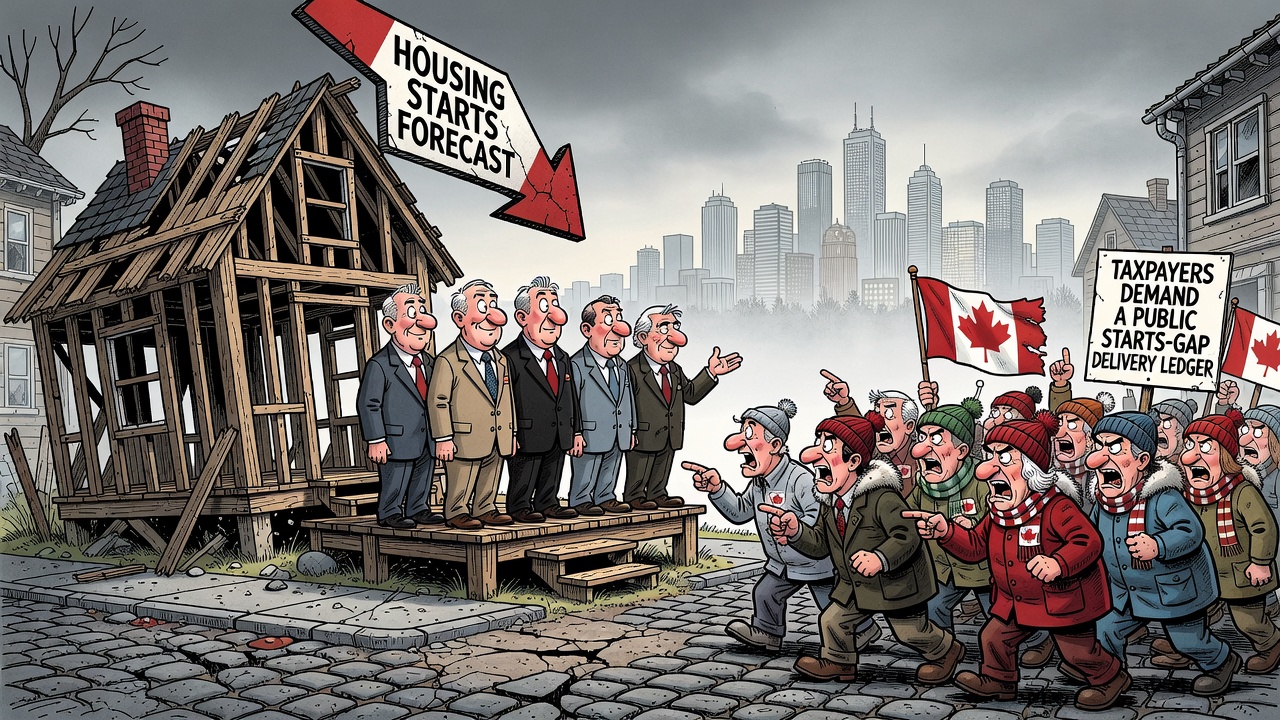
The Liberal housing promise keeps getting bigger. The housing-starts forecast keeps getting smaller.
That is the accountability gap Canadians should watch. CMHC’s summer 2026 housing outlook says housing activity will likely remain weak in the near term, with slow population growth, uncertainty, high borrowing costs and modest income growth limiting demand. It also says average prices are likely to decline in 2026 before rising slowly, while housing starts continue to fall through the forecast period because of weak demand, high costs and elevated inventories.
Those are not opposition talking points. That is Ottawa’s own federal housing agency describing the market Ottawa says it can “turbocharge.”
The numbers make the problem impossible to spin. A Housing, Infrastructure and Communities Canada parliamentary briefing cites CMHC’s 2026 outlook estimating 247,000 housing starts in 2026, 223,000 in 2027 and 216,000 in 2028. The same federal page cites CMHC’s June 2025 supply-gap work estimating Canada would need roughly 430,000 to 480,000 starts every year for the next decade to restore affordability to pre-pandemic levels.
In plain English: the affordability benchmark is roughly double the forecast. And the forecast moves in the wrong direction each year.
That does not mean government can magically order private builders to pour foundations during a weak market. Costs, rates, inventories, labour, land, permits and buyer demand all matter. But it does mean Liberal ministers should stop treating announcements as construction. A press conference is not a building permit. A funding envelope is not a completed unit. A slogan is not a key in a family’s hand.
The conservative accountability test is simple: publish the delivery ledger. If Build Canada Homes, federal land releases, low-cost financing, infrastructure deals and housing accelerator agreements are supposed to close the gap, show the public the math project by project. List the location, units promised, units started, units completed, federal dollars committed, per-unit subsidy, approval status, zoning dependency, infrastructure dependency and expected occupancy date.
Then reconcile that ledger with population policy. Ottawa cannot invite housing demand on one spreadsheet while hoping supply catches up on another. If immigration, temporary resident, student and worker targets are changing, the housing plan should show the assumed household formation behind every forecast.
Canadians have heard years of Liberal housing ambition while rents climbed, ownership slipped away and young families were told to wait. CMHC’s forecast is a warning that the market is not obeying the talking points. If Ottawa wants credit for a building boom, it should first publish the receipts proving one exists.
- CMHC: Canada Housing Market Outlook: Summer 2026
- CMHC: Economic uncertainty to continue weighing on housing market
- Housing, Infrastructure and Communities Canada: Housing, Homelessness and Infrastructure parliamentary briefing
- CMHC: Housing Market Outlook 2026
This article does not claim Ottawa controls every private-market housing start. It argues that federal promises should be reconciled with CMHC’s own forecast and Canada’s affordability supply benchmark.