Carney’s Trade Promise Hits the Tariff Wall
After Canada-U.S. talks collapsed and 50% tariffs hit, Ottawa owes Canadians the non-security-sensitive negotiating and sector-impact ledger.
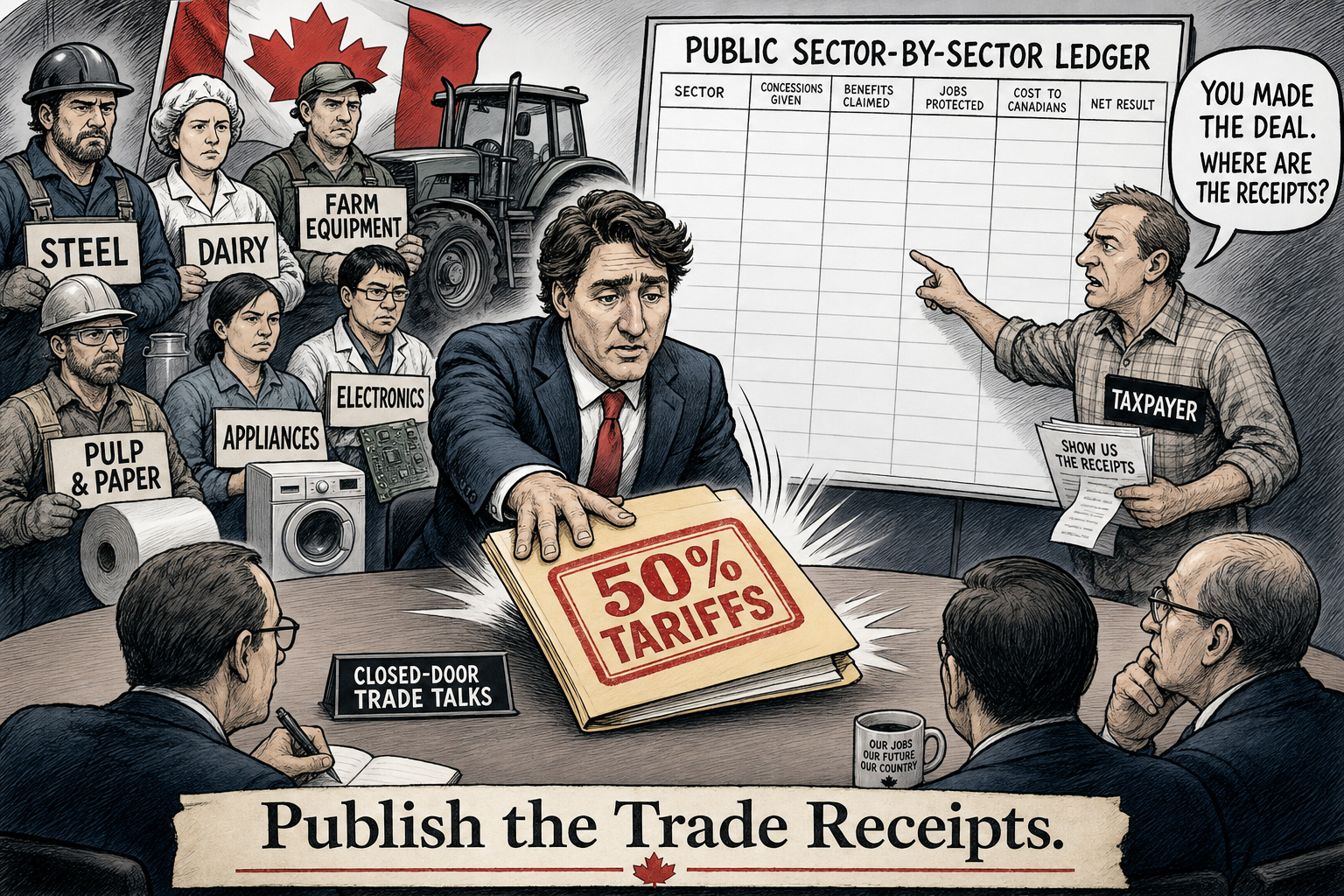
Mark Carney said Canada walked away from a bad Canada-U.S. trade deal. Fine. Then publish the receipts.
On August 21, the Prime Minister’s Office said Carney had suspended trade negotiations with the United States and ordered Canada’s negotiators back to Ottawa. The stated reason was not vague disappointment. Ottawa said last-minute U.S. changes were “unfair,” “uneconomic,” and raised questions about whether any deal could be relied on. The same statement said Washington intended to impose a 50% tariff on roughly $28 billion of Canadian goods at midnight, and that Canada would match the tariffs dollar for dollar.
By Saturday, the tariff wall was no longer hypothetical. The Associated Press reported that the United States imposed 50% tariffs on about $20 billion worth of Canadian products early Saturday after last-ditch talks failed, with Canada setting September 8 as the start date for retaliatory penalties. Axios likewise reported the talks collapsed late Friday and both sides said steep new tariffs would proceed.
Carney’s August 22 remarks added the next layer of cost. He said Canada’s countermeasures would be concentrated in sectors such as steel, dairy, appliances, agricultural equipment, pulp and paper, and electronics. He also said details would be released “in the coming days” and come into force the Tuesday after Labour Day.
No conservative should pretend Washington’s conduct is harmless. Tariffs are taxes, supply chains are integrated, and workers on both sides of the border will pay for political escalation. But accountability does not stop at blaming Donald Trump. Carney asked Canadians to trust his expertise, his closed-door process, and his promise of greater trade stability. Now the public is being asked to accept retaliation, uncertainty, and higher costs before seeing the full damage ledger.
That is not good enough.
If the deal was truly unacceptable, Canadians deserve a non-security-sensitive negotiating record: what the U.S. demanded, what Canada offered, what concessions were rejected, what red lines were defended, and which sectors were placed at risk. If retaliation is necessary, Canadians deserve the product list, the expected consumer-price effect, the relief plan for affected employers, the timeline to reopen talks, and the benchmarks for success.
This is especially important because retaliation is not free. A tariff may sound tough at a podium, but at the checkout, on a farm, in a machine shop, or inside a mill, it becomes a cost. Ottawa should not hide those costs behind patriotic branding while workers wait for details “in the coming days.”
The trade file has moved from promise to receipt test. Carney says he rejected a bad deal to protect Canadian sovereignty and industry. Prove it. Publish the ledger, sector by sector, before taxpayers are asked to fund another round of emergency supports.
- Prime Minister of Canada: Statement on Canada-U.S. trade negotiations
- Prime Minister of Canada: Remarks on Canada-U.S. trade negotiations
- Associated Press: U.S. and Canada fall deeper into a trade war with new tariffs
- Axios: U.S.-Canada trade talks collapse, 50% tariffs go into effect
This article does not defend U.S. tariffs. It argues that Ottawa should disclose the non-security-sensitive record behind failed negotiations, retaliatory tariffs and sector-level impacts.