Carney’s NATO Spy Reassurance Needs a Screening Ledger
Espionage allegations are unproven. The screening questions are real.
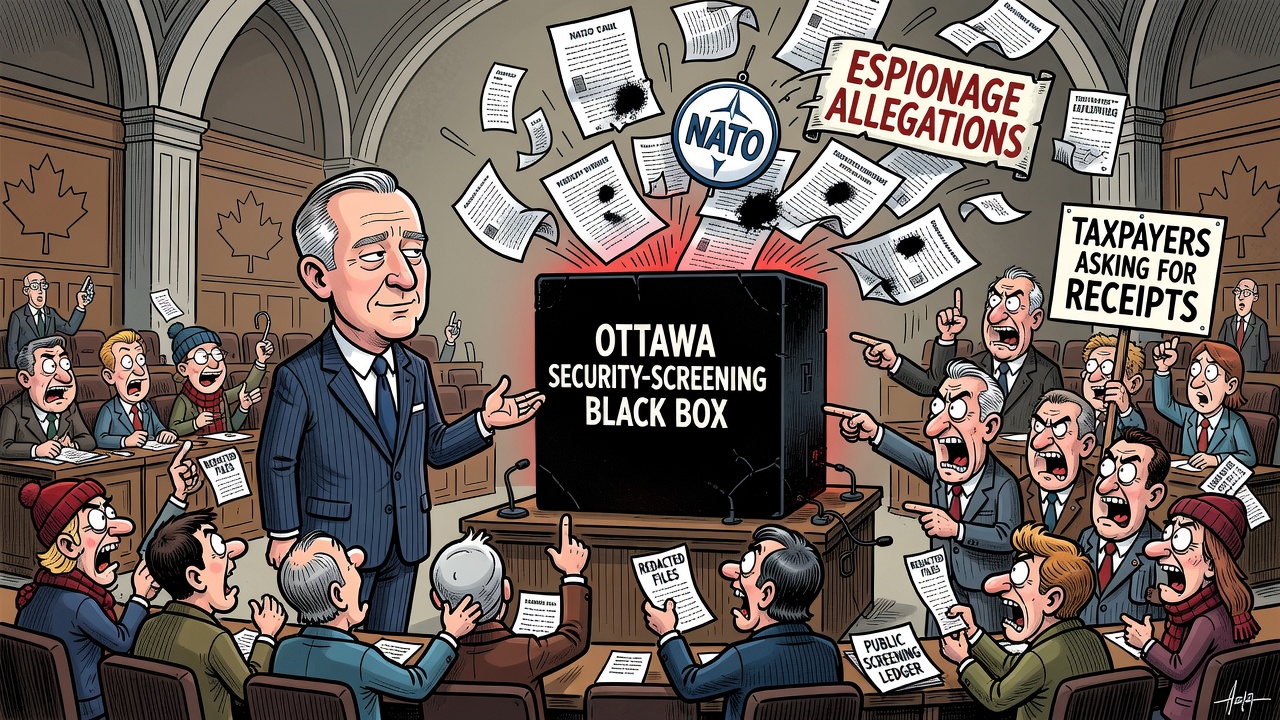
Canada does not need a show trial. It needs a security-screening ledger.
CBC reported August 13 that Conservative and Bloc MPs called for an emergency House public safety committee meeting over espionage allegations involving Biwei Zhang, a Canadian former intern at NATO’s Supreme Headquarters Allied Powers Europe in Mons, Belgium. Zhang is in custody in Belgium, and the allegations have not been proven in court. That caveat matters. So does the accountability question now facing Ottawa.
CBC’s reporting says Zhang was identified as a systems engineer whose online résumé suggested previous work for the Canadian Space Agency and Statistics Canada. The proposed committee probe would ask how she obtained the NATO internship, what security screening occurred before access was granted, whether Canadian or allied authorities flagged concerns, and whether monitoring was adequate.
Those are not partisan gotcha questions. They are the minimum questions any serious country asks when a Canadian national is accused of espionage inside the military headquarters of the alliance Canada depends on for collective defence.
Prime Minister Mark Carney tried to reassure Canadians on August 5 by saying Canadian officials were involved “from the start” in the investigation. But that phrase answers less than it appears to answer. From the start of what — the Belgian arrest, NATO’s internal concerns, RCMP cooperation, or an earlier Canadian warning? If officials were involved early, did that involvement expose a Canadian screening failure, a NATO access-control failure, or a successful counter-intelligence detection? Canadians cannot judge because the government has offered mood music instead of a timeline.
A conservative accountability standard should protect operational secrets while rejecting bureaucratic fog. Public Safety should publish a redacted screening ledger: the dates and general category of any Canadian government employment or placement, the level and expiry date of any clearance or reliability status, the agency responsible for verification, the NATO referral or sponsorship path, the first date Ottawa learned of concerns, the first date Canadian police or security agencies became involved, and the policy fixes ordered afterward.
No one is asking Ottawa to release sources, methods, allied intelligence, personal addresses, or evidence before a court has tested it. But “national security” cannot become the phrase governments use to hide whether their own process worked. If the system caught the problem, say so and show the safe parts of the timeline. If the system missed it, admit that and fix it.
Canada’s allies watch these cases closely. So should Canadians. A government that cannot explain how sensitive access is screened will struggle to convince taxpayers it can protect critical minerals, defence procurement, cyber networks, or foreign-influence files.
Carney’s “involved from the start” line may prove accurate. It is not enough. Parliament should demand the receipts.
- CBC News: Conservatives, Bloc want probe into Canadian NATO intern spying allegations — August 13, 2026
- CBC News: Carney says Canada was involved “from the start” in NATO spy investigation — August 5, 2026
This article does not allege Zhang is guilty, does not claim any Canadian official committed misconduct, and asks only for non-operational public process records that can be released without harming court proceedings or intelligence methods.