Carney’s Fast-Track Port Project Needs an Operator Ledger
A $2.3B port, a $1.16B federal-bank loan, a 40-year operator role and unfinished financing require public receipts.
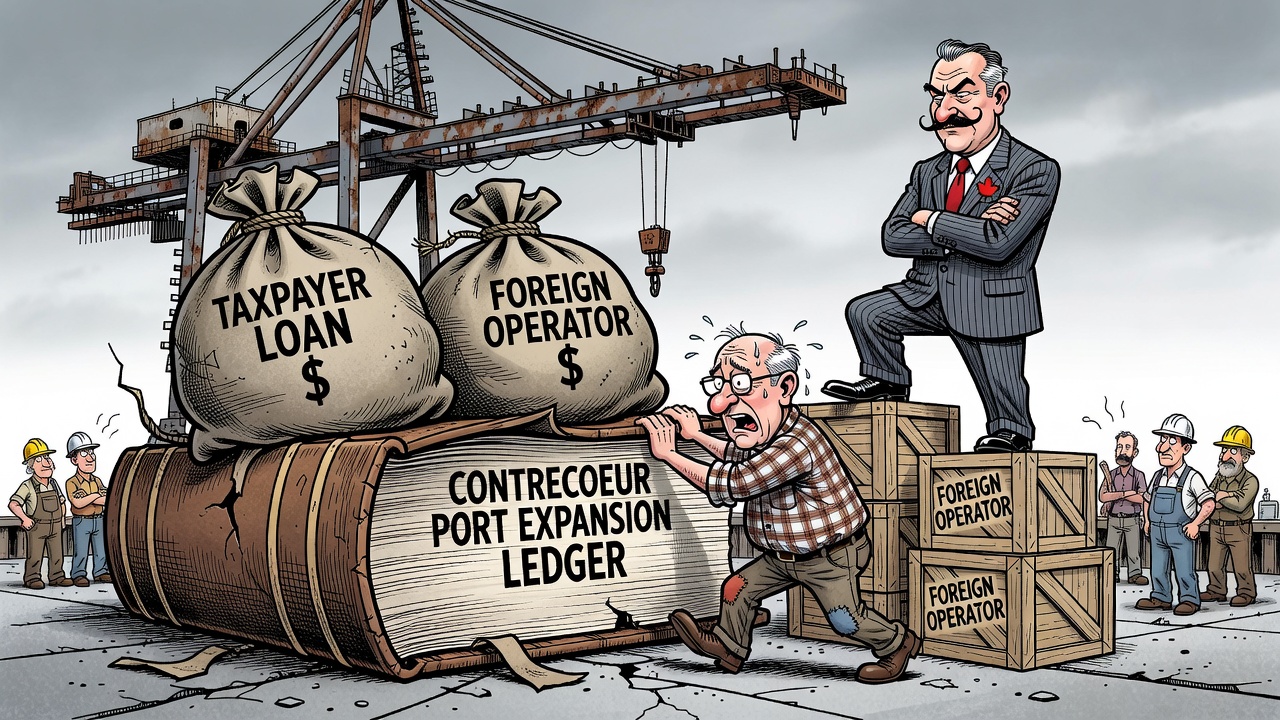
The Contrecœur terminal may be exactly the kind of infrastructure Canada needs. A larger Port of Montréal could move more goods, reduce bottlenecks and give exporters another route through the St. Lawrence gateway. But useful infrastructure is not a blank cheque. The bigger the promise, the stronger the receipt test should be.
CBC reported August 15 that construction is now underway on the $2.3-billion Port of Montréal expansion at Contrecœur, with workers building a stone jetty that will support wharf construction and later become part of a container yard. The project is expected to expand capacity at Canada’s second-largest port by 60 per cent, handle up to 1.15 million containers a year and begin operations in 2030.
Prime Minister Mark Carney’s office has already branded the expansion as a fast-tracked nation-building win. In April, PMO said the federal Major Projects Office helped streamline approvals, speed permits and support a financing model, while the Canada Infrastructure Bank committed $1.16 billion in financing. The Canada Infrastructure Bank says Quebec is contributing $130 million, Transport Canada $150 million, and that the loan is intended to be repaid through autonomous revenues and private-sector/operator contributions.
Those details sound reassuring until Canadians reach the unfinished parts. CBC reports financing has not yet been finalized: roughly 25 to 30 per cent of the $2.3-billion budget remains to be confirmed. The Montreal Port Authority expects a final deal with DP World by early 2027. CBC also reports the Dubai-based company will manage development of the container yard and rail connection, build terminal-related infrastructure, and then operate and maintain the terminal for 40 years.
That is not a minor procurement footnote. It is the public asset question at the centre of the project. The facilities are to be built on Government of Canada land managed by the Montreal Port Authority. Taxpayer-backed financing is already central. A foreign multinational is expected to receive a long operating role. Environmental offsets include a reported $36 million in measures tied to wetlands and the copper redhorse fish. And the final private-operator deal is not yet public.
A conservative accountability standard says build what Canada needs, but publish the ledger before the ribbon-cutting tour becomes the story. Ottawa should disclose the CIB loan terms, repayment assumptions, interest-risk protections, default consequences, federal and provincial exposure, DP World’s proposed rights and revenue structure, performance penalties, environmental-offset liabilities, Indigenous and community consultation milestones, and what happens if the project misses the 2030 operations target.
Carney wants Canadians to trust a faster federal state. Fine. Trust is earned by showing contracts, risks and outcomes — not by calling every large announcement “nation-building” and asking taxpayers to admire the hard hats.
If Contrecœur is a good deal, publish the receipts. If the receipts are not ready, Ottawa should stop pretending the accountability question is settled.
- CBC News / The Canadian Press: Construction on Montreal port expansion underway as “nation-building” effort ramps up — August 15, 2026
- Prime Minister of Canada: Prime Minister Carney breaks ground on the Contrecœur terminal expansion — April 9, 2026
- Canada Infrastructure Bank: Landmark $1.16 billion loan to boost trade capacity — April 2026
- Government of Canada Major Projects Office: Contrecoeur Container Terminal Project
This article does not argue against port expansion. It argues that taxpayer financing, federal land, a long private-operator role and unfinished financing require public disclosure before Canadians are asked to treat the project as a completed success.