Carney’s Tuscany Ethics Advice Should Not Stay a Black Box
Confidential ethics advice is legitimate. A blank public record is not.
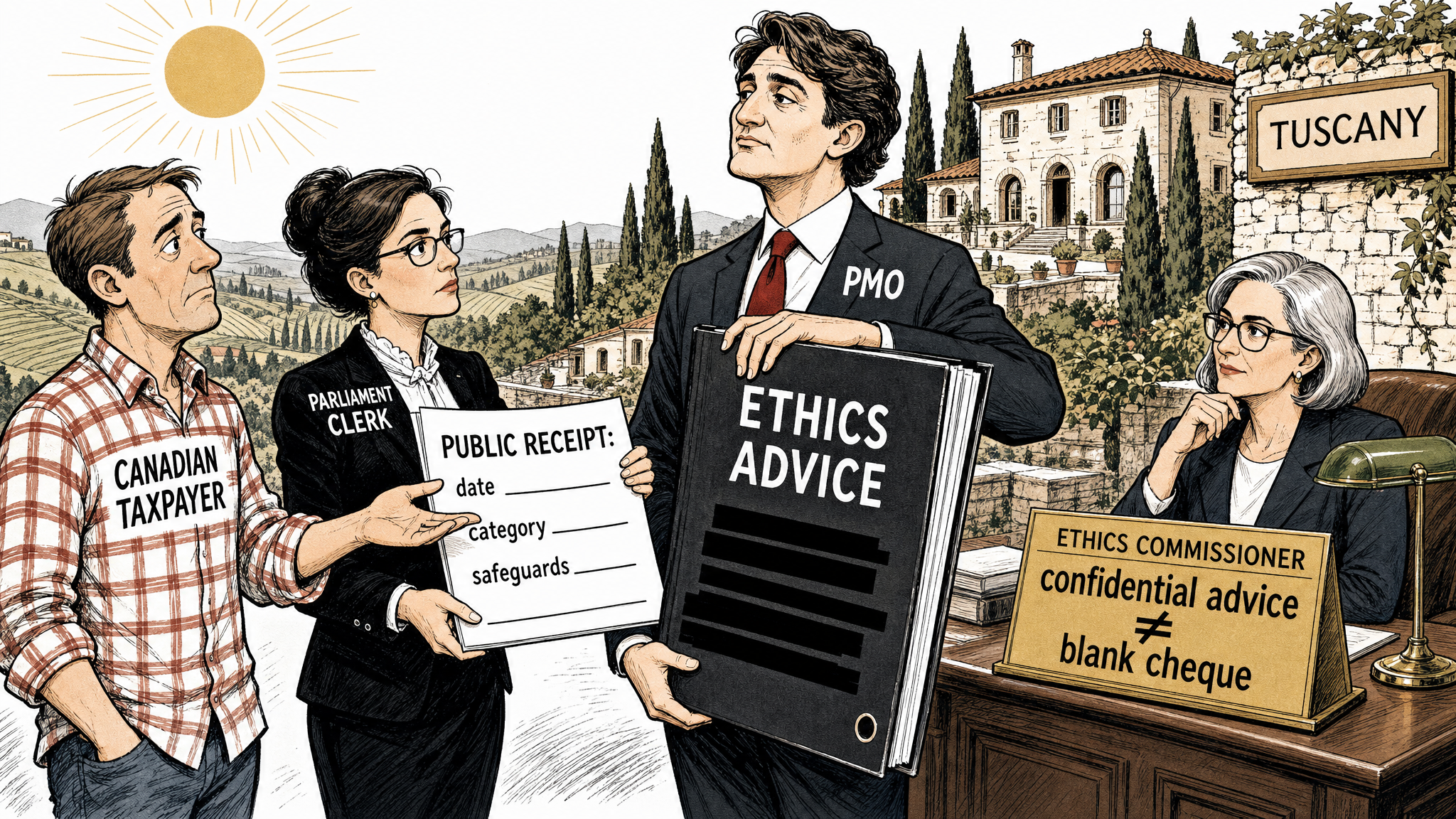
Prime ministers are entitled to private time. They are not entitled to turn public ethics safeguards into a black box.
Toronto Sun reported that the Prime Minister’s Office said Mark Carney would be in Italy for personal commitments until August 17 and that all relevant rules had been followed, and would continue to be followed, “in consultation with the Ethics Commissioner.” A follow-up Warmington column pressed the obvious question: if the commissioner was consulted, what exactly was reviewed?
That question can be answered without publishing an address, itinerary, security detail, family schedule, or any other genuinely private information. Canadians do not need to know where the Prime Minister sleeps. They do need to know whether the ethics consultation involved hospitality, accommodation, travel reimbursement, meetings, gifts, former business associates, recusals, or some other general category of risk.
The official rules make the issue bigger than one vacation. House of Commons procedure says the Conflict of Interest and Ethics Commissioner administers both the Members’ Code and the Conflict of Interest Act, and provides confidential advice to public office holders on their obligations. The Conflict of Interest Act says its purpose includes minimizing conflicts between private interests and public duties and resolving conflicts in the public interest. It also defines a “gift or other advantage” to include services, property, or use of property provided free or below commercial value, and requires reporting public office holders to disclose certain gifts above the statutory threshold.
That does not prove wrongdoing by Carney. It proves why the public needs a narrow receipt. When a prime minister with a high-profile private-sector past says the ethics office was consulted during a foreign personal trip, the public interest is not satisfied by a sentence from PMO.
The conservative accountability standard should be practical and defensible: publish the date of consultation, the general subject category, whether any gift, travel, accommodation, meeting, reimbursement, recusal, or reporting question was reviewed, and whether the commissioner recommended any condition. If the answer is “none,” say that. If the answer is “confidential,” explain why a redacted public summary cannot be released.
Ottawa often uses confidentiality as a shield when what Canadians are asking for is not the private advice itself, but proof that the guardrails exist and were applied. The commissioner can protect legal advice and privacy while still allowing the government to disclose process facts. Parliament should demand that distinction.
If Carney’s Tuscany trip cleared every rule, the public receipt should be easy: no address, no itinerary, no speculation, just the category of advice and the safeguards. If the government refuses even that, Canadians are left with the worst possible accountability model: trust PMO, trust the black box, and stop asking.
- Toronto Sun: Carney vacations in Tuscany while Trump’s 50% tariff deadline looms — August 10, 2026
- Toronto Sun: Mark Carney turning blind eye to Canada by vacationing now — August 10, 2026
- House of Commons Procedure and Practice: Conflict of Interest and Ethics Commissioner responsibilities
- Justice Laws Website: Conflict of Interest Act — purpose, definitions and core conflict rules
- Justice Laws Website: Conflict of Interest Act — compliance measures, recusal and gift disclosure
This article asks for public process records and expressly does not allege an ethics breach, improper accommodation, or any unverified private meeting.