Carney’s “Lost Control” Immigration Admission Needs a Ledger
A government that admits it lost control should not be allowed to declare control restored without publishing the ledger.
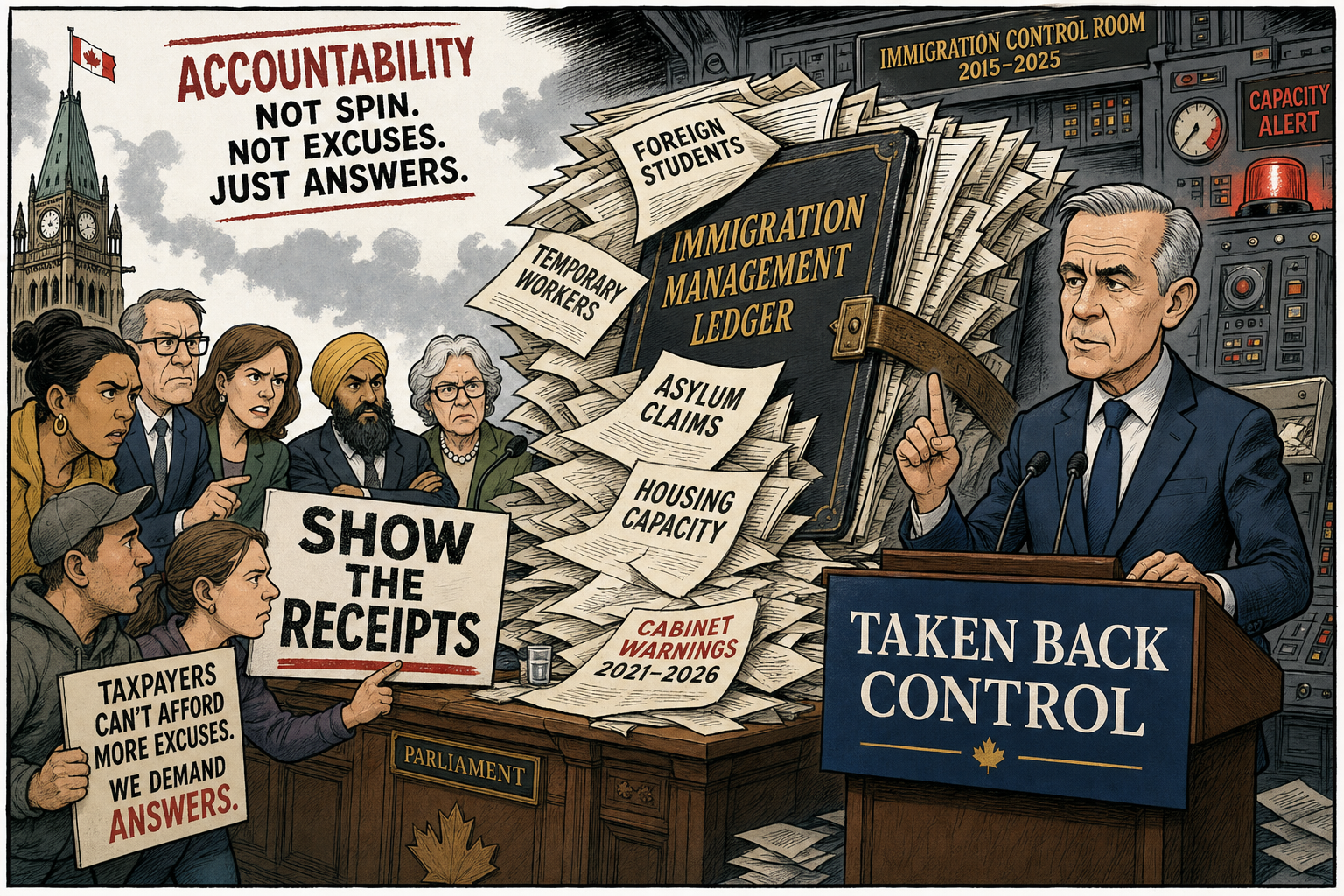
Prime Minister Mark Carney has given Canadians an unusually blunt admission. In a July 29 Canadian Press report from Red Deer, he said immigration was “far too high” when his government took over, said Canada had “lost control” of foreign-student and temporary-worker levels, and then claimed Ottawa had “taken back control.”
That is not a small communications reset. It is a confession that the federal system responsible for intake, capacity and enforcement was allowed to outrun its own controls. A conservative accountability response should be simple: if Ottawa lost control, publish the control ledger.
Carney pointed to progress, saying asylum-seeker flow was down by one third, temporary foreign workers by one half, and foreign students by two thirds. Those figures deserve examination, not applause on trust. Canadians need the baselines, time periods, definitions, inventories and policy changes behind each claim. A percentage drop can still leave housing, classrooms, health services, wage pressure and immigration tribunals under strain if the starting point was reckless.
The ledger should cover every month from 2021 through 2026. It should show study permits, temporary foreign worker permits, asylum claims, removal orders, actual removals, permanent-resident admissions, expired-status estimates, processing backlogs and the number of people in Canada on temporary status. Beside each line, Ottawa should publish the housing-capacity assumption, labour-market assumption, provincial-service warning and cabinet or deputy-minister briefing that informed the decision.
This is not an argument against immigrants, students, workers, refugees or asylum claimants. They did not design the federal machine. Ministers did. If the machine broke, accountability belongs with the people who set targets, ignored warnings, widened streams, delayed enforcement, and then asked communities to absorb the consequences.
Carney also acknowledged continuing housing pressure and said there is an argument for “a few more years of restraint.” That line matters because it admits the pressure is not imaginary and not over. It also raises the obvious question: restraint compared with what, measured against which housing supply, which schools, which hospitals, which jobs, and which enforcement capacity?
IRCC’s own planning material says immigration levels and temporary-resident volumes are being managed through annual plans, targets and policy changes. Good. Put the scoreboard in public. If the government has truly regained control, it should be able to show the before-and-after numbers without hiding behind slogans.
Parliament should demand one table, updated monthly: intake by stream, exits by stream, unresolved inventory, regional housing assumptions, provincial capacity warnings, enforcement outcomes and the minister accountable for each variance. If Ottawa cannot produce that table, then Canadians should treat “taken back control” as a promise still waiting for proof.
- Canadian Press via CityNews: Carney says government has “taken back control” of immigration — July 29, 2026
- Immigration, Refugees and Citizenship Canada: Supplementary Information for the 2026–2028 Immigration Levels Plan
- Immigration, Refugees and Citizenship Canada: 2026–27 Departmental Plan
- Immigration, Refugees and Citizenship Canada: 2026 consultations on immigration levels
This article criticizes federal immigration management and public reporting. It does not blame immigrants, students, workers, refugees or asylum claimants for government policy failures.