Carney’s Immigration Control Claim Has a Confidence Problem
Control is not a podium line. It is measurable confidence backed by public receipts.
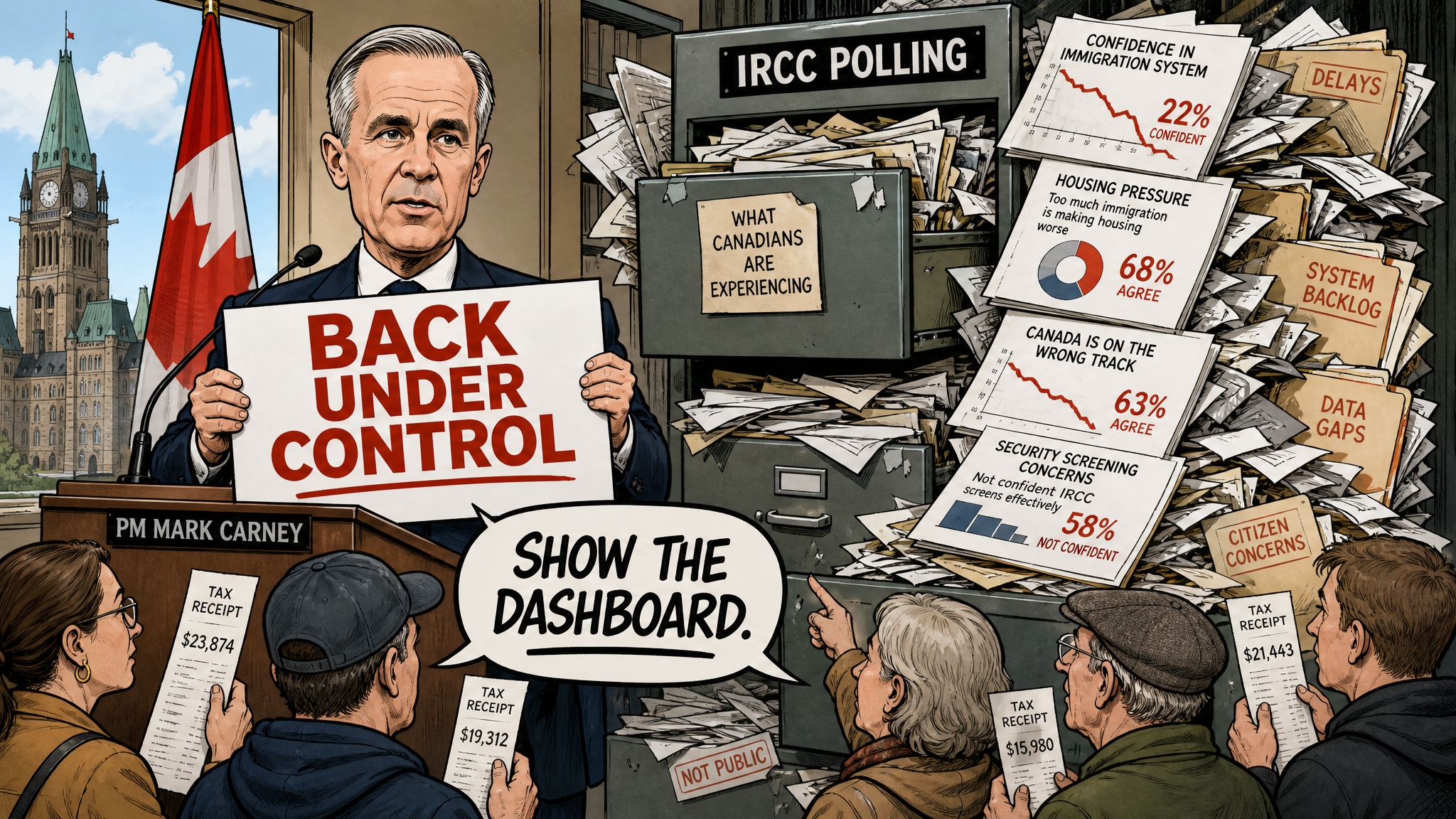
Prime Minister Mark Carney says Ottawa has “taken back control” of immigration. That is the line Canadians heard from a July 29 Canadian Press report, after Carney said immigration was “far too high” when his government took over and that Canada had “lost control” of foreign-student and temporary-worker levels.
The government’s claimed reductions are specific: asylum-seeker flow down by one-third, temporary foreign workers down by one-half, and foreign students down by two-thirds. Carney also acknowledged immigration levels were still putting pressure on housing and said there was a good argument for “a few more years of restraint.” Those admissions matter. They confirm that the public was right to ask whether intake, housing, public services and enforcement capacity had been properly matched.
But Ottawa’s own polling shows why a victory lap is premature. IRCC’s Deputy Minister 2026 transition material says Canadians’ views of immigration levels remain more negative than they were in the 25 years before 2023. In January 2026, 41% of Canadians said the federal government was on the wrong track managing immigration, while only 26% said it was on the right track.
The management numbers are even harder for the Liberals to explain. In August 2025, only 22% of Canadians agreed the immigration system was well managed overall. Only 22% agreed Ottawa does a good job deciding annual intake. Only 24% agreed the system effectively selects people who will contribute positively to the country. Only 29% agreed immigrants are properly screened to ensure they do not pose a security risk before arrival.
That is not an anti-immigrant verdict. It is a government-competence verdict. A lawful, serious immigration system should protect Canadians, treat newcomers honestly, fill real labour gaps and stay within the capacity of housing, infrastructure, health care, schools and local services. When public confidence falls that low, ministers should not ask for applause. They should publish the proof.
IRCC’s own consultation page says Ottawa is trying to reduce the temporary population to less than 5% of Canada’s population by the end of 2027 and keep permanent resident admissions below 1% of population after 2027. It also says immigration levels must be better aligned with infrastructure, public services and housing. Fine. Then show the monthly dashboard.
Canadians should see asylum intake and removals, expired permits and overstays, student and temporary-worker approvals, security-screening backlogs, housing-capacity assumptions, provincial service-capacity inputs, and progress against the temporary-resident target. If the system is back under control, the receipts should strengthen Carney’s case. If Ottawa will not publish them, the slogan is not control. It is marketing.
- Canadian Press via CityNews: Carney says government has “taken back control” of immigration — July 29, 2026
- Immigration, Refugees and Citizenship Canada: Public Opinion Research on Immigration — page details July 27, 2026
- Immigration, Refugees and Citizenship Canada: 2026 consultations on immigration levels — archived July 2, 2026
This article criticizes federal immigration management and public reporting. It does not blame immigrants, students, workers, refugees or asylum claimants for government policy failures.