Carney’s Trust Premium Is Not an Accountability System
When Canadians trust one leader more on the same policy text, the proper response is not blind faith. It is harder proof.
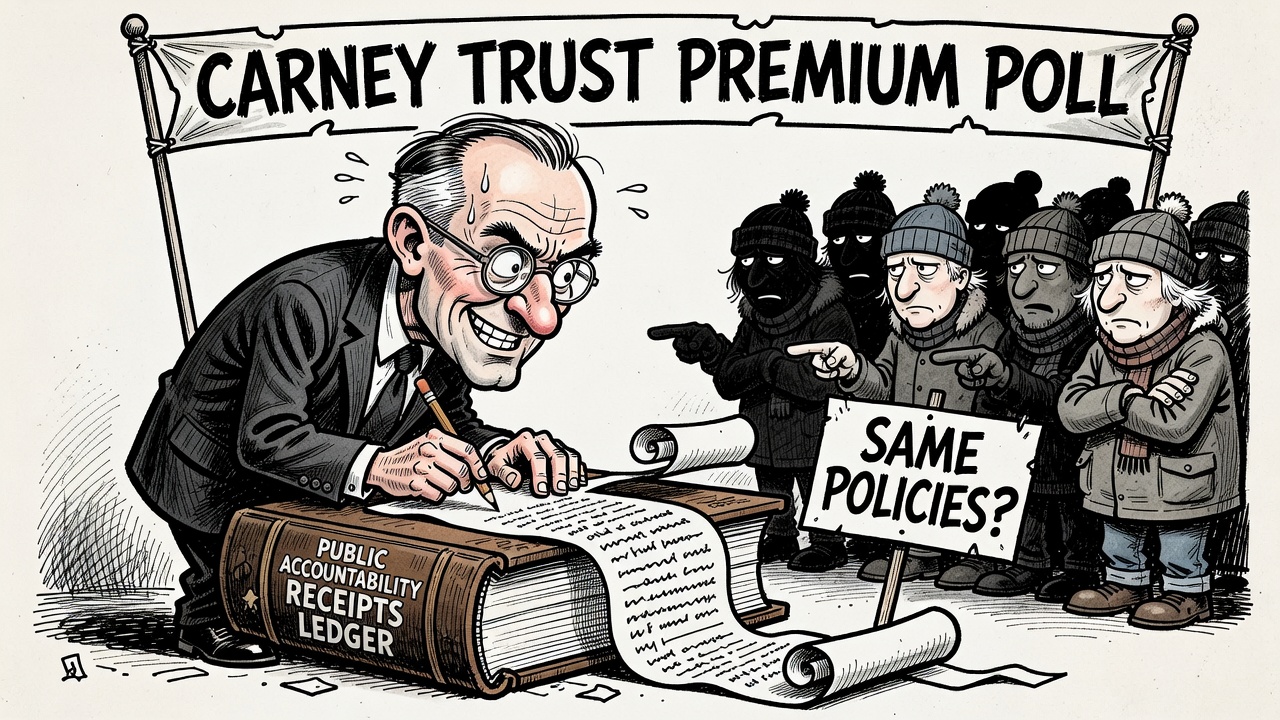
Leger’s August federal survey should make every accountability-minded Canadian sit up. The Liberals remain well ahead nationally, but the more important finding is not the horse race. It is the trust gap.
Leger says it randomly split respondents into two groups and showed them the same policy positions, changing only whether the position was attached to Mark Carney or Pierre Poilievre. Carney led on every tested comparison. On reducing immigration to ease pressure on health care and housing, Leger reported trust at 69% for Carney versus 56% for Poilievre. On accelerating major infrastructure and energy projects, it was 64% to 51%. On pipelines and energy production, 62% to 51%. On military spending and Arctic presence, 60% to 46%.
That is politically useful for Carney. It is also democratically dangerous if it becomes a substitute for evidence. A policy does not become cheaper, faster, fairer or better screened because it is printed under a banker’s name instead of an opposition leader’s name. Trust may win a news cycle. It does not pour concrete, house families, clear immigration backlogs, build ships, protect the Arctic or secure a trade deal.
The weakest trust result in Leger’s comparison was also the most urgent file: a U.S. trade deal that could require Canadian concessions. Carney still led, 50% to 38%, but both numbers were lower than on domestic files. That tells Ottawa what Canadians already understand. Concessions on autos, dairy, alcohol retaliation, procurement or CUSMA rules are not abstract strategy. They are jobs, prices, farms and provincial leverage.
A conservative accountability standard is simple: no government gets to govern by aura. If Carney wants public trust on immigration control, publish the expired-permit, asylum, enforcement, housing-capacity and health-system impact dashboard. If he wants trust on major projects, publish approval timelines, Indigenous consultation records, conflict screens, subsidy exposure and completion milestones. If he wants trust on defence and Arctic spending, publish procurement schedules, unit costs, readiness gaps and delivery dates. If he wants trust on U.S. concessions, publish the concession categories before Canadian sectors read about them after the deal.
Leger also found government satisfaction and Carney approval still positive but down slightly from June. That should be a warning, not a victory lap. A trust premium is fragile when household costs are high and promises are broad. The more Canadians are willing to give Carney the benefit of the doubt, the more Parliament should demand receipts before the doubt becomes damage.
Carney’s brand may be competence. Canada’s accountability system cannot be branding. It has to be ledgers, timelines, votes, audits and consequences.
- Leger: Federal Polling: Carney Leads Poilievre on Trust Across Key Issues — August 10, 2026
- Prime Minister of Canada: Statement by Prime Minister Carney on the United States administration’s intention to impose new tariffs — July 20, 2026
This article relies on published polling and official statements. It does not claim the poll proves policy performance; it argues that higher personal trust makes transparent performance ledgers more necessary.