PrescribeIT’s $50M Freeze Proves Ottawa Needs the Failure Ledger
PrescribeIT was sold as the way to axe the fax. After hundreds of millions in reported spending, a shutdown and a federal funding freeze, Canadians need the receipts before Ottawa writes another digital-health cheque.
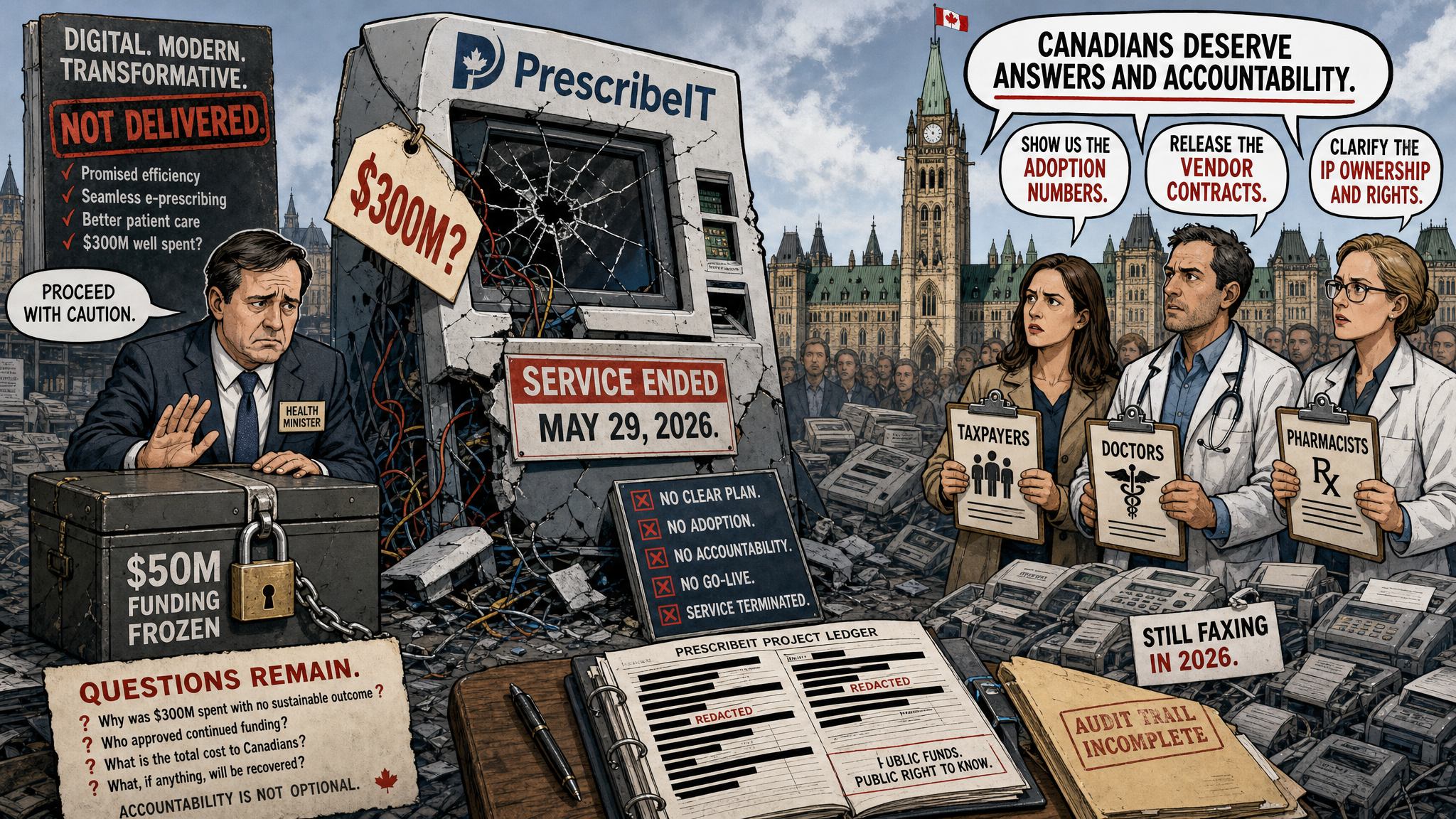
Ottawa’s PrescribeIT story has moved from failed program to live governance test. The service was launched in 2017 to modernize prescriptions between doctors and pharmacies. By April, The Canadian Press reported that Conservative MPs were asking the Auditor General to investigate the federally funded program, described then as a $250-million file set to end May 29 while Canada Health Infoway moved to an open-standards model.
PrescribeIT’s own FAQ confirms the hard date: the operated service concluded on May 29, 2026, at 11:59 p.m. EST. It also says the national ePrescribing standard was made publicly available on April 29, 2026 and will be maintained by Infoway. That may preserve technical work. It does not answer the taxpayer question: how did the flagship national service get this far before Ottawa admitted the model was not sustainable?
The later receipts are worse. Canadian Healthcare Technology reported on June 10 that Health Minister Marjorie Michel was withholding $50 million in federal funds from Canada Health Infoway until governance concerns were addressed. The same report said PrescribeIT had been shut down in most of the country after fewer than five per cent of prescriptions flowed through it, and that Telus Health disclosed receiving $98 million of the $298 million in federal funds spent on the program.
In the House of Commons on June 8, opposition MPs pressed the government over claims that Infoway had blown $300 million on PrescribeIT. Michel replied that there were governance issues, that the CEO had left, that an acting director was in place and that mandates were being reviewed. She also told the House the government had decided to halt funding when it concluded Infoway was not completely fulfilling its mission.
A conservative accountability standard starts with value for money. If Ottawa funds a national technology platform, ministers should be able to show the business case, the exit criteria, the cost controls and the public asset Canada received. If the government holds no useful ownership over the core technology, taxpayers deserve to know when that was approved and why.
That answer is not enough. A funding freeze is a symptom. Accountability requires the ledger: total federal dollars allocated and spent, every contribution agreement, every vendor contract, every adoption target, actual provider usage by province, peak and final prescription share, intellectual-property ownership, consultant spending, internal audits, board minutes tied to funding approvals and any recovery options.
Parliament is already asking the right questions. Written question Q-1064 seeks the funding, benchmarks, provider-use numbers, approval timeline, pre-launch studies, audits and accountability steps for PrescribeIT. Ottawa should answer it in full, table the documents publicly and let the Auditor General follow the money.
Canadians do not need another vague promise that digital health is important. Of course it is. They need proof that the federal government can stop turning modernization into a costly black box where failures are noticed only after the cheques clear and the service shuts down.
- Canadian Healthcare Technology: Ottawa withholds $50 million from Infoway
- The Canadian Press / CityNews: Conservatives call on auditor general to investigate $250 million PrescribeIT program
- PrescribeIT: Frequently Asked Questions
- House of Commons Hansard: Debates No. 131, June 8, 2026
- House of Commons written question: Q-1064 on PrescribeIT funding and accountability
This article distinguishes reported allegations and opposition claims from confirmed program facts. The accountability demand is for public documents, audits and adoption data.