Bill C-18 Wildfire Blackout Needs a Public-Safety Receipts Test
Liberals said Bill C-18 would save journalism. In wildfire country, Canadians deserve proof it did not help cut emergency news out of the feed.
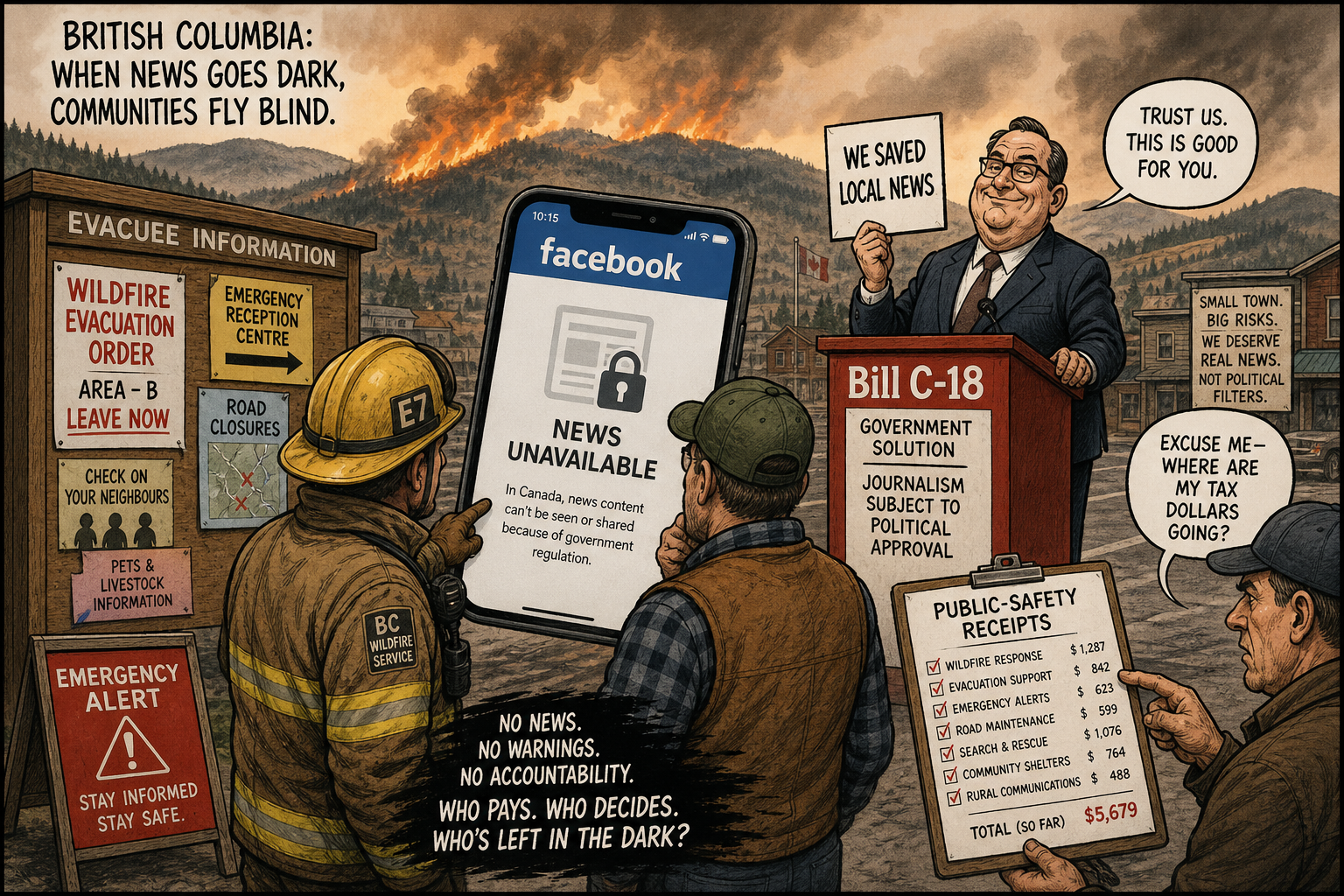
The Liberal case for Bill C-18 was simple: make dominant platforms compensate Canadian news businesses and help stabilize journalism. Canadian Heritage still describes the Online News Act as a bargaining framework meant to ensure platforms compensate news businesses when their content is made available on their services. It received Royal Assent on June 22, 2023, and the CRTC oversees the framework.
But a law should be judged by results, not press-release intent. Blacklock’s Reporter says a report to the Commons heritage committee found the 2023 Act left Canadians, especially rural Canadians, too reliant on mainstream media and official voices. The same excerpt says the Act provoked a Facebook news ban that left communities lacking credible information on the platform they used most.
Rebel News, citing the study When Good Intentions Cause Harm: The Online News Act, Meta’s News Ban And Public Safety During Wildfire Emergencies, reported that researchers examined wildfire coverage in several British Columbia communities. Their core finding is devastating for Ottawa’s media-control experiment: rural communities lost access to credible journalism at the exact moment emergency information mattered most.
That is not an abstract free-speech debate. Wildfire communication is public safety. Evacuation orders, road closures, shelter information, fire maps, corrections and local reporting have to reach people where they actually are. In many rural communities, that place was Facebook. If a federal law helped trigger a platform-wide news blackout, Cabinet owes Canadians more than a shrug and a talking point about big tech.
Rebel reported that removing journalism from Facebook did not remove fire-related information. Personal accounts and emotional material remained, while credible journalism disappeared from the feed. Researchers linked that vacuum to problems of trust, compliance and public safety. Blacklock’s excerpt also notes criticism that coverage became more dependent on mainstream outlets and official voices, leaving affected communities treated as compliance problems rather than people in crisis.
The accountability question is not whether Meta behaved admirably. It did not have to choose the broadest possible news block. The question for Ottawa is whether ministers were warned that their bargaining scheme could make emergency information harder to find, and whether they measured the harm after it happened. Conservatives should force that record into the open.
Parliament should demand a rural public-safety receipts test for Bill C-18: which communities lost local news reach, what emergency agencies changed after Meta’s ban, what warnings Canadian Heritage received, how local outlets were affected, and whether Ottawa will amend the Act before the next major wildfire season. If the Liberals truly meant to save journalism, they should prove their law did not make Canadians less informed when the smoke was at the door.
- Blacklock’s Reporter: Blame Bill For News Blackout
- Rebel News: Online News Act left rural Canadians without credible information during wildfires: report
- Canadian Heritage: The Online News Act
This article criticizes federal policy consequences and calls for public records. It does not allege unlawful conduct by any individual.