CBSA’s Extortion-Removal Funnel Needs Monthly Receipts
If Ottawa says it is cracking down on extortion-linked immigration cases, publish the funnel from investigation to enforced removal.
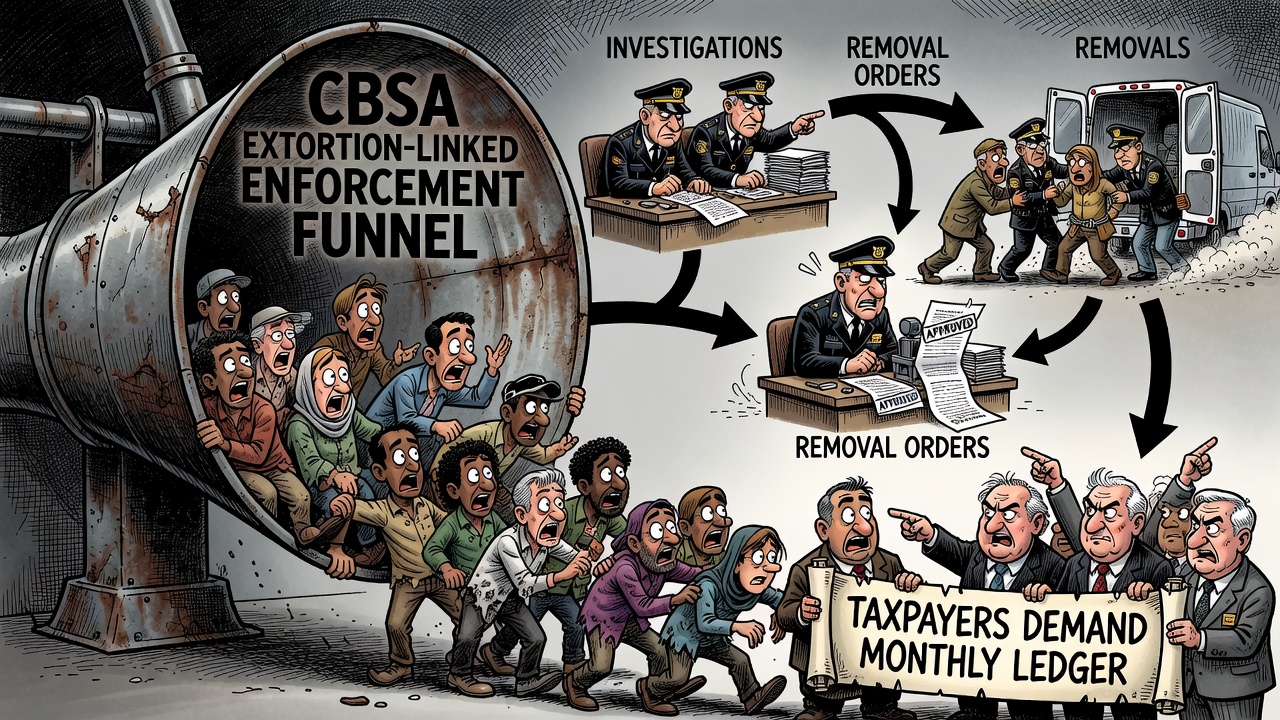
Ottawa has finally put some numbers beside Canada’s extortion-linked immigration-enforcement problem. Now Canadians need the next step: a monthly public funnel showing how many cases move from investigation to inadmissibility finding, removal order and enforced removal.
The Canada Border Services Agency said on June 25 that enhanced tracking of immigration-enforcement cases with potential extortion links began in the Pacific and Prairie regions in August 2025 and expanded to the Greater Toronto Area in November 2025. As of June 18, 2026, CBSA reported 484 immigration investigations, 139 removal orders issued on various inadmissibility grounds and 81 people already removed from Canada.
The regional split matters because extortion has not been a single-city problem. CBSA reported 150 investigations, 69 removal orders and 46 removals in the Pacific region; 196 investigations, 33 removal orders and 17 removals in the GTA; and 138 investigations, 37 removal orders and 18 removals in the Prairie region. Global News later reported the same national figures in a July Edmonton story tied to extortion-related policing, underscoring that these files involve coordinated local, federal and border-enforcement work.
Those figures are useful, but they are still a snapshot. They do not tell taxpayers how old the cases are, how many are detained, how many are in hearings, how many are delayed by appeals or refugee claims, how many involve organized-crime inadmissibility grounds, or how often removed individuals are stopped from re-entering. Without that funnel, ministers can announce removals while the public remains unable to measure the gap between threats identified and risks actually cleared.
This is not an argument against immigrants. Law-abiding newcomers and targeted business owners are often the people most harmed when extortion networks exploit weak enforcement. The conservative accountability standard should be firm and fair: due process for the accused, protection for victims and witnesses, and transparent aggregate numbers so Parliament can see whether Ottawa’s enforcement machine is keeping pace with the danger.
CBSA’s own quick facts raise the stakes. The agency says it removed 23,160 inadmissible people in 2025, including 1,010 under serious inadmissibility categories, and says it is currently removing about 400 inadmissible individuals weekly. It also says Canada’s Border Plan allocated $30.4 million to strengthen capacity for 20,000 removals annually and that Budget 2025 will support hiring 1,000 new CBSA officers. Good. Then publish the performance ledger that proves those resources are reducing the extortion-linked backlog.
Prime Minister Mark Carney’s government cannot ask communities to trust press-release enforcement. If Ottawa says it is cracking down, it should publish a monthly extortion-removal funnel by region: investigations opened, inadmissibility reports, detention decisions, hearing outcomes, removal orders, removals completed, legal barriers, average case age, re-entry controls and public-safety outcomes. The promise is safety. The proof is the ledger.
- Canada Border Services Agency: CBSA provides update on enforcement actions targeting extortion across Canada — June 25, 2026
- Global News: Edmonton traffic stop leads to extortion-related arrest — July 2, 2026
This article relies on aggregate CBSA enforcement figures and does not allege that any unnamed individual has committed an offence. It argues for transparent public reporting while preserving due process, privacy and operational security.