Threat-State Trade Needs Public Guardrails
Trade diversification cannot become a national-security blind spot. If Ottawa wants closer ties with governments CSIS still warns about, Canadians deserve the rules before the photo ops.
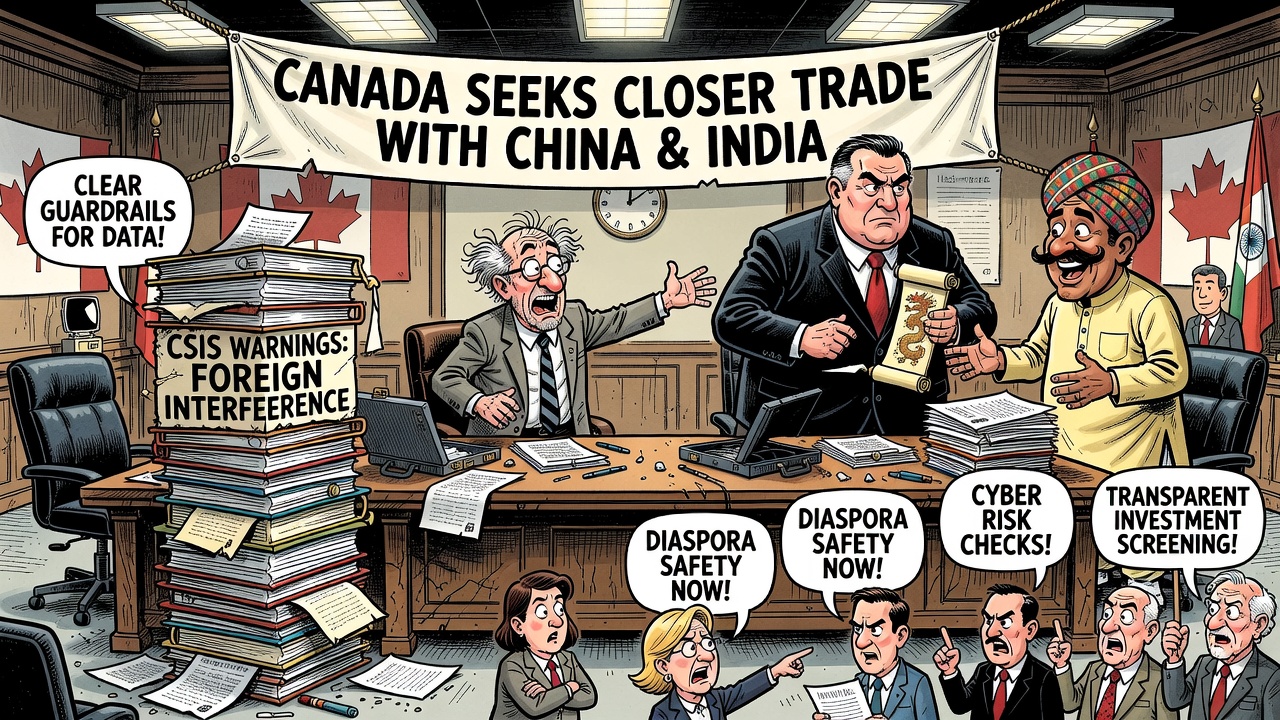
The Carney government keeps presenting trade diversification as a simple answer to Canada’s dependence on the United States. The harder question is what happens when the new partners are also named in Canada’s own security briefings.
CSIS released its 2025 Public Report on May 1, saying the report covers foreign interference, transnational repression and cyber intrusion by foreign states. A Global News video published this week framed the tension bluntly: Canada is drawing closer to countries that remain among its largest security threats. That is not an argument for shutting down diplomacy. It is an argument for publishing the guardrails before Ottawa signs the next memorandum, market-access deal or investment framework.
Global Affairs Canada’s 2026 briefing material for the Procedure and House Affairs committee says the Foreign Interference Public Inquiry described China as Canada’s most persistent and sophisticated foreign-interference threat. The same briefing points to Canada’s cyber threat assessment identifying China as the most comprehensive cyber-security threat facing Canada. That is not campaign rhetoric. It is the government’s own national-security baseline.
India raises a different but equally serious test. AP reported in February that Carney visited India to restore relations and diversify trade after relations were strained by Ottawa’s allegation of Indian government involvement in the killing of a Sikh separatist leader in Canada. That context matters because transnational repression is not an abstract file to diaspora communities. It is a question of whether people in Canada can speak, organize and criticize foreign governments without intimidation.
China raises the data, cyber and industrial-policy test. AP reported in January that Carney’s China outreach was part of a push for new partnerships to reduce reliance on the United States. Fine. But a government that wants more trade with Beijing has to show how it will protect research, ports, telecom networks, critical minerals, universities, public procurement, voter data and diaspora communities from coercion or covert influence.
The accountability standard is straightforward. Before any new trade or investment package with China or India is finalized, Ottawa should publish a public guardrails ledger: national-security risk assessments in releasable form; cabinet-level red lines; diaspora-safety protocols; cyber and data restrictions; investment-screening criteria; procurement exclusions; university and research safeguards; ministerial briefing dates; and a schedule for parliamentary review.
None of that requires hysteria. It does not require insulting Canadians with Chinese or Indian heritage. It does not require pretending Canada can avoid hard countries in a hard world. It requires treating national security as a condition of trade, not a footnote after the handshake.
Conservatives should say it plainly: trade is not the problem. Secretive trade with threat-state risks is the problem. If the Carney government believes its China and India outreach is safe, it should publish the guardrails and let Canadians judge the receipts.
- Global News: CSIS report warns Canada drawing closer ties with countries that remain biggest threats
- Canadian Security Intelligence Service: CSIS releases 2025 Public Report
- Canadian Security Intelligence Service: CSIS Public Report 2025
- Global Affairs Canada: Briefing for PROC on foreign interference
- Associated Press: Carney India visit and Canada-India relations context
- Associated Press: Carney China outreach and trade-diversification context
This article argues for public national-security guardrails around trade and investment policy. It does not argue against lawful diplomacy or legitimate trade with Canadians of any background.