The Toronto Access Ledger Needs Real-Time Receipt Checks
A Liberal Toronto fundraiser report shows why after-the-fact names are not enough. Publish the access crosswalk.
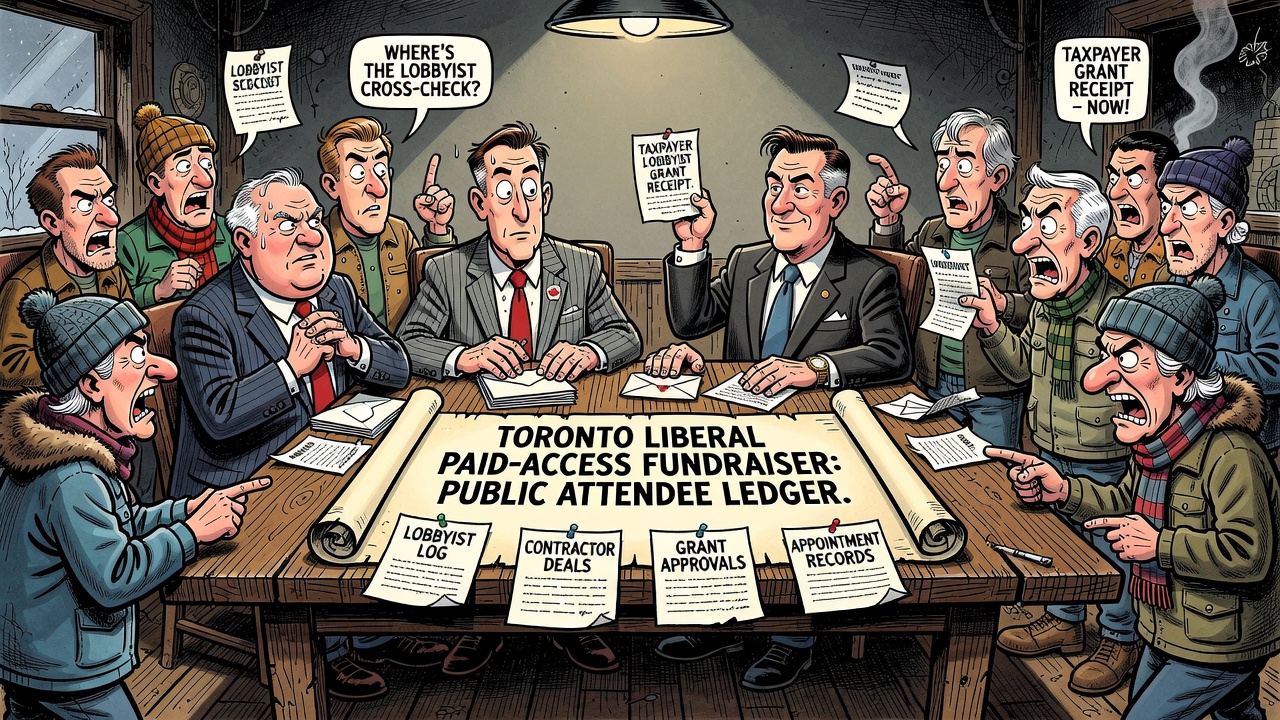
Elections Canada has posted another regulated Liberal fundraising report, and the lesson is bigger than one room in Toronto: paid political access should come with real-time public receipt checks, not a partial ledger months after the fact.
The report identifies a June 23, 2026 Liberal Party of Canada event in Toronto called “An Evening with Claude Guay, Leslie Church and Evan Solomon.” It benefited the LaSalle—Émard—Verdun Federal Liberal Association and the Toronto—St. Paul’s Federal Liberal Association. The listed required contribution or payment range was $0 to $550, and the report names Evan Solomon as the prominent attendee.
Those details matter. They show the disclosure system is working in one narrow sense: Canadians can eventually see an event title, a price band, a prominent attendee and a list of attendees. The problem is what the system still does not show.
A name on a PDF does not tell voters whether an attendee was a registered lobbyist, a federal contractor, a grant applicant, an appointment seeker, a Crown-corporation file holder, a procurement adviser, or a stakeholder with business before a minister’s office. It does not show meetings 12 months before or after the fundraiser. It does not show whether the riding association, national party, ministerial office and relevant departments screened for conflicts. It does not show who bought a ticket for whom.
That is the accountability gap. The issue is not to accuse every attendee of wrongdoing. It is to stop pretending that a retrospective list is the same thing as a firewall.
The attendee list published with this report includes 69 names. Among the recognizable names are Scott Brison, Jerry S. Grafstein, Steve Paikin, Claude Guay and Leslie Church, alongside other donors and attendees with city, province and postal-code fields. Again, the point is not that attendance is illegal. Canada allows political fundraising. The point is that a governing party selling access around prominent political figures should be held to a higher transparency standard than “check back later.”
Conservatives should be precise about this. Banquets, receptions and riding fundraisers are not automatically corruption. But when the same federal government controls contracts, grants, appointments, regulations, tax rulings, immigration pathways, defence spending and housing money, access has public value. The public deserves to know whether access is being insulated from decisions or quietly braided into them.
The fix is simple: publish a real-time access crosswalk. For every regulated fundraiser involving cabinet ministers, parliamentary secretaries, party leadership figures or senior caucus voices, disclose the event, price range, beneficiary, purchaser, guest, employer, lobbying status, active federal contracts, grants, contribution history, appointments, departmental meetings and conflict-screen result.
If the firewall is real, the receipts will prove it. If Ottawa will not publish the crosswalk, Canadians are entitled to ask why paid access still gets more privacy than taxpayers do.
- Elections Canada: Regulated fundraising events registry
- Elections Canada: Liberal Party of Canada event report, June 23, 2026 Toronto event
This article argues for stronger proactive disclosure. It does not allege illegal conduct by any attendee or organizer; the concern is whether the current fundraising disclosure system lets voters audit access in real time.