Carney’s Summer Spending Black Box Needs an Operating Manual
The PBO says Carney’s Spring Economic Update still leaves taxpayers without the operating manual for major new spending vehicles.
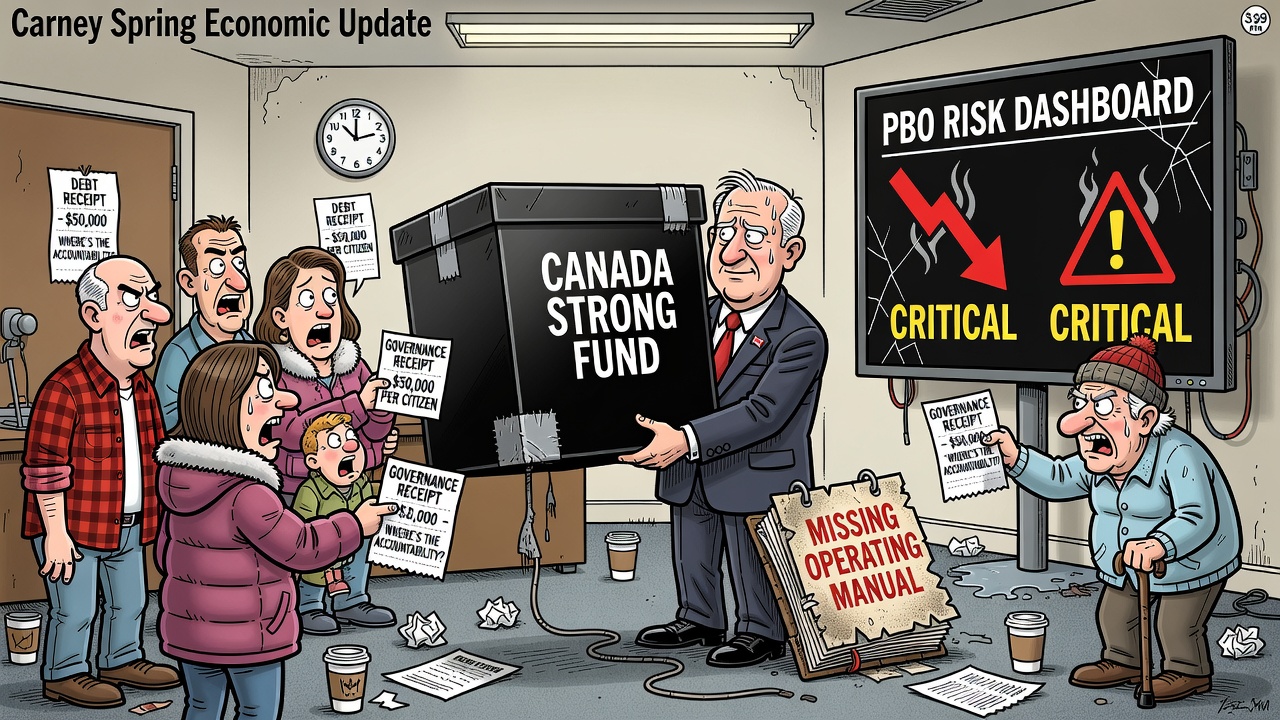
Finance Canada sold the 2026 Spring Economic Update as a “clear and transparent account” of the government’s plan. The Parliamentary Budget Officer’s follow-up makes a simpler point: the sales brochure is not the operating manual.
That distinction matters to taxpayers. The update announced a Canada Strong Fund with a $25 billion endowment over three years, a national trades push called Team Canada Strong, an electric-vehicle affordability program, conservation spending, a fuel-tax suspension and more financial-crime machinery. These are not tiny pilot projects. They are large public commitments made while Ottawa is still borrowing and while debt charges keep eating more revenue.
The cleanest example is the Canada Strong Fund. PBO says its design details still remain to be specified: governance structure, investment policy, risk-management framework, retail-product terms and accountability mechanisms. That is a remarkable list of blanks for a fund being pitched as Canada’s first sovereign wealth fund. Conservatives do not need to oppose every investment to insist on basic controls before taxpayers become the backstop.
The fiscal risk is also plain. PBO notes that creating a $25 billion fund when the federal government is not in surplus turns it into a leveraged taxpayer investment. PBO also says it is not clear whether the interest costs on debt issued to finance the fund will be included when Ottawa calculates commercial returns. If the government borrows money, pays interest, and then reports only the shiny side of the return ledger, Canadians are not getting transparency. They are getting marketing.
The same problem runs across the update. PBO says the government preserved its capital-budgeting framework but provided no added precision on key definitions. That matters because Ottawa’s new fiscal anchor depends on separating “operating” spending from “capital” spending. If tax expenditures, subsidies or loosely defined investments can be labelled capital without a clear test, the anchor becomes easier to announce than to audit.
Even where the fiscal track looks stable on paper, the warning lights are real. PBO projects federal debt per person rising from $33,592 to $38,295 over the medium-term horizon. It also says public debt charges are on a concerning upward track, rising from 10.6 percent to 13.2 percent of revenues between 2025-26 and 2030-31. Those are dollars unavailable for tax relief, defence, health transfers or future emergencies.
So the accountability demand is modest: publish the operating manual. For every major Spring Economic Update pledge, Ottawa should table a one-page public dashboard showing legal authority, total spending authority, borrowing cost, delivery department, governance board, conflict rules, private beneficiaries, performance targets, reporting dates and sunset or review triggers.
Carney’s Liberals want credit for moving fast. Fine. But speed without receipts is how taxpayers get stuck with risk after the ribbon-cutting is over.
- Parliamentary Budget Officer: PBO Assessment of Spring Economic Update: Departmental Spending and New Measures
- Parliamentary Budget Officer: PBO Assessment of Spring Economic Update: Fiscal Anchors and Fiscal Sustainability
- Department of Finance Canada: Government of Canada releases 2026 Spring Economic Update
- CityNews / The Canadian Press: New PBO says economic update lacks details on targets, results
This article argues for disclosure and fiscal controls. It does not allege illegal conduct; the concern is whether Parliament and taxpayers have enough detail to audit major commitments.