ISIS Returnee Risk Ledger: Ottawa Needs a Prosecution Plan
If Ottawa knows returning ISIS detainees are a high-risk file, Canadians deserve the evidence, charges and monitoring plan before the next arrival.
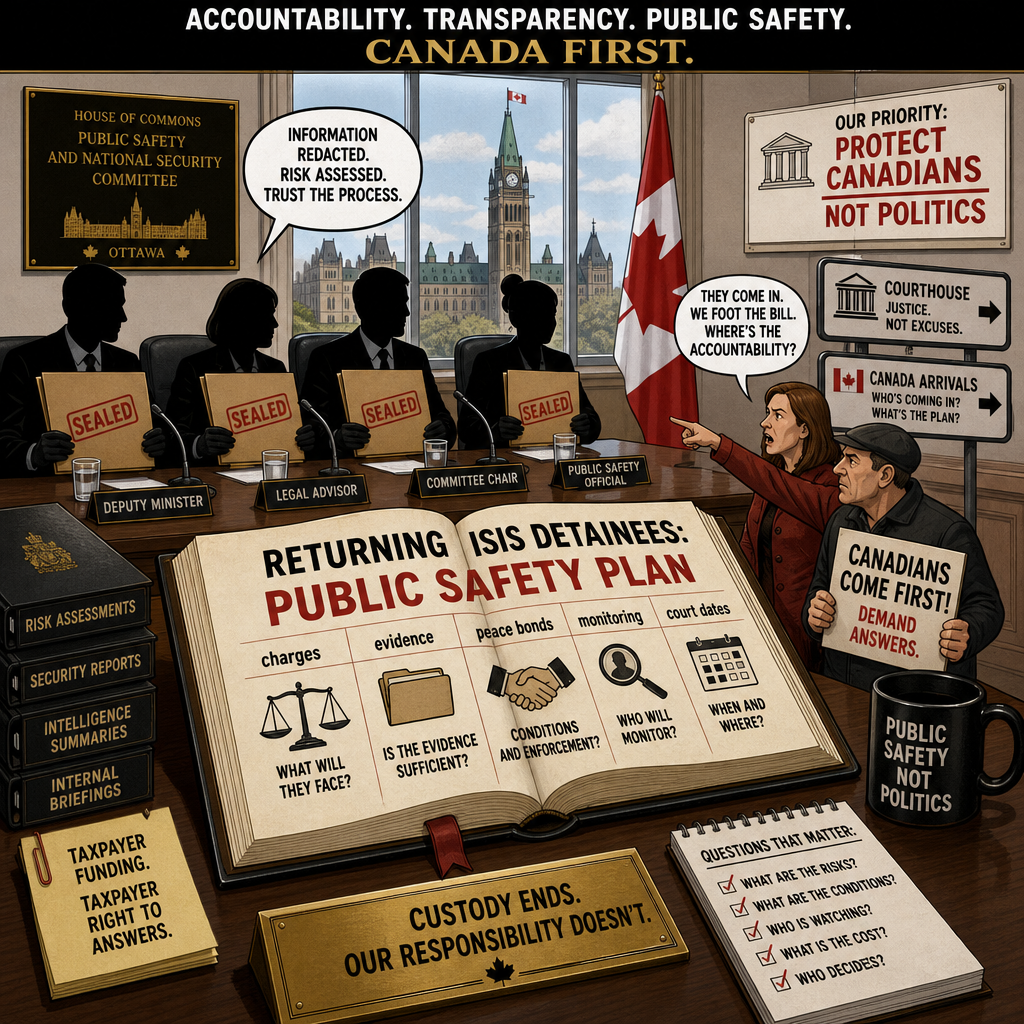
Canadians do not need another closed-door national-security promise. They need a plan before alleged ISIS members return to Canadian communities.
Global News reported on July 28 that a June Integrated Threat Assessment Centre report warned Canadian detainees overseas who allegedly joined ISIS would “highly likely” pose a violent extremist threat if they return to Canada. The report followed Iraq’s statement that it had taken custody of an unspecified number of ISIS members from Canada. Global reported the assessment warned returnees could contribute to extremism directly through violence or indirectly by radicalizing others.
That is not a partisan talking point. It is the government’s own threat machinery raising the alarm. CSIS’s 2025 public report supplies the same basic frame: DAESH remains a significant threat to Western interests, developments in Syria could accelerate possible repatriation timelines, and some Canadian extremist travellers would likely pose national-security and public-safety risks without sufficient mitigation measures.
The Liberal accountability failure is not that Canada must respect citizenship, courts and the Charter. Of course it must. The failure would be bringing high-risk returnees back, or allowing them to arrive, without a public safety ledger that tells Canadians what the government is prepared to do next.
Global reported that between 2021 and 2023 Ottawa repatriated nine women who had left Canada to join ISIS, plus their children. About a third of the women were charged, while most others were placed on terrorism peace bonds restricting movement and online access. Peace bonds may be a lawful tool, but they are not a substitute for a prosecution plan when admissible evidence exists.
The February Global report adds why this file cannot be managed with vague assurances. Iraq said nearly 6,000 ISIS suspects from 61 countries had been transferred from Syria into Iraqi custody, including Canada among listed nationalities. Global identified at least five Canadian men previously held in Syria, including Muhammad Ali of Mississauga, who Global reported admitted being part of an ISIS sniper team and used social media to incite attacks in Canada.
Before any return or repatriation, Ottawa should publish an ISIS returnee risk ledger with legitimate operational redactions. It should state how many Canadian detainees are held by country; what evidence has been preserved for Canadian courts; how many files are charge-ready; what peace-bond thresholds will be used if charges cannot proceed; how monitoring resources are staffed; what passport controls apply; and which minister signs off when prosecution is not ready.
Names, sources and sensitive methods can be protected. The framework cannot be secret. If the government believes its plan is strong enough to protect Canadians and survive court scrutiny, it should be strong enough to describe in public.
National security is not a press release. It is preparation, evidence, prosecutions where warranted, and honest disclosure of the limits of every fallback tool. Publish the ISIS returnee risk ledger before Canadians are asked to trust another black box.
- Global News: Canadians returning from ISIS “highly likely” to pose threat, intelligence report says
- Global News: Canadians accused of joining ISIS moved out of Syria to prisons in Iraq
- Canadian Security Intelligence Service: CSIS Public Report 2025 — Operations and analysis
This article does not assert guilt for any person who has not been convicted in court. It argues that Ottawa should publish a public-safety framework, with necessary national-security redactions, for prosecution readiness, court controls and monitoring resources.