Carney’s Three-Byelection Call Needs the Spending-Limit Receipts
A legal timing decision can still be a democratic accountability problem when it changes the money available in a competitive riding.
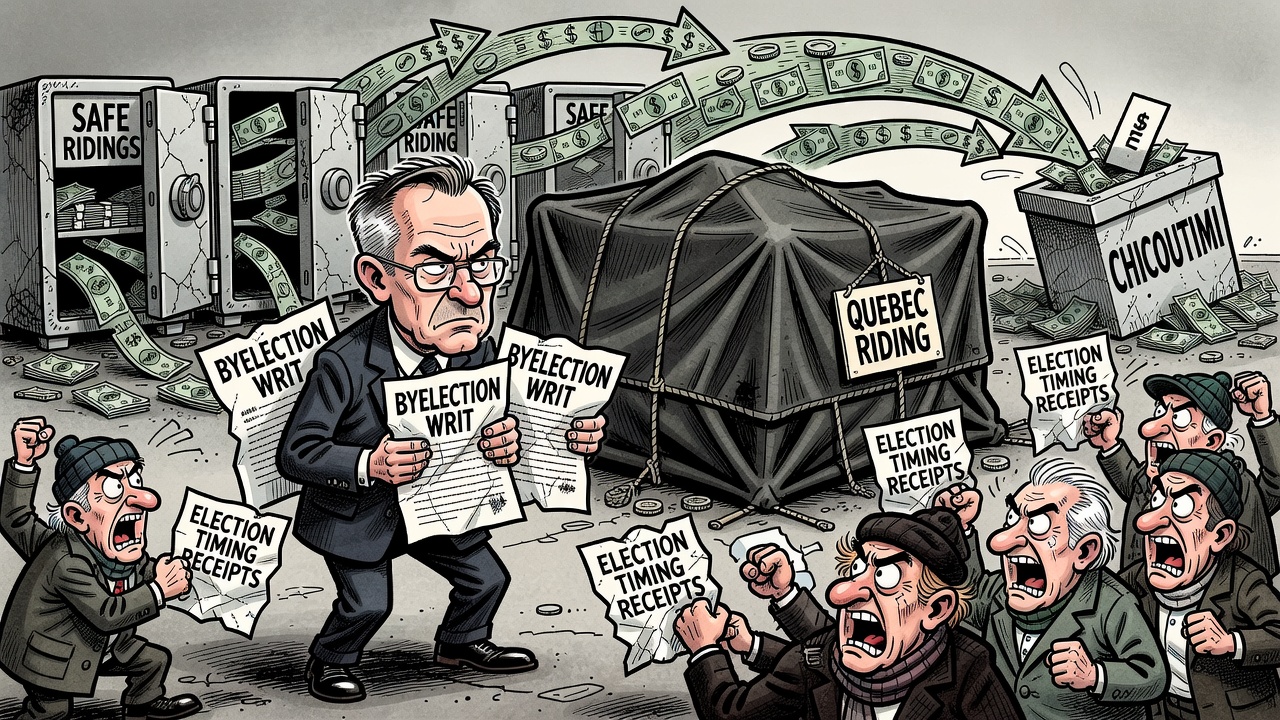
Prime Minister Mark Carney has called August 31 by-elections in North Vancouver–Capilano, Beaches–East York and Chicoutimi–Le Fjord. One federal riding, Saint-Hyacinthe–Bagot–Acton, is also vacant, but it was not included in the same round. That choice may be legal. It is not therefore above scrutiny.
The accountability problem is campaign finance. Elections Canada lists preliminary candidate spending limits of $140,839.70 in North Vancouver–Capilano, $134,454.45 in Beaches–East York and $131,296.71 in Chicoutimi–Le Fjord. Local candidate limits stay in their ridings. Party limits work differently. Elections Canada’s registered-party handbook says that when multiple by-elections are held on the same day, a party with candidates in more than one district may distribute its election-expense limit among those districts as it sees fit.
That rule matters because Chicoutimi–Le Fjord is the real fight. Global News reported that the riding was a three-way toss-up after the 2025 result, while North Vancouver–Capilano and Beaches–East York are safer Liberal defences. In plain English: parties running in all three contests can collect spending headroom from three ridings and concentrate the party-level money where it helps most.
This is where the Bloc Québécois angle becomes unavoidable. In this three-riding package, the Bloc is naturally competing only in Quebec. If Saint-Hyacinthe–Bagot–Acton had been called at the same time, the Bloc’s safe Quebec seat could have created extra party-level room that might be shifted into Chicoutimi. By holding that fourth vacancy back, Carney’s decision leaves Liberal, Conservative and NDP national campaigns with broader pooling options while the Bloc does not get the same Quebec-to-Quebec headroom.
No one has to claim the rule was broken. The more serious point is that the Prime Minister controls timing power that can affect the practical campaign battlefield. When that timing power intersects with legal spending formulas, voters deserve a written explanation before they vote, not a shrug after the polls close.
Carney’s Liberals often present themselves as managerial adults. Fine. Then manage in public. If the fourth by-election was delayed for administrative, statutory or public-interest reasons, release the memo. If the government considered finance effects and rejected them as irrelevant, release that too. But do not ask Canadians to believe that sophisticated political operators failed to notice a rule that could nearly double the firepower available in Chicoutimi.
Democracy is not only about whether politicians obey the letter of the law. It is also about whether they use public power fairly. On this file, the receipts should come before August 31.
- Global News: Analysis: With four vacant ridings, why did Carney call just three byelections?
- Elections Canada: Preliminary election expenses limits for candidates — August 31, 2026 by-elections
- Elections Canada: Political Financing Handbook — election expenses for by-elections
This article argues for disclosure of timing and finance records. It does not allege illegal conduct; the concern is whether lawful timing power is being used in a way voters can audit.