By-Election Majority Firewall Needs the Appointment Receipts
Carney’s August 31 by-elections are not routine housekeeping. They are a House-control test created in part by appointment decisions.
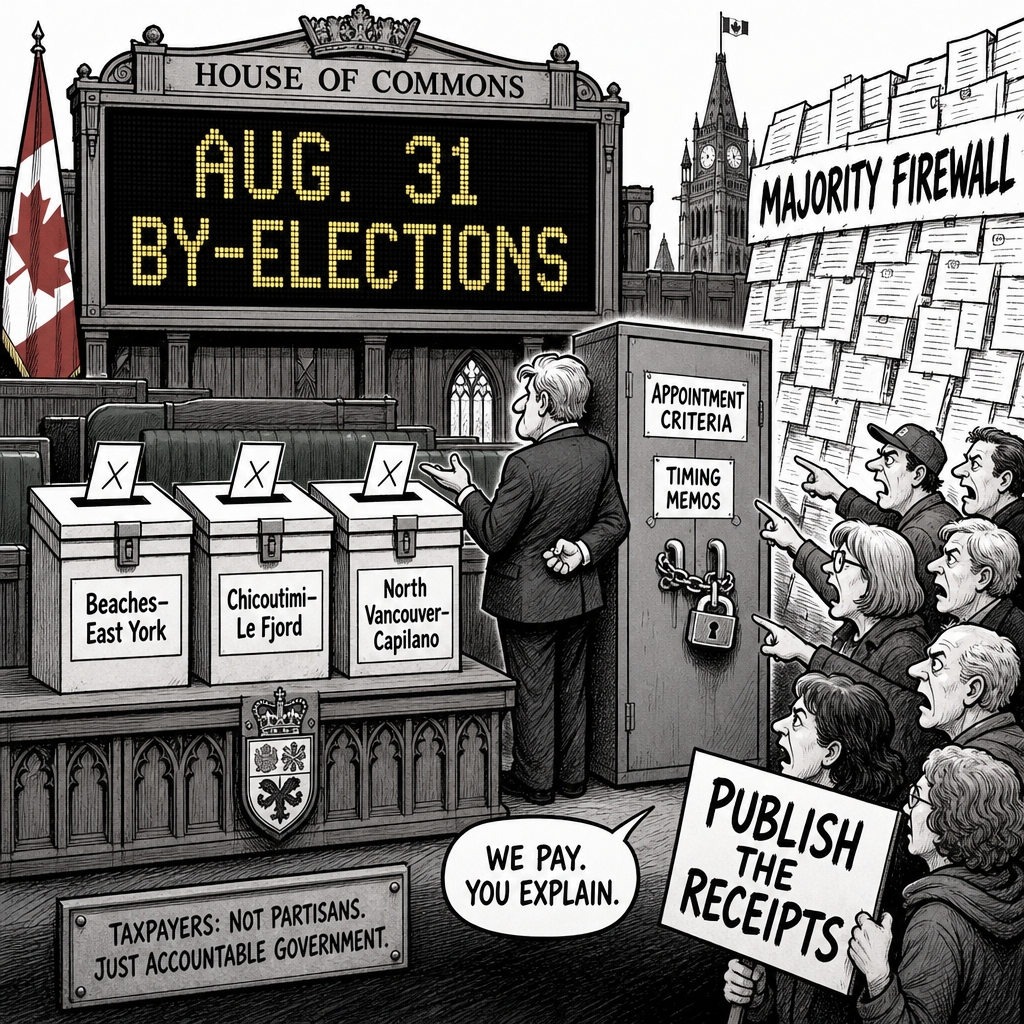
Prime Minister Mark Carney has called three federal by-elections for August 31 in Beaches–East York, Chicoutimi–Le Fjord and North Vancouver–Capilano. Elections Canada confirms those same three contests are under way to fill vacancies in the House of Commons. On paper, that is the machinery of democracy doing its job. In context, it is also a majority-management story that deserves receipts.
Global News reported that the three seats became vacant after one MP left politics, one was named ambassador to the European Union, and one was named to the Senate. The details matter. Nate Erskine-Smith stepped down in Beaches–East York. Jonathan Wilkinson left North Vancouver–Capilano after Carney named him Canada’s EU ambassador. Richard Martel left Chicoutimi–Le Fjord after Carney named him to the Senate.
That is not just normal churn. It is a chain of vacancies with direct consequences for the balance of power. Global framed the August 31 votes as by-elections with “control of house at stake” and reported the Liberals currently hold 172 seats, with the Conservatives at 139, the Bloc at 21, the NDP at five, one Green MP, one Independent and another Quebec vacancy still outstanding.
The Senate piece is especially revealing. Carney’s own July 7 release says the government is removing the non-partisanship criterion for Senate appointments and confirms Richard Martel was among the new Senate choices for Quebec. A prime minister can recommend senators. A prime minister can appoint ambassadors. But when those decisions open competitive House seats while the government is defending a thin majority, Canadians are entitled to more than ceremony and press lines.
The accountability standard should be simple: if an appointment creates a vacancy, publish the public-interest rationale. If a by-election date is selected, publish the timing rationale. If one vacant riding is left outside the same round, explain why. Elections Canada says the Saint-Hyacinthe–Bagot–Acton vacancy remains separate; voters deserve to know whether that was pure legal timing, administrative readiness, political convenience, or some combination backed by documented reasons.
None of this requires speculation about what voters will do on August 31. The public record already shows enough to demand transparency now: three ridings, one majority firewall, two appointment-driven vacancies, and a government whose Senate policy now openly welcomes partisan experience it previously screened out.
Carney’s Liberals like to talk about modern, disciplined government. Discipline means putting the paperwork on the table. Publish the appointment receipts. Publish the by-election timing memo. Publish the majority-management ledger before Canadians vote, not after the results are safely filed away.
- Global News: Carney calls 3 byelections in B.C., Ontario and Quebec
- Global News video: Carney calls August byelections for 3 ridings, control of house at stake
- Elections Canada: Federal by-elections now under way
- Prime Minister of Canada: Senate appointment process changes
This article argues for disclosure of appointment and timing records; it does not predict by-election results or allege undisclosed conduct beyond the cited public record.