The Smaller Deficit Headline Needs the Cash-Borrowing Receipt
Finance Canada’s new Fiscal Monitor shows a much smaller deficit. It also shows why Canadians should not confuse a revenue windfall with a smaller Ottawa.
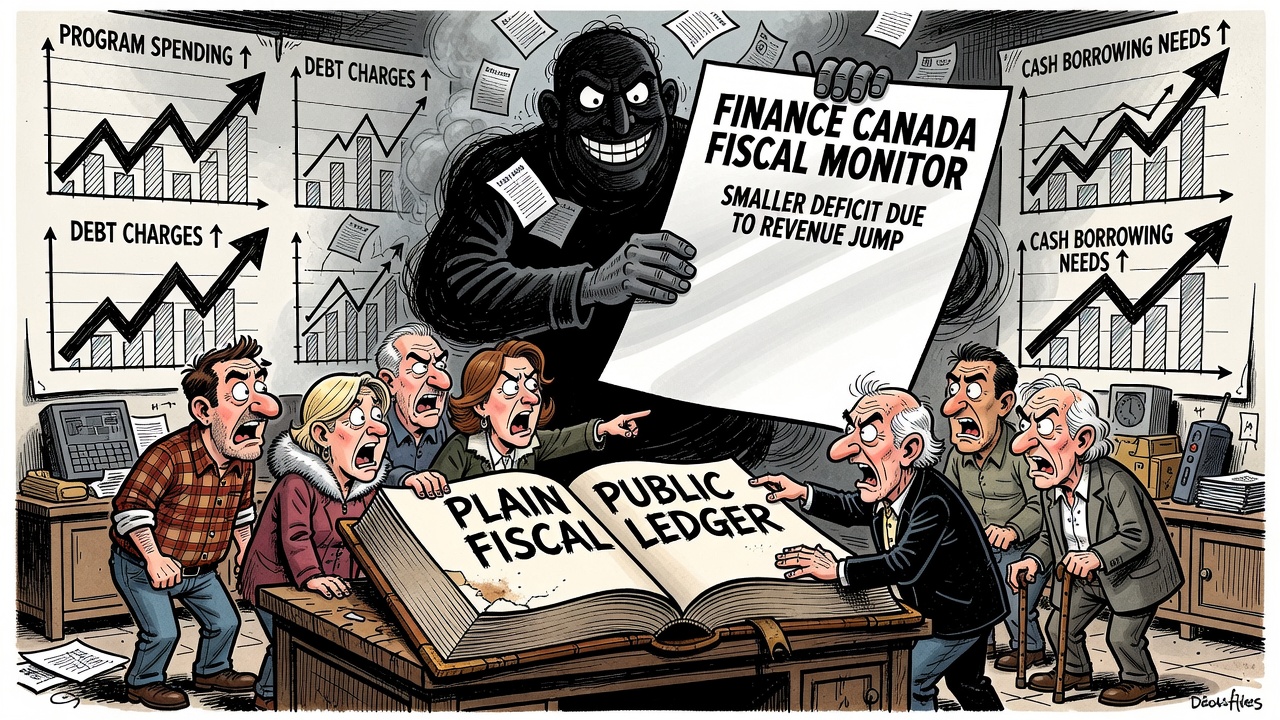
The easy headline from Finance Canada’s latest Fiscal Monitor is that Ottawa’s books look better than they did a year ago. For April and May 2026, the federal government reported a $1.4 billion budgetary deficit, compared with $9.9 billion for the same two months in 2025. That is a real improvement on the accrual deficit line.
But conservatives should read the whole receipt, not just the press-friendly line. Finance Canada says revenues rose $11.8 billion, or 15.5%, over the two-month period, driven largely by higher income-tax and excise-tax receipts. In plain English: the deficit shrank mainly because Ottawa collected much more money.
That is not the same thing as Ottawa getting smaller. Program expenses, excluding net actuarial losses, still rose $2.8 billion, or 3.7%. Direct program expenses rose $3.9 billion, or 12.1%. Public debt charges climbed another $0.3 billion to $9.9 billion for just April and May. When interest on past borrowing costs almost $10 billion in two months, no responsible government should be taking a victory lap.
The most important number may be the one that rarely makes the headline. Finance Canada explains that the budgetary balance is accrual accounting, while the financial source or requirement measures cash coming in and cash going out. On that cash basis, Ottawa had a $23.6 billion financial requirement for April and May 2026 — slightly higher than the $22.9 billion requirement in the same period a year earlier.
That is the accountability problem for Mark Carney’s government. A smaller accrual deficit can sit beside a larger cash call. Higher revenues can flatter the deficit while operating spending and debt charges keep rising. Non-budgetary transactions, loans, investments, accounts payable and other cash movements still have to be financed. Taxpayers do not pay bills with slogans about fiscal discipline; they pay them through taxes, borrowing and interest costs.
Finance Canada also notes that Fiscal Monitor results are monthly, unaudited, and can be volatile because of timing. Fair enough. That caution cuts both ways. Liberals should not overclaim a two-month deficit improvement, and critics should not pretend two months prove the full fiscal year. The defensible standard is transparency.
Every monthly fiscal update should answer four simple questions: how much of the improvement came from tax receipts, how much came from real spending restraint, how much went to debt interest, and how much new cash financing was required? Until Ottawa publishes that dashboard, the smaller-deficit headline is incomplete. Canadians deserve the full ledger.
- Department of Finance Canada: The Fiscal Monitor — April and May 2026
- Department of Finance Canada: Publications and reports
This article relies on Finance Canada’s monthly Fiscal Monitor, which the department says is unaudited and can be affected by timing within the fiscal year.