CBSA’s Enforcement Math Needs a Public Warrant Ledger
Ottawa can boast about removals all it wants. If the warrant pile is still growing faster than enforcement capacity, Canadians deserve the math.
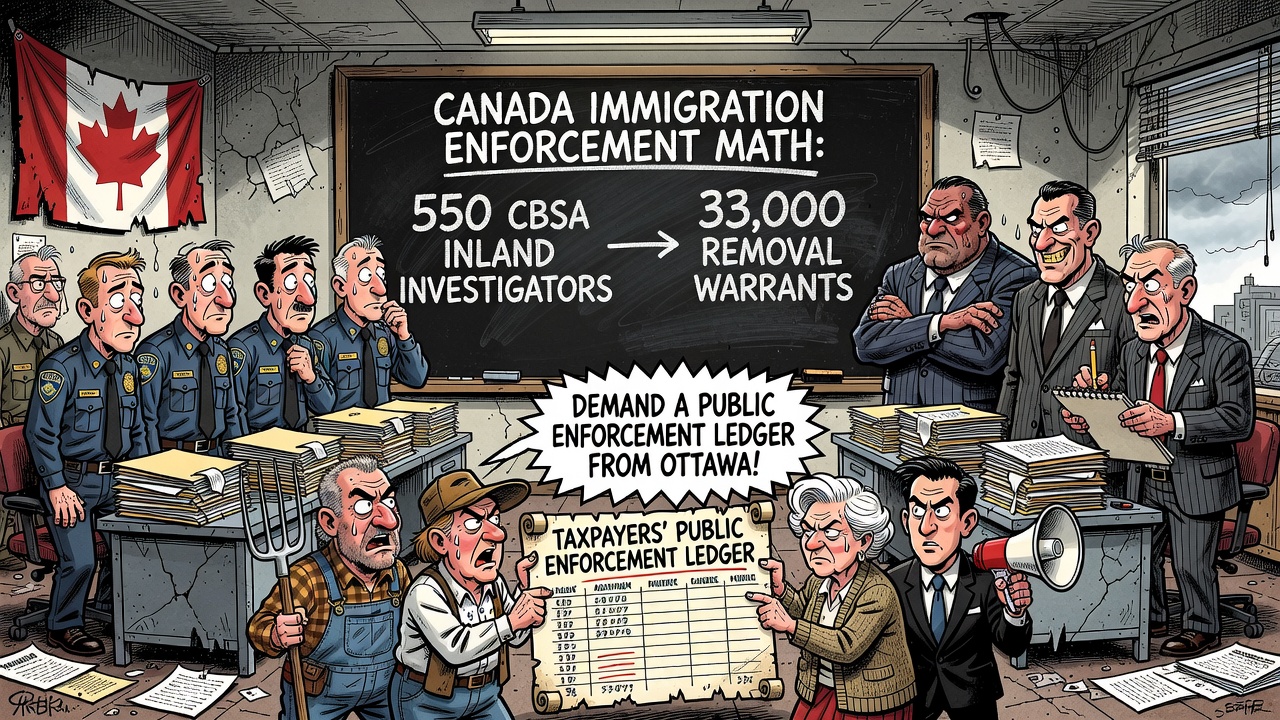
Canada’s immigration debate cannot stop at intake caps and press releases. The harder question is whether Ottawa can enforce the rules after someone is found inadmissible, ordered removed, or connected to serious public-safety investigations. On that test, the numbers demand a public ledger.
The Canada Border Services Agency says it is responsible for removing foreign nationals who are in Canada illegally, and its own statistics show removals have climbed sharply: 23,160 enforced removals in 2025 and 10,607 more from January through June 2026. That sounds impressive until Canadians ask what kind of removals are being counted, how many active warrants remain, and how many serious-criminality or organized-crime files are still waiting.
Global News reported that CBSA statistics showed more than 33,000 removal warrants in the current inventory, with more than 10,000 active for over a year. The same report said the agency had about 550 inland investigators tracking people with warrants. The Hub’s analysis then framed the problem bluntly: if roughly 550 investigators are chasing 33,000 warrants, the system is not just busy; it is mathematically underpowered.
This is not an argument against immigrants. Law-abiding newcomers are often the first victims when extortion networks, fraud rings and transnational gangs exploit weak enforcement odds. CBSA’s June 25 update on extortion-linked enforcement said that as of June 18, it had opened 484 immigration investigations, issued 139 removal orders on various inadmissibility grounds, and removed 81 individuals. That is useful disclosure. It is not enough.
Ottawa’s broader border-security update says the $1.3 billion Border Plan includes more resources for removing inadmissible foreign nationals, notes 22,576 removals in 2025, and says 1,010 removals involved serious inadmissibility categories such as national security, war crimes, organized crime and criminality. Good. Now separate the victory-lap numbers from the backlog numbers.
Conservatives should insist on a simple principle: rules without enforcement are invitations. If an inadmissible person complies and leaves, the system can process that case. The public-safety test is what happens when someone does not comply, disappears into the warrant inventory, or is tied to organized crime. Canadians should not need order-paper questions, committee testimony and scattered media reports to piece that together.
Prime Minister Mark Carney’s government says immigration is being brought back under control. Then publish the control panel. Show Parliament the warrant ledger every month. Show the serious-criminality files, the officer workload, the closure rate, and the remaining risk. If the math is improving, prove it. If it is not, stop pretending a removals headline is the same thing as enforcement.
- The Hub: The math of Canada’s immigration enforcement no longer works — July 20, 2026
- Canada Border Services Agency: Immigration removal statistics
- Canada Border Services Agency: CBSA update on enforcement actions targeting extortion — June 25, 2026
- Government of Canada: Strengthening Canada’s border security: actions taken to date
- Global News / The Canadian Press: CBSA says removals at all-time high, but 10K warrants are over a year old
This article distinguishes immigration enforcement capacity from immigration status generally and does not allege that any named individual has committed an offence.