Red Chris $500M Mine File Needs the Conflict-Screen Receipt
A $500 million public investment, a named mine proponent, and a prime minister’s securities disclosure should trigger receipts — not another trust-me file.
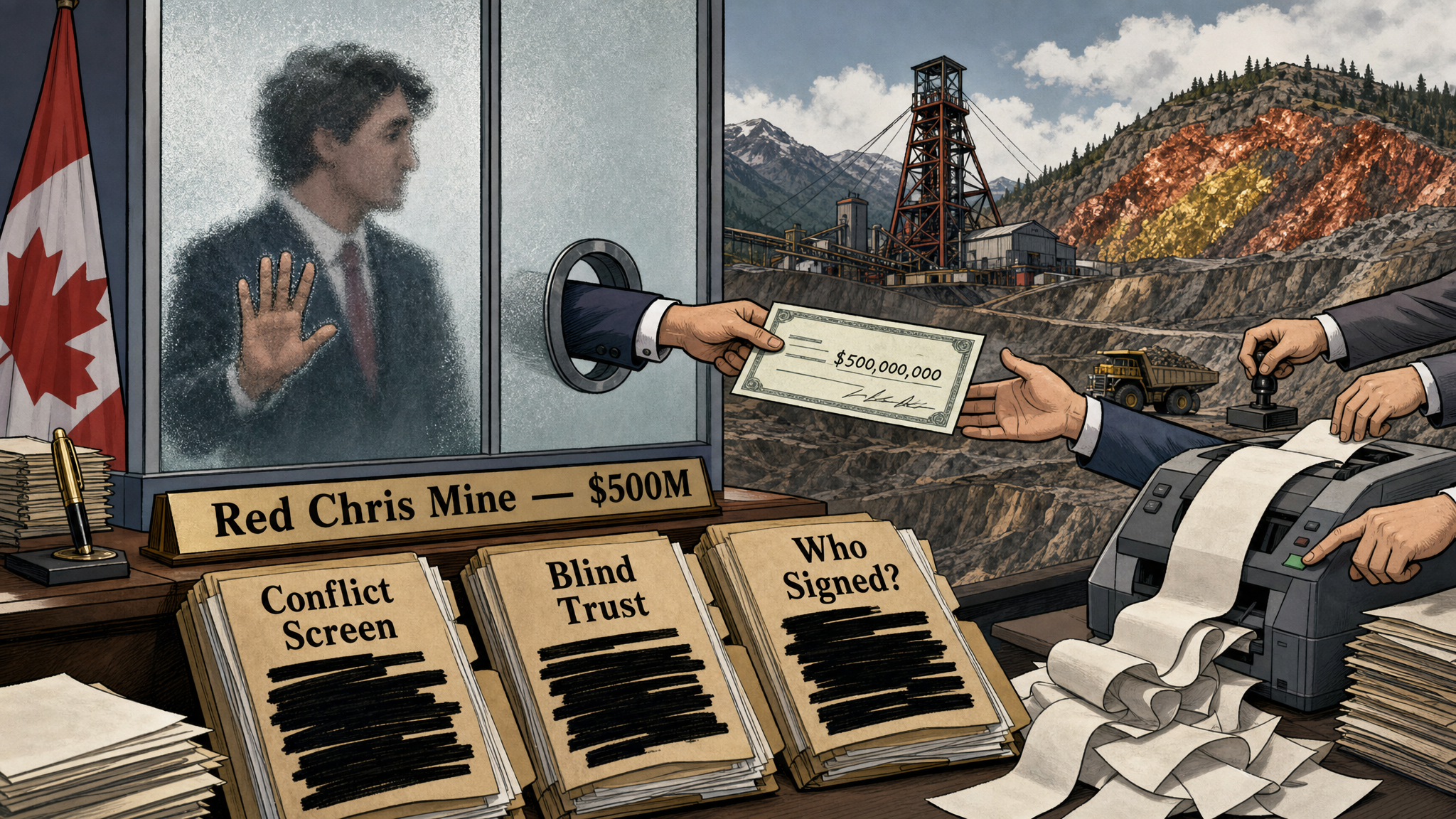
Ottawa’s Red Chris file has a simple accountability problem: the government put a $500 million investment beside a mine whose official project page names Newmont Mining and Imperial Metals as proponents. Newmont says it holds a 70 percent interest in, and operates, Red Chris in a joint venture with Imperial Metals. That does not prove wrongdoing. It does prove the public deserves the paperwork.
The Prime Minister’s Office announced on July 2 that Canada and British Columbia had signed a cooperative prosperity agreement and that Ottawa would invest $500 million to expand Red Chris Mine. The official Major Projects Office page repeats the figure, identifies the project as a copper-and-gold mine near Iskut, and says the expansion would increase Canada’s annual copper production by more than 15 percent.
Here is the ethics wrinkle. The Conflict of Interest and Ethics Commissioner’s appendix to Mark Carney’s summary statement lists assets divested into a blind trust under section 27 of the Conflict of Interest Act. On that long securities list is “Shares of Newmont Corp.” Separately, the Commissioner’s public registry describes Carney’s conflict screen as a preventive measure designed to avoid preferential treatment involving Brookfield Asset Management, Brookfield Corporation, Stripe Inc., and companies owned or controlled by them. The same registry says the screen is administered by Carney’s chief of staff and the Clerk of the Privy Council so he is not made aware of, or participating in, screened matters.
Juno News reported July 16 that Ottawa approved $500 million for Red Chris after Newmont appeared in Carney’s conflict architecture. The official documents require careful wording: Newmont is visible in the blind-trust securities appendix, while the posted conflict screen is framed around Brookfield, Stripe and related companies. That distinction matters. It is also exactly why Ottawa should release a clean file note instead of forcing Canadians to reverse-engineer the firewall from scattered registry pages.
Conservatives should not have to allege corruption to demand sunlight. A prime minister with a massive investment disclosure, a blind trust, and a formal conflict-screen architecture should welcome a project-by-project audit trail when large public money touches a named corporate proponent.
If the firewall worked, publish the receipt. If Carney was excluded, say who handled the file. If no screen applied, explain why a $500 million mine investment tied to a company in the disclosed securities appendix did not require one. Public trust is not built by telling taxpayers to admire the firewall from the outside. It is built by showing who stood on which side of it when the cheque was approved.
- Juno News: Carney’s conflict screen linked to $500M Red Chris mine subsidy — July 16, 2026
- Major Projects Office: Red Chris Mine Expansion
- Prime Minister of Canada: Canada-British Columbia cooperative prosperity partnership — July 2, 2026
- Ethics Commissioner: Appendix to Carney’s summary statement
- Ethics Commissioner: Public Declaration of Agreed Compliance Measures
- Newmont: Red Chris operations page
This article argues for conflict-screen disclosure and does not allege that Carney personally approved the Red Chris investment or that any law was broken.