Toronto Star Subsidy Lobbying Needs a Public Receipt Ledger
Torstar says journalism supports protect democracy. Fine. Then the public should get a clean ledger showing who receives the money, how much, and for how many newsroom salaries.
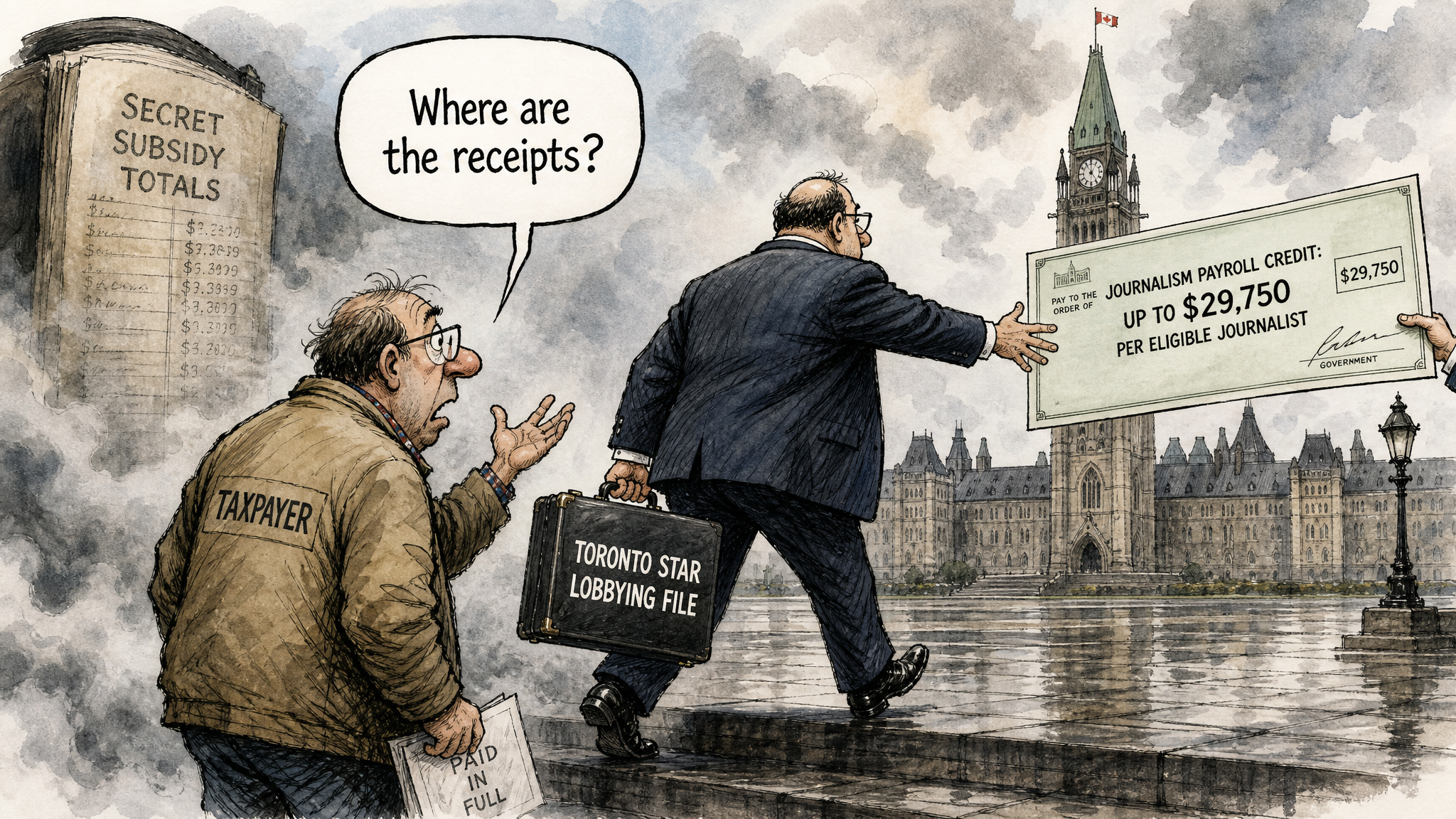
The Toronto Star’s parent company is asking Parliament to keep the richer version of Ottawa’s newsroom payroll subsidy. Taxpayers should read that request carefully, because this is not an abstract debate about “saving democracy.” It is a direct request to preserve a federal labour tax credit worth up to $29,750 per eligible newsroom employee.
Blacklock’s reported July 28 that Torstar’s pitch to MPs framed continued subsidies around ethical governance and democratic accountability. Torstar’s own May submission to the House of Commons heritage committee says the company is the parent of the Toronto Star and other Ontario news brands, then recommends that Ottawa maintain existing supports for Canadian journalism, including the Local Journalism Initiative. It says priority should be given to maintaining the Journalism Labour Tax Credit at current rates.
The current rates matter. The Canada Revenue Agency says the credit started at 25 percent in 2019 and rose to 35 percent for the period from January 1, 2023, to December 31, 2026. CRA also says the annual labour-cost cap increased from $55,000 to $85,000 per eligible newsroom employee. Finance Canada’s 2026 consultation page translates that into a maximum credit of $29,750 per individual and says the rate is scheduled to return to 25 percent on January 1, 2027.
This is where the Star’s argument runs into the taxpayer’s right to know. Torstar’s submission itself says federal information on media supports is “complex, fragmented, and opaque.” It says CRA does not publish a list of Qualified Canadian Journalism Organizations, making it impossible for Canadians to know which organizations are eligible to access supports. That is not a conservative talking point. That is the applicant-side lobby document acknowledging an opacity problem.
Parliament is already pressing the same issue. Written Question Q-942 asked the Canada Revenue Agency to provide, for each of the past five years, the number of companies that received the Canadian Journalism Labour Tax Credit, the annual value of the credit, and the number of journalist salaries supported. Those are basic public-money questions, not attacks on reporters.
Conservatives should be blunt but fair: local reporting can be valuable, and journalists should be free to do hard work without political interference. But when private media companies lobby government for richer payroll support, the public deserves more than high-minded language about democracy. It deserves receipts.
If the Liberals believe subsidized journalism strengthens public trust, they should prove it with disclosure. Publish the recipients. Publish the totals. Publish the salary counts. Publish the guardrails. No newsroom that demands transparency from everyone else should object when taxpayers demand it from Ottawa’s media-subsidy machine.
- Blacklock’s Reporter: “Fed Subsidy Buys Ethics: Star” archive item — July 28, 2026
- Torstar Corporation: Submission to the House of Commons Standing Committee on Canadian Heritage — May 2026
- Canada Revenue Agency: Canadian Journalism Labour Tax Credit
- Department of Finance Canada: Consultations on extending the Canadian Journalism Labour Tax Credit
- House of Commons: Written Question Q-942 on Canadian Journalism Labour Tax Credit disclosure
This article does not claim Torstar or the Toronto Star received a specific dollar amount under the credit. It argues that if Parliament maintains or expands enhanced media supports, recipient-level disclosure should be public.