Ottawa’s TFW Enforcement Numbers Need a Public Employer Ledger
If the Temporary Foreign Worker Program is truly a last resort, Ottawa should show Canadians exactly which employers broke the rules, what they did, and whether the system protected Canadian workers first.
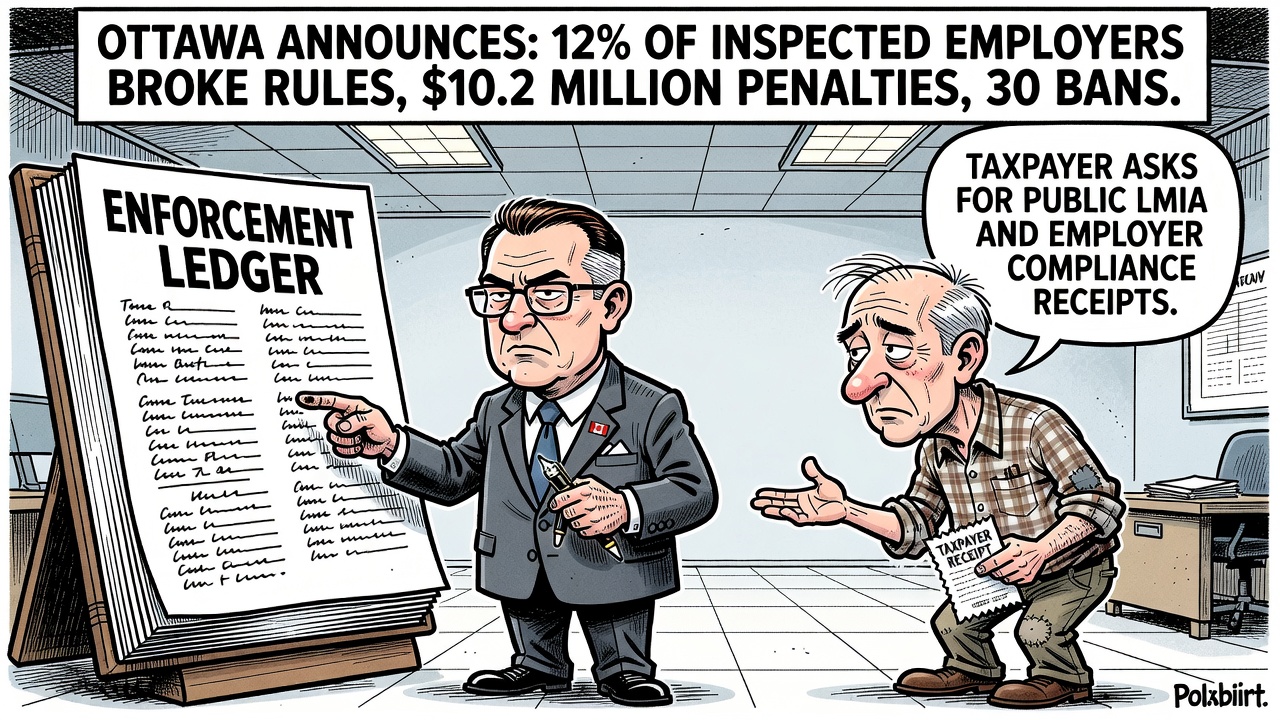
The Liberal government says the Temporary Foreign Worker Program is a last resort. Its own enforcement release now shows why Canadians should not be asked to take that on faith.
Employment and Social Development Canada announced July 9 that the TFW Program finalized 1,488 compliance inspections from April 1, 2025, to March 31, 2026, focused on areas with higher risk of non-compliance. Of the employers inspected, 12 percent were found non-compliant. Ottawa issued more than $10.2 million in monetary penalties, more than double the previous year’s $4.5 million, and banned 30 employers from the program.
Those are not anti-immigrant talking points. They are federal enforcement numbers. They matter because the program is sold to the public on a strict promise: Canadians and permanent residents are supposed to be first in line, and employers must prove they tried to recruit and train workers here before turning to temporary foreign labour.
The department’s examples are serious. A Manitoba long-haul trucking employer was fined $240,000 and banned for five years for failures tied to working conditions, labour-law compliance and documents for inspectors. A Quebec consulting-sector employer was fined $122,000 and banned for five years for failures that included inaccurate LMIA information and abuse-free workplace obligations. A Nova Scotia restaurant employer was fined $126,000 and banned for two years over wages, working conditions, labour-law compliance and abuse protections.
Ottawa has also tightened low-wage rules: eight consecutive weeks of advertising before an LMIA application, new youth-recruitment requirements, more Job Bank coordination, enhanced high-risk sector reviews, and analytics to flag possible program misuse. Those changes may be useful. But rules without visible results become another trust-us file.
The conservative accountability standard is straightforward. A labour-shortage program should not become a wage-suppression shortcut, a youth-jobs bypass, or a way for bad employers to rotate through temporary workers while hiding inside aggregate statistics. If an employer broke wage, housing, working-condition or abuse-prevention rules, Canadians should be able to see the record before that employer, its related companies or its sector receive more low-wage approvals.
That does not require vilifying temporary foreign workers. They are often the people most exposed when the system fails. The point is to protect them, protect Canadian job seekers, and force Ottawa to prove the program is being used only where it is genuinely needed.
Prime Minister Mark Carney’s government keeps promising competence, control and a stronger domestic labour market. Fine. Then release the receipts. A 12 percent non-compliance rate among inspected employers is not a rounding error. It is a warning light. Publish the employer-by-employer ledger before approving the next wave of low-wage labour requests.
- Employment and Social Development Canada: July 9, 2026 TFW compliance penalties news release
- Employment and Social Development Canada: Employer compliance obligations, inspections and consequences
- Immigration, Refugees and Citizenship Canada: Employers who have been found non-compliant
This article relies on official federal sources for inspection totals, penalty figures, employer obligations and compliance consequences. It criticizes program administration and transparency, not temporary foreign workers.