Ottawa’s Ghana Motorbike Aid Needs a Fuel-and-Parts Ledger
A nine-figure foreign-aid project that buys vehicles needs more than procurement counts. It needs proof those vehicles can be fueled, repaired, tracked and tied to results.
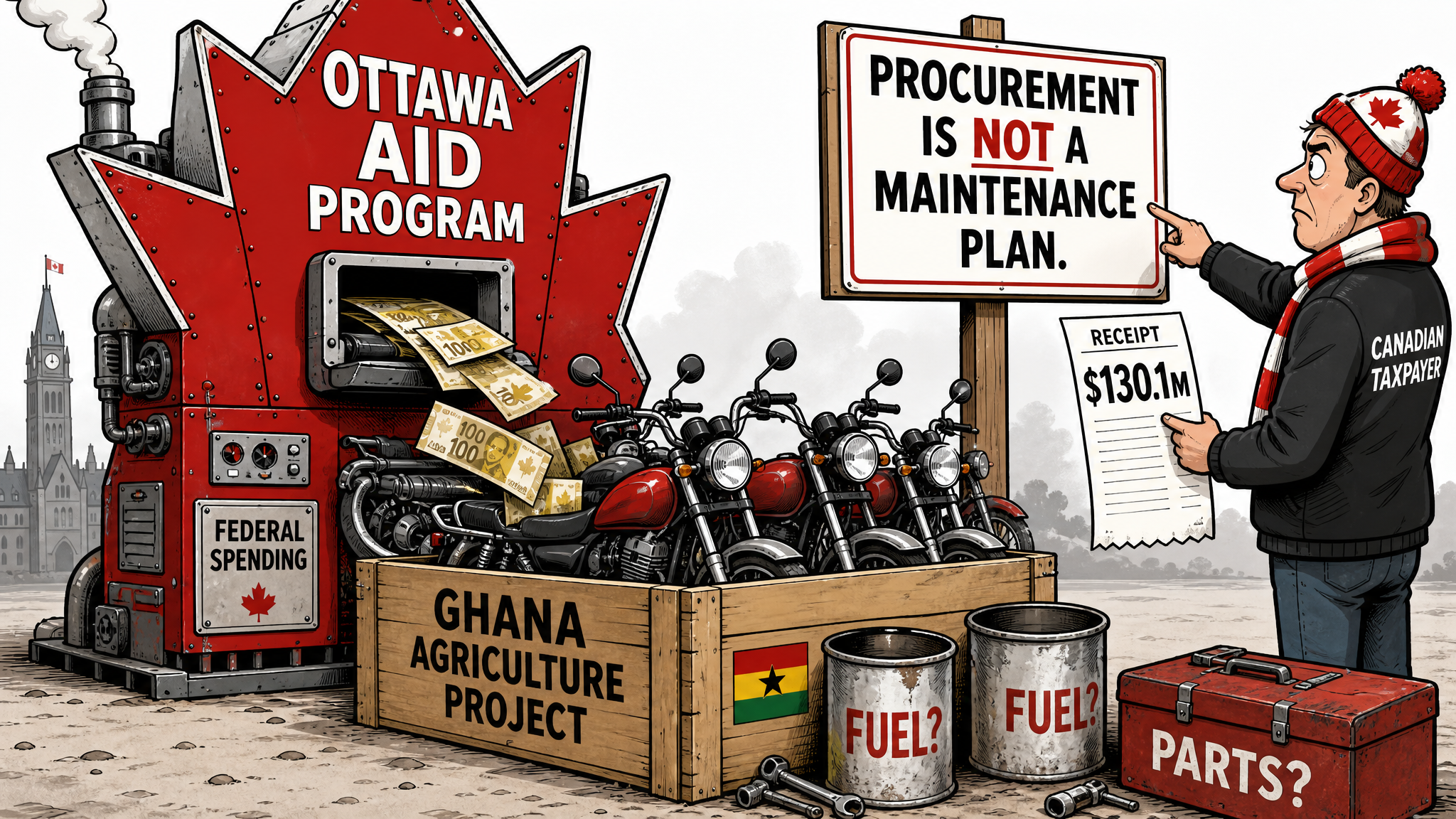
Foreign aid should be judged by results, not by ribbon-cutting procurement lists. That is why Global Affairs Canada’s Modernizing Agriculture in Ghana project deserves a plain public ledger now.
Blacklock’s reported July 28 that Foreign Affairs Minister Anita Anand’s department billed taxpayers millions for free motorbikes in Ghana, while a consultants’ report released through Access to Information found “several areas of relative weakness” in the program and recorded that funding was unavailable for motorbike fuel. That is not a small paperwork problem. If Ottawa funds vehicles abroad without a durable plan for fuel and replacement parts, taxpayers are entitled to ask whether the equipment can keep delivering after the announcement fades.
The official Global Affairs project browser lists Modernizing Agriculture in Ghana as an operational project with a maximum contribution of $130.1 million, running from February 1, 2017 to March 31, 2027. It says the project provides direct funding to Ghana’s government to improve food security and modernize agriculture, including extension services, training, equipment and logistical support at national, regional and district levels.
Ghana’s own Ministry of Food and Agriculture describes the program as CAD $135 million in Government of Canada support. It says the program procured 266 double-cabin pickup vehicles, 16 station wagons, 3,196 motorbikes, 2,305 field uniforms and 2,107 Wellington boots. It also reports that farmer visits by agricultural extension officers rose from 2.8 million in 2017 to 3.7 million in 2020.
Those official numbers may show activity. They do not answer the management question raised by the latest report: did Canada pay for equipment without locking down the operating support needed to keep it useful? A motorbike that cannot be fueled, repaired or tracked is not modernization. It is a procurement photo with a taxpayer receipt attached.
Conservatives should be clear about the standard. Helping farmers improve productivity can be a legitimate development goal. Agricultural extension services, nutrition gains and food-security projects can matter. But a nine-figure foreign-aid program cannot be defended with glossy output counts while basic implementation weaknesses are buried in access-to-information releases.
Ottawa should release the full consultants’ review, the management response and the asset-by-asset follow-up. How many of the 3,196 motorbikes are still operational? Who pays for fuel? Who pays for parts? What happens when vehicles break down? What results can Global Affairs tie to the equipment, not just to the spending?
If the Liberal government wants Canadians to trust large foreign-aid budgets while families here face high taxes, debt and housing costs, it can start with receipts. Publish the Ghana motorbike ledger. Show the maintenance plan. Prove the money bought durable results, not just another fleet of taxpayer-funded equipment with no gas in the tank.
- Blacklock’s Reporter: Ghana motorbike aid archive item — July 28, 2026
- Global Affairs Canada Project Browser: Modernizing Agriculture in Ghana project profile
- Government of Ghana, Ministry of Food and Agriculture: Modernising Agriculture in Ghana Programme
This article relies on official project pages for project size, dates and procurement counts, and on Blacklock’s Reporter for the July 28 Access-to-Information accountability trigger. It does not allege misuse by individual Ghanaian officials or Canadian public servants.