Gaza Study-Permit Refusals Need an IRCC Black-Box Ledger
Compassion cannot mean a temporary-immigration black box. If Ottawa is refusing, screening and supporting applicants under special Gaza measures, publish the ledger.
The Gaza study-permit file has moved from a delay story to a refusal-and-screening story. That makes Ottawa’s usual “trust the process” answer even less acceptable.
Juno News, citing Blacklock’s Reporter and an internal Immigration, Refugees and Citizenship Canada briefing note, reported July 26 that Ottawa had refused more Gaza-related study-permit applications than it had approved. The reported June 17 IRCC note said 14 applications had been refused, other cases were in final assessment including procedural fairness reviews where required, and four applicants had chosen not to proceed. If those numbers are accurate, they are not a footnote. They are the public-policy story.
Canada can be compassionate without turning temporary immigration into a black box. IRCC’s own public page says temporary measures for Palestinian passport holders and eligible family members in Canada were extended until July 31, 2026. Those measures can include fee-exempt study permits, work permits, visitor extensions, temporary resident permits, limited health coverage, settlement services and financial assistance. That is a serious federal program touching border screening, universities, social services and taxpayer support.
Security screening is also serious. IRCC’s security-screening briefing says biometrics are a key identity tool, that temporary resident applicants may be asked for police or criminal checks in certain cases, and that study or work permit files can be referred to the Canada Border Services Agency and CSIS for comprehensive security screening if admissibility concerns arise. It also says there is no set timeline for comprehensive screening because case complexity varies.
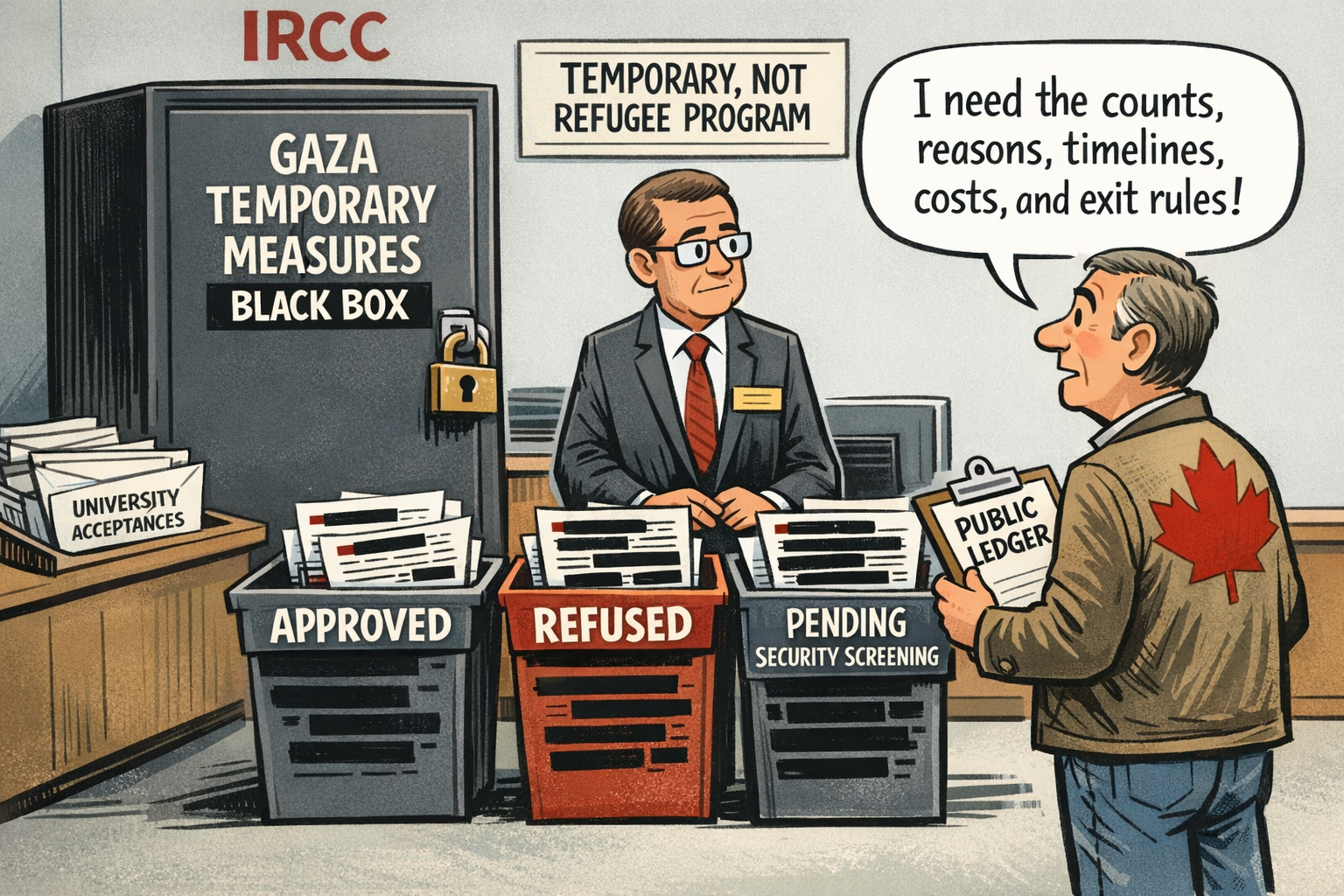
The answer is not automatic approval. It is not automatic refusal either. The answer is a public ledger. Parliament should require IRCC to publish the application counts, decision counts, refusal categories, screening-stage totals, average and longest timelines, procedural fairness counts, taxpayer supports used, and the written rules for temporary status once conditions in Gaza change.
That last point matters. Juno/Blacklock’s reported the briefing note described the pathway as temporary, not a refugee program, and said Palestinians are expected to leave Canada once conditions permit. If Ottawa is telling Canadians this is temporary, it should publish the end-date rules, extension criteria, removal or departure process, and any pathway that could convert temporary status into permanent residence. Canadians should not have to reverse-engineer immigration policy from leaked notes.
The Auditor General has already warned that international-student reforms controlled growth but fell short on integrity, including fraud and compliance follow-up. That broader context makes transparency more urgent, not less. When a special pathway, security screening, study permits and taxpayer supports overlap, secrecy protects nobody — not applicants, not universities, not Canadians, and not legitimate security work.
Compassion cannot mean a black box. If the Carney government believes this program is humane, temporary and secure, it should prove it with receipts: approvals, refusals, reasons, timelines, costs, screening safeguards and exit rules. Publish the Gaza temporary-measures ledger.
- Juno News: Why are Gazan students being denied study permits?
- Blacklock’s Reporter archive: July 2026 archive
- IRCC: Temporary measures for people affected by the crisis in Israel, the West Bank and Gaza
- IRCC: Security screening briefing
- Auditor General of Canada: International Student Program reforms controlled growth, fell short on improving integrity
This article supports rigorous security screening and argues for public counts, refusal categories, timelines, costs and temporary-status rules. It does not allege that any specific refused applicant was wrongly refused.