Carney’s $40B Off-Book Promise File Needs Receipts
New federal commitments are piling up faster than the public ledger. Canadians deserve the cost, source of funds, debt impact and return analysis before the bill arrives.
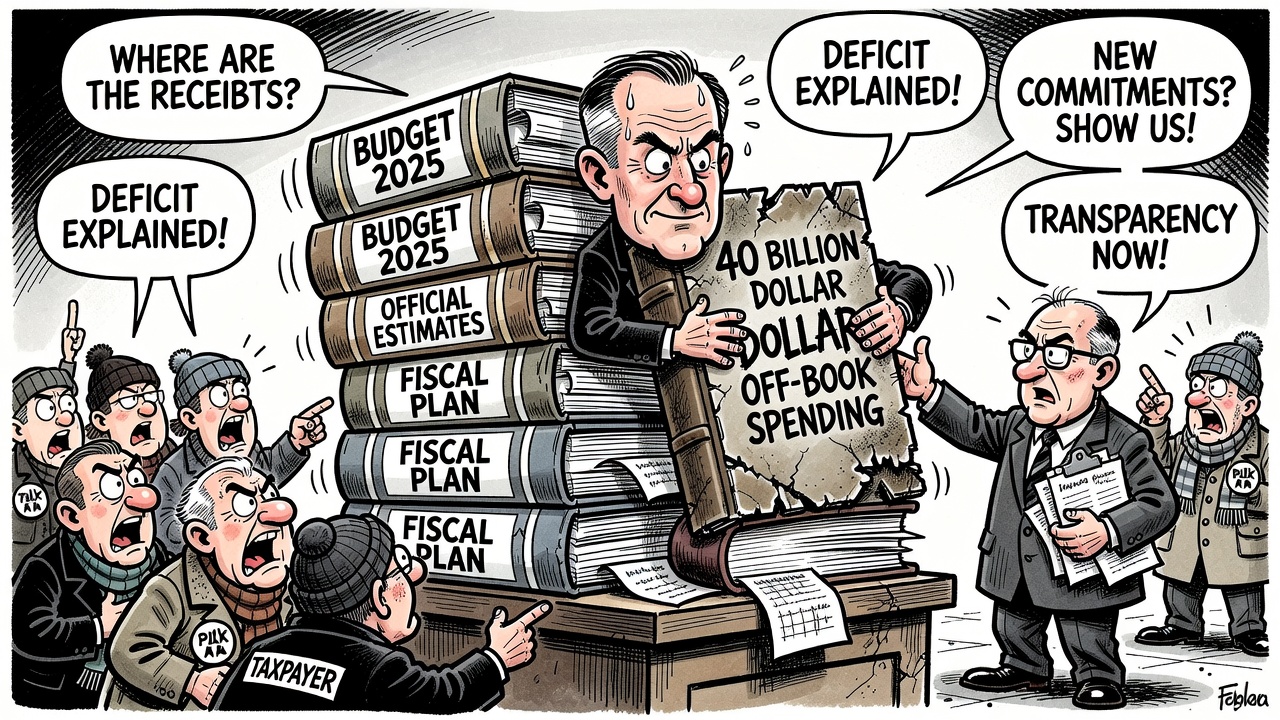
Prime Minister Mark Carney’s government has a simple problem: it keeps announcing big things while the fiscal table gets harder for Canadians to see.
National Post reported July 28 that economists are warning about a lack of transparency around federal spending and the fiscal outlook. The article cites Desjardins deputy chief economist Randall Bartlett estimating that new Carney commitments add roughly $40 billion over the next decade beyond April’s spring economic update, while also stressing that incomplete federal information makes the true accounting difficult.
The list matters because these are not tiny line items. The reported examples include a national AI strategy, a food security strategy, a West Coast pipeline project and a Canada-B.C. cooperative prosperity agreement. Some money may come from existing envelopes. Some may not. That distinction is exactly why Canadians need a public ledger instead of podium language.
The Parliamentary Budget Officer’s June outlook makes the secrecy problem more serious, not less. PBO said Budget 2025 and the Spring Economic Update together contained $68.4 billion in net new spending from 2025-26 to 2030-31. It also projected the deficit would rise to $72.0 billion in 2025-26, with deficits averaging $4.6 billion per year above the spring update from 2025-26 through 2030-31.
That is before Canadians get a clean, itemized account of the latest promises flagged by economists. If Ottawa believes these projects will generate growth, ministers should show the math: capital cost, operating cost, timing, funding source, expected private investment, expected GDP return, risk sharing, procurement plan and debt-service impact. “Growth” is not a fiscal anchor. It is a claim that needs evidence.
Conservatives should not pretend every infrastructure project is automatically wasteful. A pipeline, port, grid upgrade or AI investment can be defensible if the business case is real and the benefits exceed the borrowing cost. But a serious government proves that before it spends, not after the invoice is buried in the next update.
Carney promised competence. Competence starts with receipts. Publish the $40 billion promise file, reconcile it with the PBO baseline, and tell Canadians which costs are real, which are reannounced, and which are being pushed onto future taxpayers.
- National Post: Economists sound the alarm about “very concerning” lack of transparency on federal finances — July 28, 2026
- Parliamentary Budget Officer: Economic and Fiscal Outlook — June 2026
- Parliamentary Budget Officer: Updated outlook projects weaker growth and higher deficits — June 4, 2026
This article does not claim every cited commitment is unfunded. It argues that Ottawa should publish a commitment-by-commitment reconciliation so Canadians can distinguish already-budgeted spending from new borrowing or shifted costs.