CBC’s Disinformation Funding Needs a Public Firewall
If Ottawa funds a public broadcaster to “combat disinformation,” Canadians deserve the definitions, safeguards and receipts before the label becomes a political weapon.
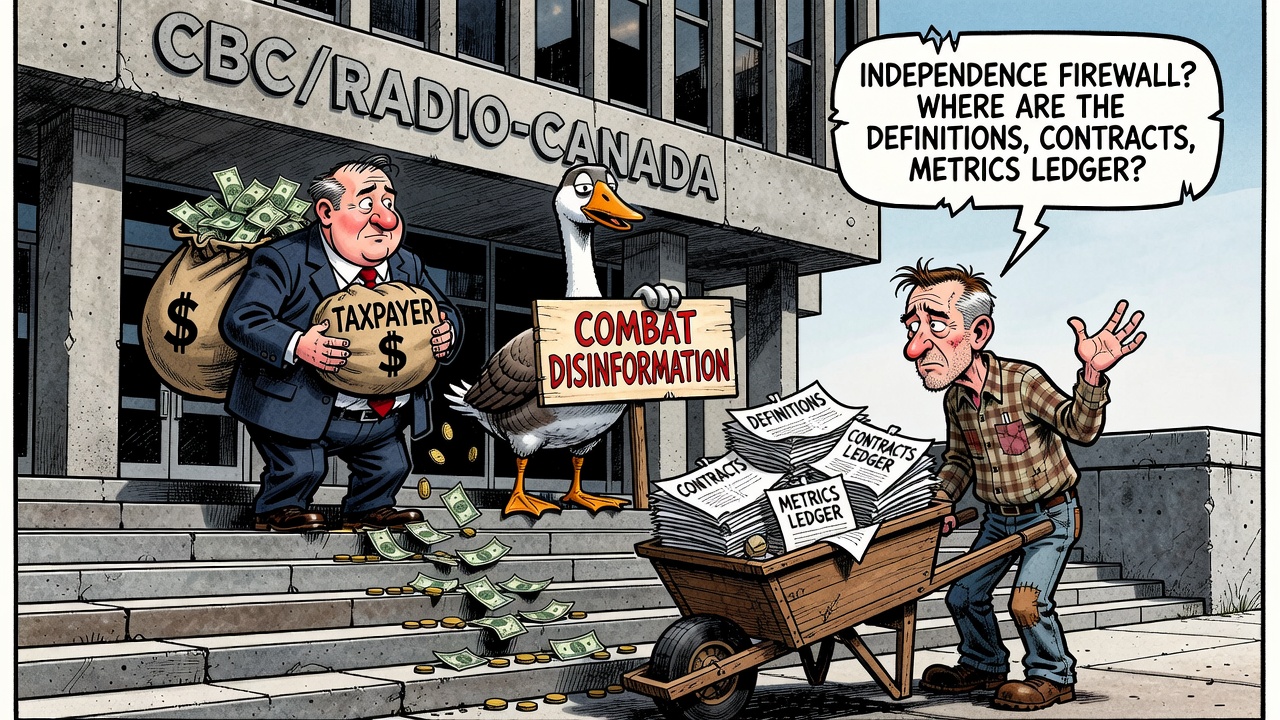
Ottawa’s latest CBC/Radio-Canada language should make every taxpayer ask a basic accountability question: who gets to define “disinformation” when the broadcaster is funded by the same government it must scrutinize?
A Government of Canada Question Period note says new support for CBC/Radio-Canada is meant to keep the corporation “independent, accountable, and financially stable,” while enabling it to strengthen local news, create Canadian programming and “combat disinformation.” The same note says the Liberal platform proposed an initial $150 million funding increase, statutory funding, mandate changes and digital tools so CBC/Radio-Canada could deliver news when and how Canadians want it.
Canadian Heritage’s public committee material for the 2026 main estimates likewise says Budget 2025 provided an additional $150 million in 2025-26 for CBC/Radio-Canada. It also says the government is exploring mandate modernization around independence, accountability, local news, emergency communications, Indigenous perspectives and combating misinformation. Western Standard reported July 22 that Ottawa says roughly $1.6 billion in CBC funding will help combat disinformation, citing Heritage briefing material. Blacklock’s July archive also flagged the same issue, reporting that CBC would use record funding this year to combat disinformation while details remained unclear.
Here is the conservative accountability concern: public broadcasting is one thing; publicly funded truth arbitration is another. A Crown corporation can do journalism, correct errors, investigate foreign propaganda and report honestly on scams. It should. But if government money is tied to a vague anti-disinformation mandate, the public needs to know where journalism ends and state-approved narrative management begins.
The answer is not to defund every local reporter or pretend foreign influence is imaginary. The answer is a firewall. Parliament should require CBC/Radio-Canada and Canadian Heritage to publish a plain-language ledger before any new anti-disinformation work expands: the exact mandate language; the internal definitions of misinformation, disinformation and malinformation; all funded positions, contracts, software tools and third-party partners; any takedown, referral or platform-notification policies; the editorial independence safeguards; and annual performance metrics that do not reward political viewpoint policing.
The ledger should also say who cannot be involved. Ministers, political staff, partisan consultants and government communications shops should have no role in selecting targets, rating news claims, flagging accounts or shaping editorial decisions. If Ottawa wants to protect CBC independence, it should prove that independence in writing.
Liberals often describe CBC as a national institution. Fine. Then treat it like one: with transparent funding, clear limits and public audit trails. Taxpayers should not be asked to fund a “combat disinformation” mandate on trust. Trust is earned by receipts.
- Government of Canada Question Period Notes: CBC/Radio-Canada priorities and proposed support
- Canadian Heritage: Standing committee appearance, Main Estimates 2026 — other items
- Western Standard: Ottawa says $1.6B CBC funding will help combat disinformation
- Blacklock’s Reporter archive: July 2026 archive
This article argues for transparency safeguards around any taxpayer-funded anti-disinformation mandate. It does not allege CBC/Radio-Canada has implemented a specific censorship program.