Carney’s Gift Registry Timeline Needs a Public Receipt
An official ethics registry entry lists June 12 gifts and a July 16 disclosure. Canadians deserve the acceptance-date and compliance receipt.
Ethics rules are not supposed to be a scavenger hunt. They exist so Canadians can see, quickly and plainly, what gifts public office holders and their families accepted, who provided them, and whether the disclosure clock was respected.
That is why one new official registry entry deserves a simple public receipt.
The Office of the Conflict of Interest and Ethics Commissioner lists a public declaration of gifts or other advantages for Prime Minister Mark Carney under the Conflict of Interest Act. The entry says the declared items were a hockey jersey, an Antarès Herbelin watch, and a copy of The Earth from the Air, received by Ms. Fox Carney. The source is listed as French President Emmanuel Macron and Brigitte Macron, and the circumstance is listed as a bilateral meeting in Paris.
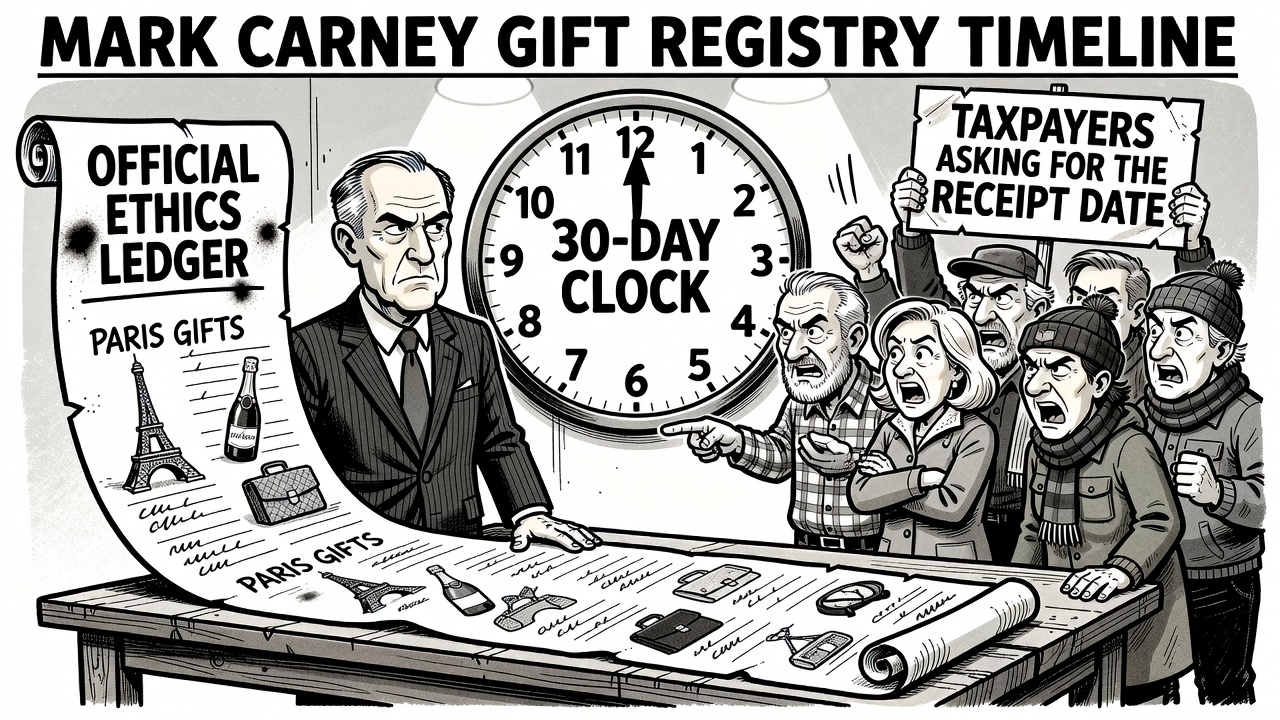
The dates are the accountability issue. The registry lists the gift received date as June 12, 2026. It lists the disclosure date as July 16, 2026. The same registry page quotes the Act’s rule that when a reporting public office holder or a family member accepts a single gift or advantage worth $200 or more, other than one from a relative or friend, the public office holder shall make a public declaration within 30 days after accepting it.
June 12 to July 16 is 34 calendar days after the gift-received date. That does not, by itself, prove a breach. There may be an administrative explanation: perhaps the relevant legal “acceptance” date differs from the received date; perhaps valuation, custody, return or retention questions affected the filing; perhaps the Commissioner’s office considered the declaration on time for reasons not visible on the public page.
Fine. Then publish the receipt.
A conservative accountability standard should be careful here. Do not allege corruption from a hockey jersey, a watch and a book. Do not pretend diplomatic gifts are automatically improper. State visits and bilateral meetings routinely include protocol gifts, and the law’s purpose is not to ban normal diplomacy. The point is that a prime minister who asks Canadians to trust his judgment must meet the cleanest possible disclosure standard — especially when the public registry itself creates a date question.
The Prime Minister’s Office should answer four narrow questions. What was the precise acceptance date for the gifts? What valuation was used to determine public-declaration requirements? Were the watch, jersey and book retained, returned, forfeited, displayed or otherwise disposed of under government rules? Did the Commissioner’s office consider the July 16 disclosure compliant with the Act’s 30-day requirement?
Those answers would not expose state secrets. They would not embarrass France. They would simply show Canadians whether the ethics system is being treated as a live rulebook or a paperwork formality.
After years of Liberal ethics controversies, the standard should be boringly strict: disclose early, explain clearly, and leave no daylight between the registry date and the statutory clock. If there is a harmless explanation, publish it. If there was a late filing, say so and accept the consequence. Either way, Canadians deserve the receipt.
- Office of the Conflict of Interest and Ethics Commissioner: Public Declaration of Gifts or Other Advantages — Mark Carney
- Department of Justice Canada: Conflict of Interest Act, section 25
This article does not allege a finding by the Commissioner. It asks for the public explanation needed to reconcile the registry’s gift-received and disclosure dates with the statutory 30-day declaration rule.