Bill C-34’s Child-Safety Pitch Needs a Regulator-Power Ledger
Protect children online, yes. But Ottawa should not sell a national internet regulator on trust-me politics.
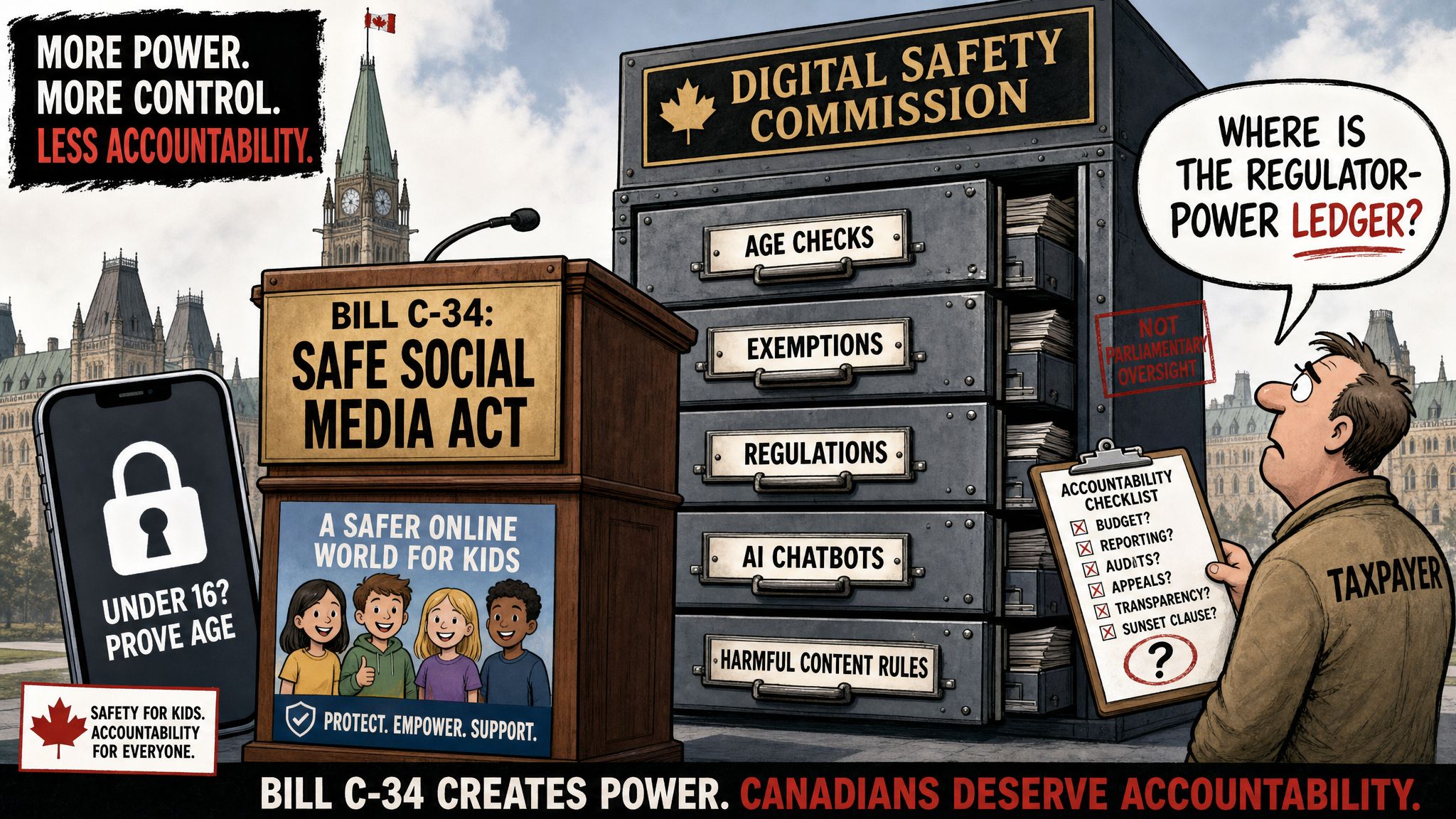
Ottawa is taking Bill C-34 back on the road. Canadian Heritage has scheduled a Vancouver roundtable on the new Safe Social Media Act for Monday, July 27, 2026. That timing matters because the government is not merely defending a slogan. It is asking Canadians to accept a new federal internet architecture.
The bill received first reading on June 10. Its text would enact the Digital Safety Act, create the Digital Safety Commission of Canada, and regulate social media services, chatbot services and other online services. The stated goals include reducing online harms, protecting children, requiring digital safety plans, and making certain material inaccessible in Canada.
No serious person should dismiss child safety. Parents have legitimate concerns about predators, self-harm content, coercive bullying, addictive design and explicit material. But a legitimate problem does not erase the need for limits on state power. The conservative accountability test is simple: before Ottawa builds a regulator, publish the regulator-power ledger.
That ledger should show, clause by clause, what Parliament is defining in the statute and what cabinet or the commission will decide later. Bill C-34’s own structure points to future regulations for categories of online services, design features, age measures, harmful-content measures, synthetic-content measures, emergency chatbot measures, cost recovery and more. That is not a footnote. That is where the real operating system of the law will be written.
The under-16 account rule is the clearest example. Global News reported that exemptions would be handled by a future Digital Safety Commission and based on safeguards still to be set by the Privy Council. Experts quoted by Global also flagged the enforcement and privacy problem: if age-verification or age-estimation tools are used, Canadians need to know what data is collected, how it is destroyed, and who audits compliance.
The Canadian Civil Liberties Association is warning about the same accountability gap from a rights perspective. CCLA says the bill raises freedom-of-expression and privacy concerns because it grants broad powers to government and a new digital safety regulator, could encourage platforms to over-comply, and could require users to prove their age absent exemptions.
That is the danger of compassionate packaging. Ottawa says “child safety,” then the fine print produces a commission, exemption system, inspection powers, compliance orders, penalties, chatbot rules, data access questions and age-check infrastructure. Some pieces may be defensible. But Canadians should not have to discover the guardrails after the machinery is built.
Before MPs advance Bill C-34, the government should publish a public table answering five questions: which services are covered; what personal data age checks collect; how deletion is verified; who grants exemptions and on what evidence; and how lawful speech is protected from over-removal. If the Liberals want Canadians to trust this bill, they can start by showing the receipt.
- Parliament of Canada: Bill C-34, Safe Social Media Act, first reading
- Canadian Heritage: Roundtable on the new Safe Social Media Act
- Global News: Canada’s social media ban for kids may narrow
- Canadian Civil Liberties Association: CCLA warning on Bill C-34
- Rebel News: Government briefing-note report on Safe Social Media Act messaging
This article supports child-protection goals while evaluating the privacy, delegation and implementation risks in Bill C-34.