Ottawa Has the Homelessness Count. Now Show the Results.
Federal data counted nearly 60,000 people experiencing homelessness in 74 communities, including 17,088 in unsheltered locations. Publish the city-by-city spending, placement and encampment outcome ledger.
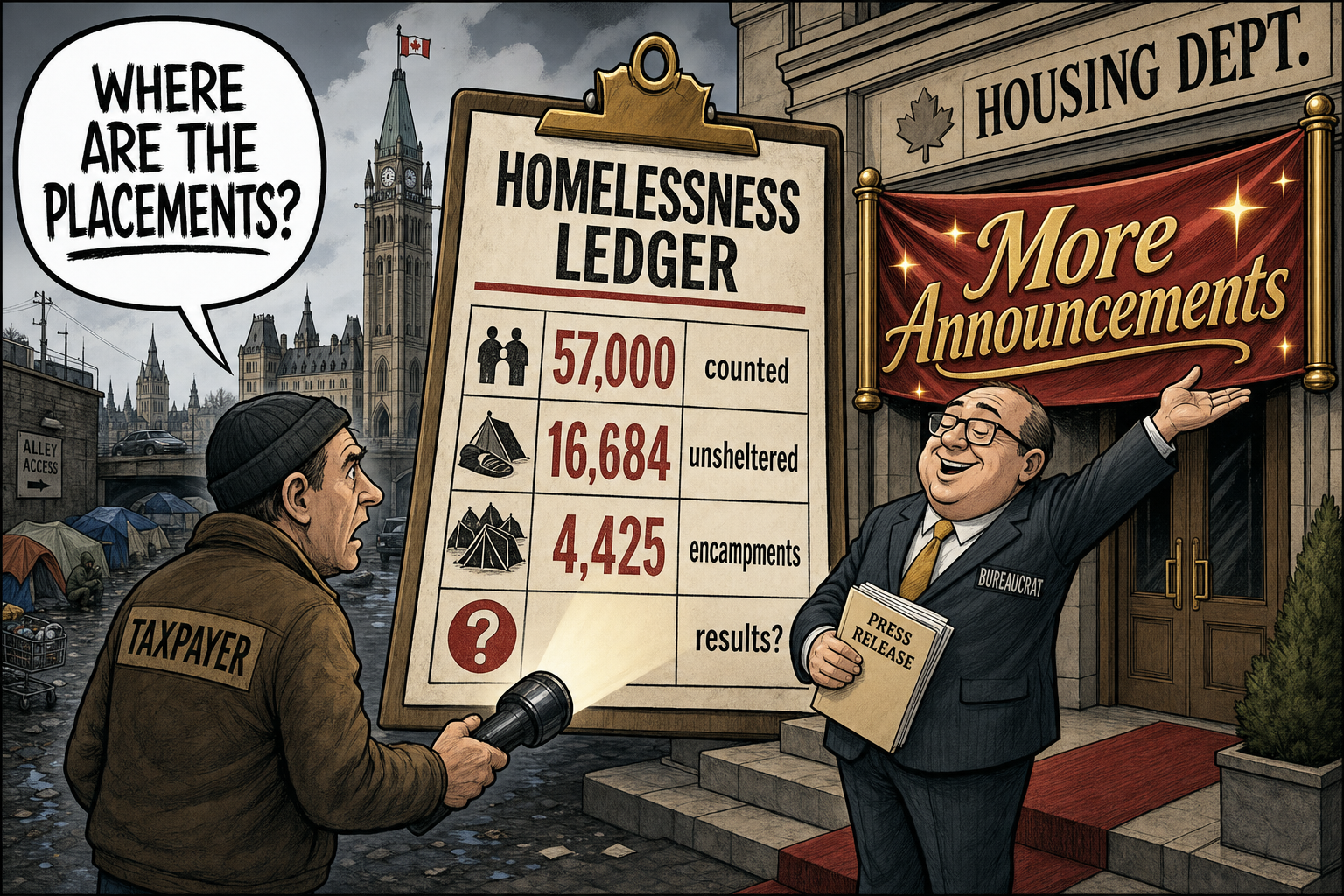
Ottawa does not lack a homelessness count. It lacks a public results ledger.
Blacklock’s Reporter’s public July archive says nearly 13,000 people were reported sleeping in cars, alleys or abandoned buildings nationwide, with another 4,700 in tent cities, citing new data from Housing Minister Gregor Robertson’s department. The official federal report is just as damning: Housing, Infrastructure and Communities Canada’s Everyone Counts 2024 highlights report says nearly 60,000 people were identified as experiencing homelessness on a single night in 74 communities.
The breakdown should end the press-release comfort. HICC counted 35,864 people in shelters, 17,088 in unsheltered locations, including 4,982 in encampments, and 6,872 in transitional housing. The same report says Quebec communities did not participate in the 2024 count; if the 2022 Quebec counts remained stable, the one-night figure would exceed 67,000 people in 87 communities. Among communities with comparable counts, unsheltered homelessness more than doubled from the previous count and quadrupled compared with 2018.
This is not a mystery file buried in someone else’s jurisdiction. Ottawa funds and manages the federal homelessness architecture. Reaching Home is described in federal directives as a community-based program meant to prevent and reduce homelessness through direct support and funding to designated, Indigenous, territorial, rural and remote communities. Those same directives require designated communities and territorial capitals to use HIFIS or an equivalent system, coordinated access and an outcomes-based approach.
On April 1, 2026, the federal government announced $125 million to extend the Unsheltered Homelessness and Encampments Initiative, saying it would support Community Encampment Response Plans with provincial, territorial and municipal partners. HICC’s 2026-27 Departmental Plan also promises to advance federal efforts to prevent and reduce homelessness, continue Reaching Home and the Veteran Homelessness Program, and work with Build Canada Homes on supportive and transitional housing.
Fine. Then show the receipts.
Canadians should be able to see, community by community, how many people were counted outside, how many were moved into stable housing, how long they stayed housed, how much federal money was spent, which organizations received it, how many encampments were closed, and whether people were actually housed or merely displaced. A national total without an outcome ledger is not accountability. It is an inventory of failure.
Conservative accountability does not mean ignoring human suffering. It means refusing to let a government turn suffering into a permanent announcement machine. If Ottawa can count people in shelters, vehicles, ravines, alleys and tents, it can publish the matching ledger of dollars, placements, timelines and results.
The question for the Liberal government is simple: after years of programs, strategies, funds and new agencies, are fewer Canadians sleeping outside, or are taxpayers just funding another layer of bureaucracy to count the crisis more professionally?
- Blacklock’s Reporter: July 2026 archive
- Housing, Infrastructure and Communities Canada: Everyone Counts 2024 — Highlights Report Part 1
- Government of Canada: $125 million UHEI extension announcement
- Housing, Infrastructure and Communities Canada: Reaching Home directives
- Housing, Infrastructure and Communities Canada: 2026–27 Departmental Plan
This article argues for disclosure of public spending and outcomes. It does not blame people experiencing homelessness and supports dignified, housing-focused responses that can be measured publicly.