Ottawa’s New French Rules Need a Compliance Ledger
Ottawa’s proposed French-language rules for federally regulated private businesses include declarations, annual statements, certificates and committee machinery. Publish the cost and compliance ledger.
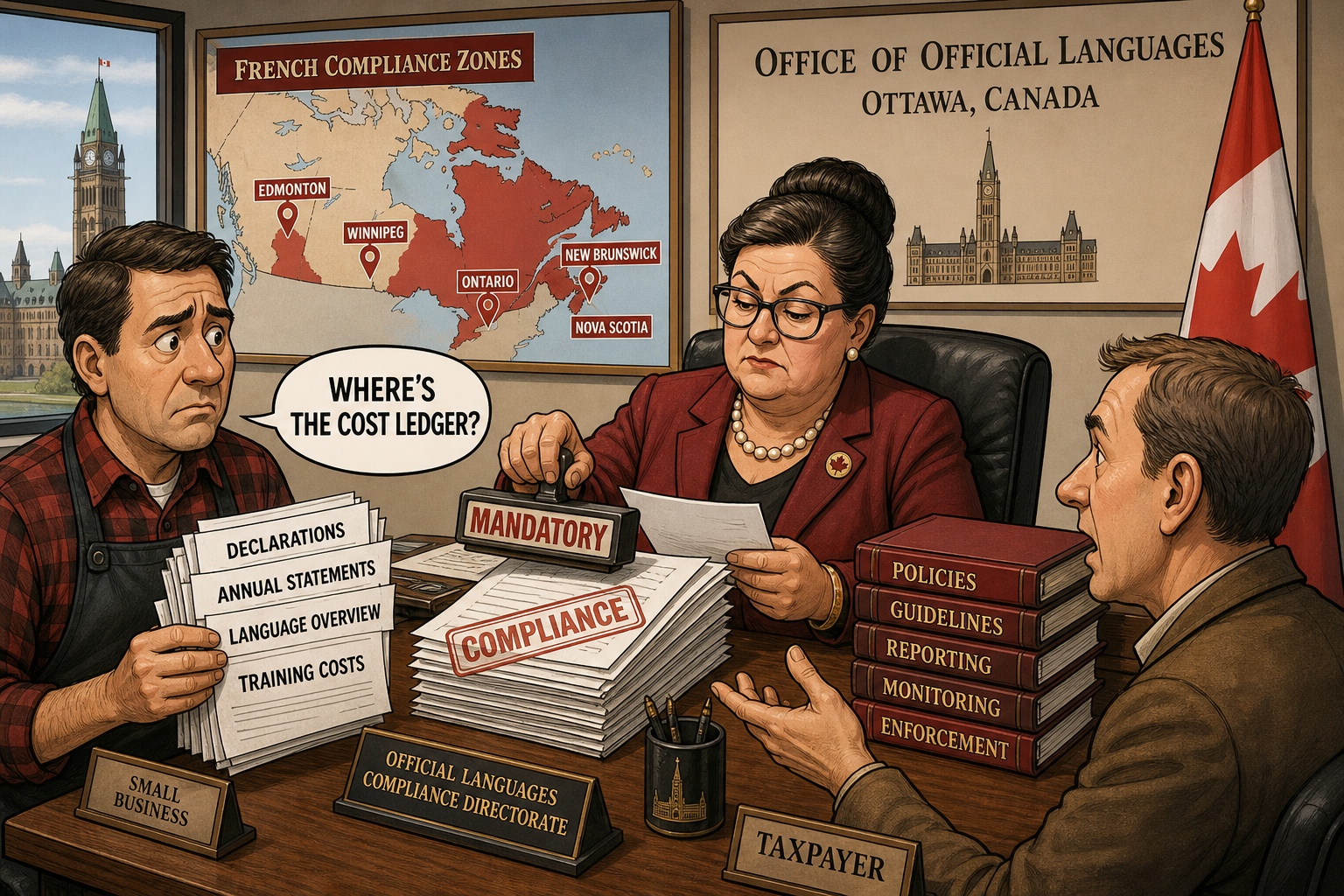
Ottawa’s newest language file is being sold as cultural protection. It is also a compliance regime, and Canadians deserve to see the bill before it lands on federally regulated private businesses.
On July 18, the Canada Gazette published proposed Use of French in Federally Regulated Private Businesses Regulations under the federal Act. The regime is aimed at federally regulated private businesses in Quebec and in “regions with a strong Francophone presence.” Canadian Heritage says implementation would begin in Quebec, then expand two years later to those designated regions.
That is not a small technical adjustment. The Gazette says the proposed rules would apply to federally regulated private businesses with at least 25 employees in Quebec, and to businesses with 100 or more employees in Canada in the designated regions. Those regions include all of New Brunswick, three census divisions in Nova Scotia, eight in Ontario, and 22 census tracts in the Winnipeg and Edmonton census metropolitan areas.
The rights at issue are real. The federal Act is designed to protect the use of French in federally regulated workplaces and consumer services. No serious accountability argument requires pretending French-speaking Canadians should lose access to service in their language.
But rights do not erase costs, paperwork or enforcement questions. The Gazette’s own regulatory statement estimates total business-and-government implementation costs over 2027 to 2036 at $243 million in present value, with costs tied to language training, translation, signage changes, committees, administrative requirements and government operations. It also estimates $48.5 million in present-value federal-entity costs over that period, including Canadian Heritage, the Office of the Commissioner of Official Languages and the Canada Industrial Relations Board.
The paperwork is not imaginary. The proposed regulations describe written declarations, certificates of registration, annual statements, lists of registered businesses, committees for the fostering of French, language-situation overviews, certificates of generalization of the use of French, annual or triennial reports, possible suspension, possible revocation and action plans.
That is a compliance stack. Maybe Ottawa can justify every layer. If so, publish the ledger.
Canadians should be able to see the affected-business list, the regional map, the estimated compliance cost by sector, the small-market service impact, the staffing assumptions, the exemption process, the complaint pathway, the enforcement budget and the expected number of businesses covered in Quebec and every designated region outside Quebec. Edmonton-area banks, telecoms, transport operators or grain-sector employers should not learn the practical burden through paperwork after the fact.
A conservative accountability test is straightforward: protect lawful language rights, but do not hide the machinery. When Ottawa expands a national regulatory regime into private workplaces and customer service, it owes the public more than slogans about values. It owes a plain accounting of who is covered, what it costs, who enforces it and how success will be measured.
If the Liberal government wants trust on official languages, it should start with transparency. Publish the compliance ledger before the mandate becomes another federal form stack dropped on businesses and workers.
- Canada Gazette: Proposed Use of French in Federally Regulated Private Businesses Regulations
- Canadian Heritage: Draft regulations announcement
- Justice Laws Website: Use of French in Federally Regulated Private Businesses Act
- Blacklock’s Reporter: July 2026 archive
- Rebel News: Alberta compliance-angle report
This article supports lawful official-language rights and argues for transparent cost, coverage and enforcement disclosure before implementation.