The June Housing Starts Receipt Is a Warning for Carney’s Homebuilding Promise
CMHC’s June housing-starts data show the national trend falling before Ottawa’s homebuilding machinery has proved it can scale. Publish the monthly receipts.
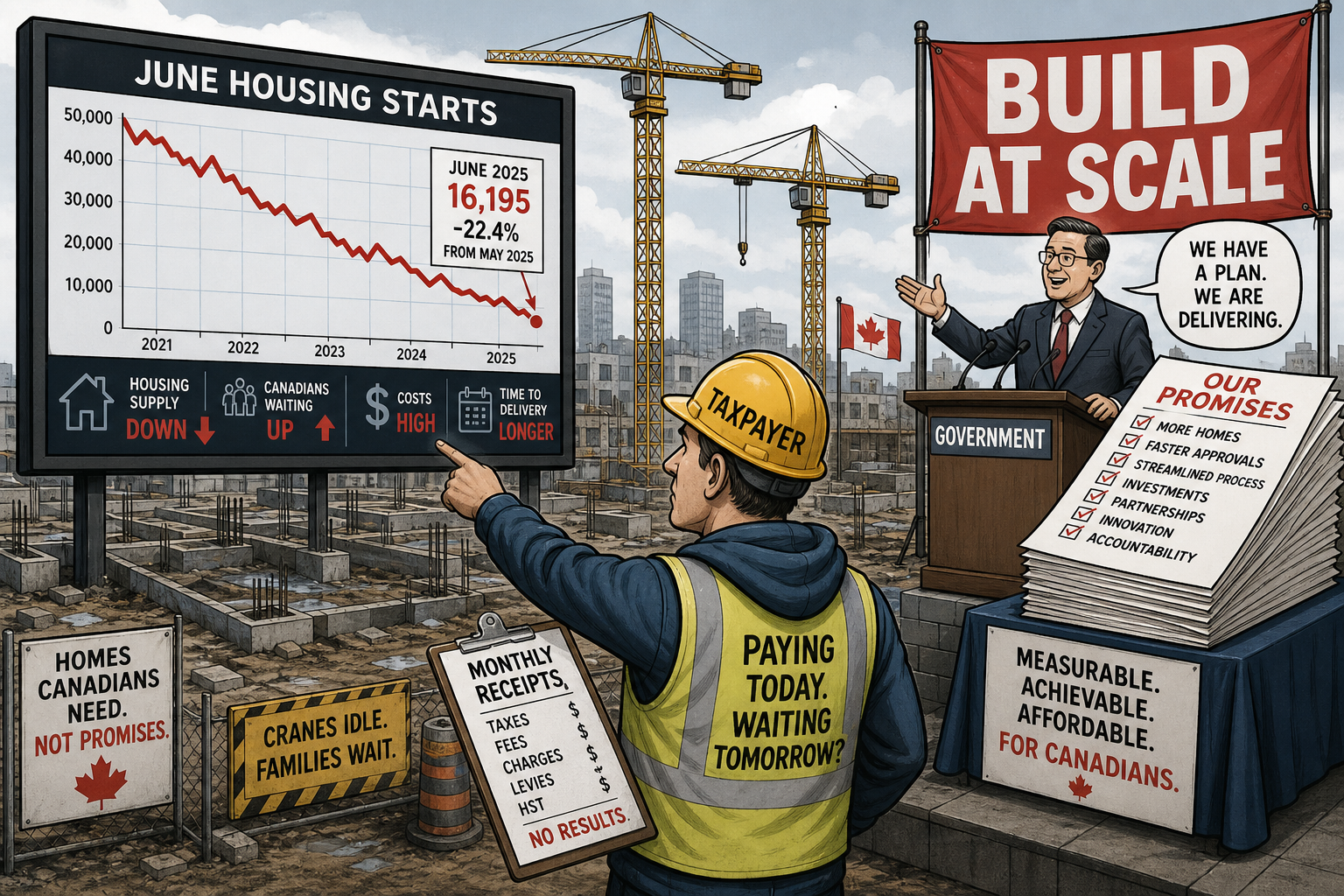
The housing file does not need another victory lap. It needs a dashboard. CMHC’s June release is the latest receipt: the six-month trend in national housing starts fell 2.8 percent to 248,123 units, and the seasonally adjusted annual rate dropped to 238,971 units in June from 253,083 in May. That is not collapse. It is worse for Ottawa’s argument: it is a warning light blinking while the government is still selling scale.
CMHC did not blame a mysterious partisan force. The Crown corporation pointed to rising uncertainty, higher development costs, weaker demand and more unsold homes, and warned that those conditions are expected to hold back construction in the short-to-medium term. Deputy Chief Economist Kevin Hughes said actual 2026 housing starts are now expected to come in below last year’s levels. For a government promising to turn housing supply into a signature achievement, that sentence should land like an audit finding.
Prime Minister Mark Carney’s government launched Build Canada Homes last September with a promise to create a new federal housing agency, use public lands, support factory-built homes and build affordable housing at scale. In February, Ottawa said the initiative was backed by an initial $13 billion over five years and that legislation would establish Build Canada Homes as a new Crown corporation. Fine. But an agency announcement is not a home, a funding envelope is not a completion, and a press release does not change the national starts trajectory by itself.
That is the accountability gap. Liberals inherited and then deepened a housing crisis in which young Canadians were told to wait for supply. Now the Carney government wants credit for a new machinery of delivery before the delivery is visible in the monthly numbers. Conservatives should not let Ottawa hide behind pipeline language, pilot projects or photo-op math. If June is a temporary dip, prove it. If development costs and unsold inventory are choking starts, show which federal measures are reducing the choke points and by how much.
The minimum public ledger is obvious: monthly starts and completions tied to Build Canada Homes; units by province, tenure and affordability level; federal land projects with permits, financing and occupancy dates; factory-built-home contracts and delivered units; average cost per subsidized unit; and a reconciliation between CMHC’s national starts data and every ministerial claim about progress. Canadians should also see whether federal interventions are adding net new supply or simply rebadging projects that were already in the system.
The June receipt is not an argument to give up on building. It is an argument to stop confusing announcements with construction. Ottawa promised scale. CMHC’s latest dashboard shows the trend line sliding before that promise has proved itself. Publish the starts, completions, costs and affordability receipts every month, or admit the housing plan is still a slogan looking for a foundation.
- Canada Mortgage and Housing Corporation: Housing starts, June 2026
- Government of Canada: Build Canada Homes funding and Crown corporation statement
- CityNews / The Canadian Press: CMHC reports annual rate of housing starts in June down six per cent from May
- Blacklock’s Reporter: House Starts Falling: CMHC
This article uses CMHC’s June 2026 housing-starts release as the primary data source and asks for a monthly public ledger connecting federal housing promises to measurable delivery.