Carney’s Gordie Howe Toll Story Needs the Signed Receipts
Canada financed the bridge. Ottawa now says toll sharing comes only after debt repayment. Then publish the contract and prove it.
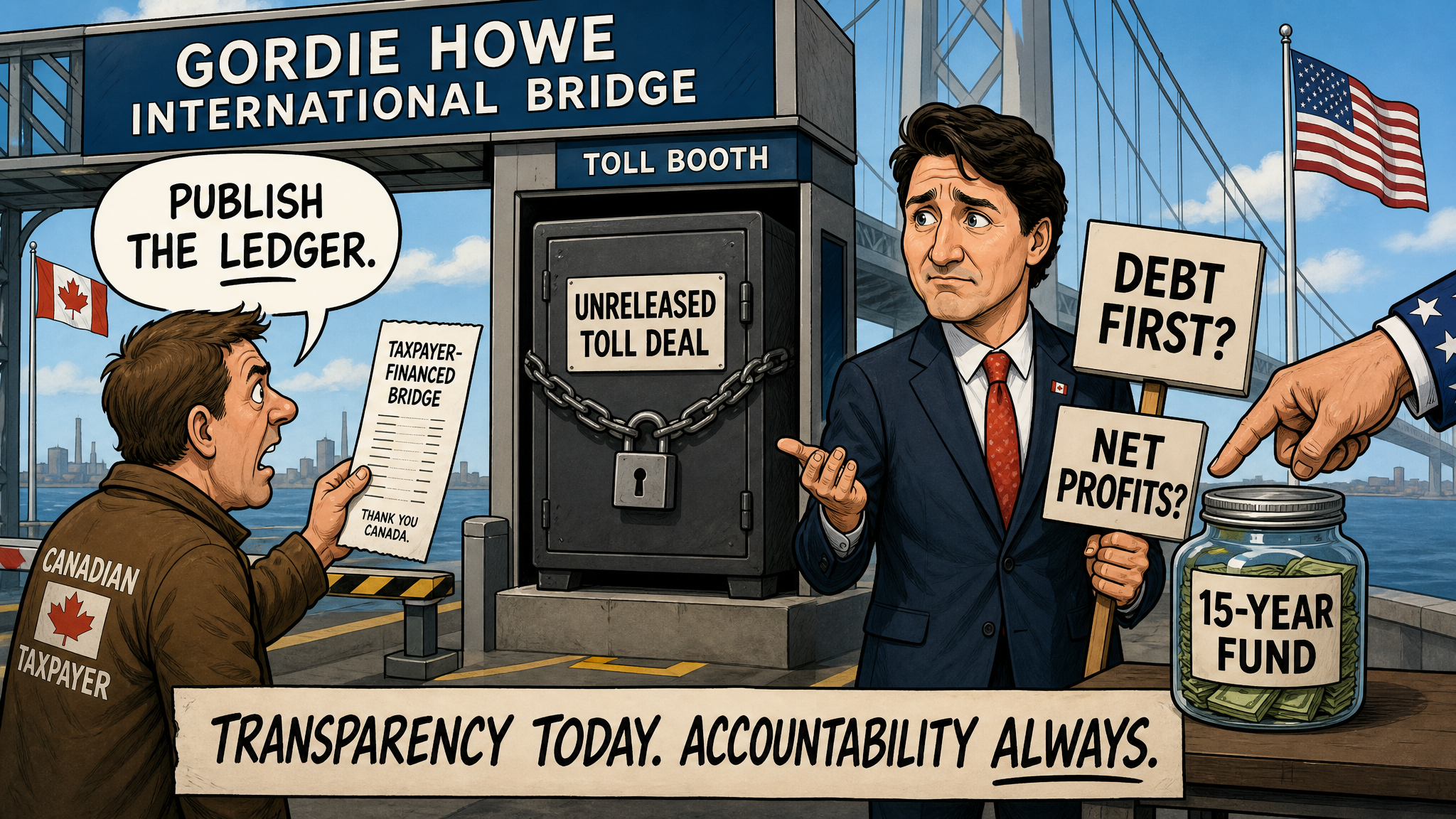
The Gordie Howe International Bridge should be a win for trade. A new six-lane crossing between Windsor and Detroit can ease pressure on one of North America’s most important commercial corridors. But a useful bridge does not excuse a hidden toll deal.
On July 10, the official bridge announcement said Canada and Michigan agreed to open the crossing on July 27, with U.S. government support. The same release said Canada and the United States agreed to cooperative measures on toll governance and transparency, plus a 15-year economic development fund tied to a portion of profits from bridge operations. It also said the Windsor-Detroit Bridge Authority would seek U.S. concurrence for certain non-market toll changes.
That is the sentence Ottawa needs to explain in plain English. Canadian taxpayers were told in 2012 that Canada would fund the project and recoup federal costs from toll revenues over a number of years. The Auditor General’s 2022 special examination described future toll collections as expected to cover operations, maintenance, rehabilitation and construction-related costs, including Michigan’s share, the U.S. port of entry and the I-75 interchange.
Now Prime Minister Mark Carney is insisting, according to CTV News, that Gordie Howe tolls will not be shared until all debt is repaid. If that is true, the signed agreement should be easy to publish. Show the clause. Show the definition of “debt.” Show whether interest, private-partner payments, operating costs and rehabilitation reserves are deducted before any U.S.-linked fund receives money.
The problem is that other public descriptions have not sounded so simple. Global News has reported unresolved questions about how the profit-sharing formula works. The Globe and Mail has reported that Ottawa has made no promise to release the text of the new arrangement. National Post reporting has flagged conflicting Canadian and U.S. descriptions of the financial terms. Those are not partisan quibbles; they are basic contract-governance questions on a taxpayer-financed asset.
This government wants credit for getting the bridge opened after a delay. Fine. But competence is not measured by ribbon cuttings. It is measured by whether the public can see what was traded away, what was protected and how long repayment will take.
The receipt test is straightforward: publish the full side agreement; a before-and-after comparison with the 2012 crossing framework; the net-profit formula; the debt-service schedule; projected annual toll revenue; the 15-year fund rules; the U.S. concurrence triggers for toll changes; and every ministerial briefing note assessing taxpayer risk.
Conservatives should support infrastructure that strengthens trade. They should also demand that a Canada-financed bridge not become another black box where taxpayers pay first and learn the details later. If Carney’s version is accurate, the documents will prove it. If the documents remain hidden, Canadians are entitled to ask why.
- Gordie Howe International Bridge / Housing, Infrastructure and Communities Canada: The Gordie Howe International Bridge will open on July 27 — July 10, 2026
- CTV News: PM Carney insists Gordie Howe Bridge tolls will not be shared “until all debt is repaid” — July 16, 2026
- Global News: How will Gordie Howe Bridge profit-share deal work between Canada, U.S.?
- The Globe and Mail: Ottawa makes no promise to release text of new Gordie Howe bridge deal
- Government of Canada: Detroit River International Crossing — June 15, 2012
- Auditor General of Canada: Windsor-Detroit Bridge Authority special examination — 2022
This article supports trade-enabling infrastructure where taxpayers are protected. The accountability issue is the unreleased toll arrangement, debt treatment and repayment ledger.