Carney’s $2B Armoured-Vehicle Deal Needs a Procurement Ledger
Nearly $2 billion. 190 vehicles. One strategic partner. Canadians deserve the contract math before Ottawa takes another defence victory lap.
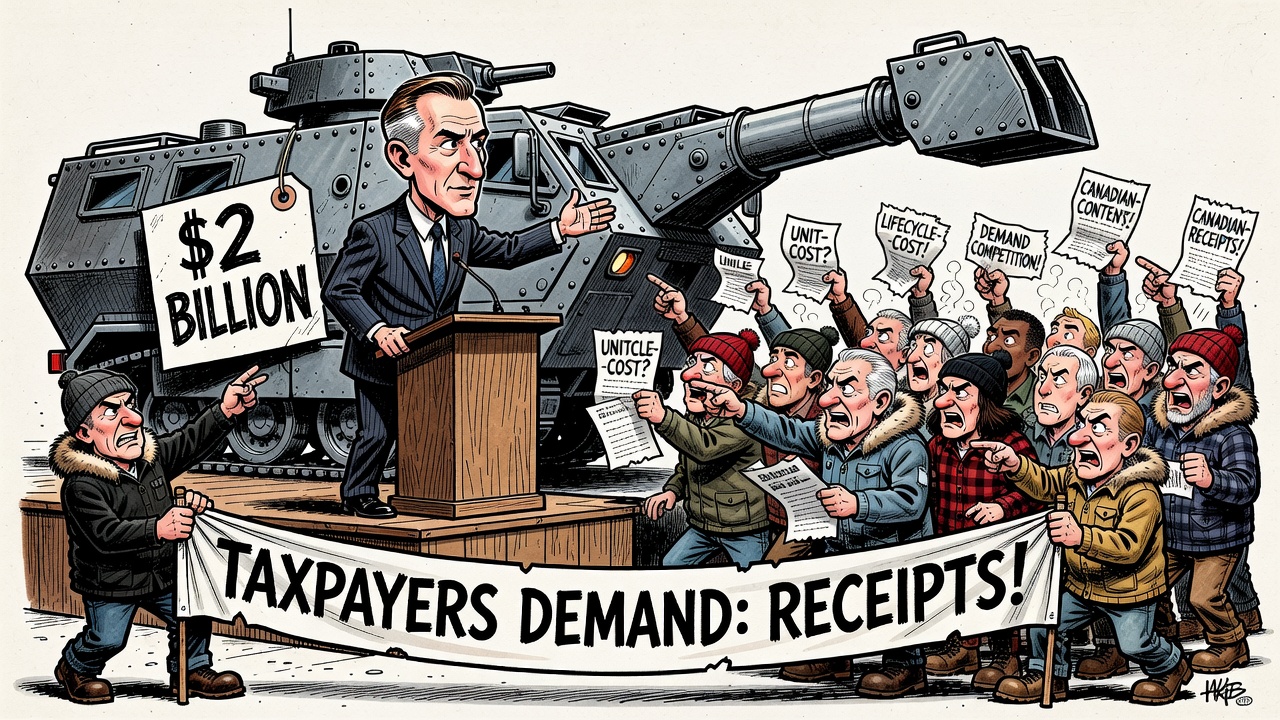
Canada’s soldiers need equipment that works. A serious country should be able to build armoured vehicles, keep its troops protected and maintain a domestic defence industry. But supporting the Canadian Armed Forces does not mean giving any government a blank cheque.
On July 16, Prime Minister Mark Carney announced what the PMO calls a new strategic partnership with General Dynamics Land Systems-Canada. Ottawa says it will invest nearly $2 billion over four years to build and deliver 190 additional Armoured Combat Support Vehicles, expanding the fleet from 360 to 550. The vehicles are to be built in London, Ontario, with Canadian materials and Canadian workers, and the government says the work will create or sustain more than 6,000 jobs a year over eight years.
Those are big promises. They also raise basic accountability questions. “Nearly $2 billion” for 190 vehicles works out to roughly $10.5 million per vehicle before Canadians even see the detailed variants, sustainment package, spare parts, training, warranties, upgrades and lifecycle costs. If the real per-vehicle cost is lower because part of the money covers long-term support, Ottawa should publish the split. If it is higher for specialized variants, publish that too.
The government is also describing GDLS-Canada as Canada’s first “Strategic Partner” under its Defence Industrial Strategy framework. In return for investment, research, hiring and supply-chain commitments, Ottawa says it will act as an “anchor customer,” accelerate approvals and open doors to export markets. That may be defensible policy. It may also become an insider lane unless the criteria, scoring and future procurement rights are public.
ISED’s Industrial and Technological Benefits records already show the earlier Armoured Combat Support Vehicle project with a $1.906 billion obligation, about $1.304 billion completed to date and about $602 million in progress. That table is useful because it proves Ottawa can publish procurement-benefit ledgers when it chooses. The new deal deserves the same treatment from day one, not years later after the ribbon-cutting photos have aged.
The receipt test is straightforward: release the contract value table; the unit-cost and lifecycle-cost assumptions; the delivery schedule; the variant mix; the competition or sole-source rationale; the Strategic Partner selection criteria; the Canadian-content calculation; the supplier list; the ITB obligations; the export-risk terms; and the penalties if vehicles are late, defective or over budget.
Conservatives should not oppose defence production just because it happens under a Liberal prime minister. But conservatives should insist that patriotism is not a procurement method. If Carney wants credit for rearming Canada, he should welcome a public ledger proving taxpayers are buying capability, not just announcements.
- Prime Minister of Canada: Prime Minister Carney announces landmark partnership with General Dynamics Land Systems-Canada — July 16, 2026
- Global News: Canada will buy 190 armoured vehicles from Ontario firm, Carney says — July 16, 2026
- Reuters / Yahoo Finance: Canada inks near C$2 billion armoured-vehicle deal — July 16, 2026
- Innovation, Science and Economic Development Canada: Breakdown of current obligations by contractor
This article supports equipping the Canadian Armed Forces. The accountability issue is whether Ottawa publishes the procurement, cost, delivery and Canadian-benefit receipts behind the new strategic partnership.