Carney’s New PMO COO Role Needs an Ethics and Authority Ledger
If the Prime Minister’s Office is importing corporate titles into the centre of government, Canadians deserve more than anonymous reassurance.
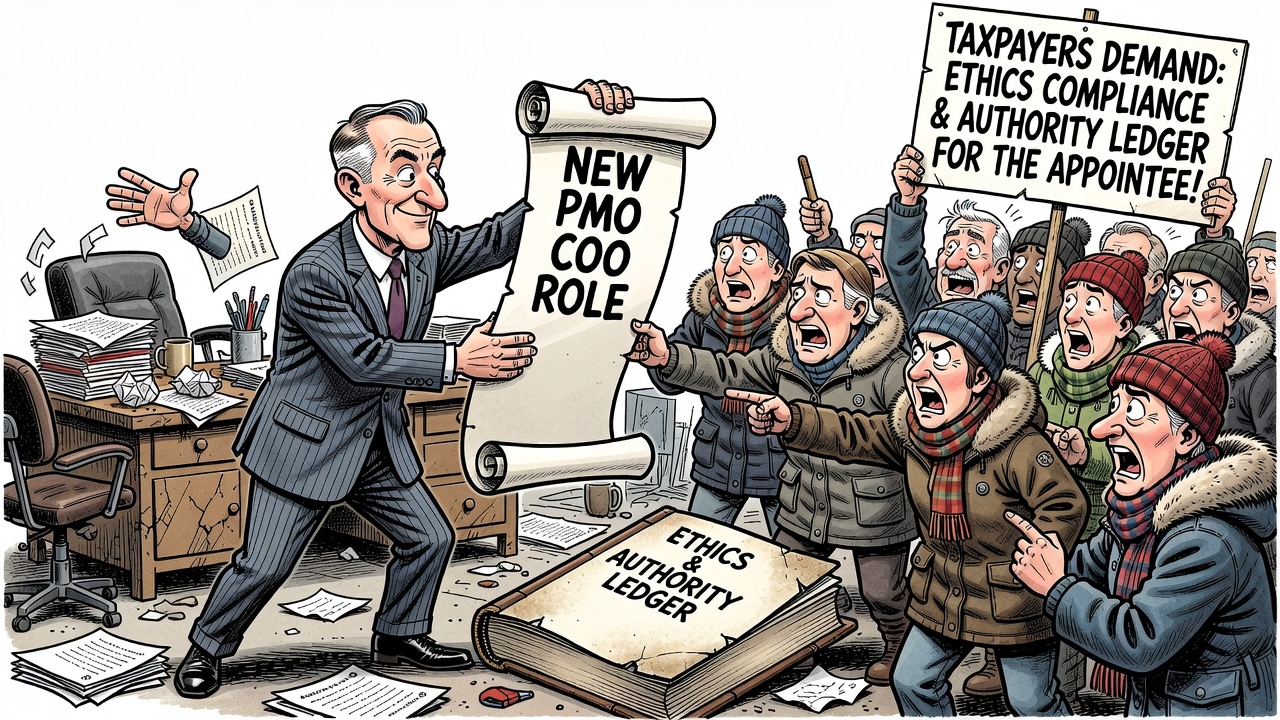
Prime Minister Mark Carney is again reshaping the machinery around him. Canadian Press reports that Maia Johnson will take on a newly created chief operating officer role in the Prime Minister’s Office while remaining a senior adviser on Canada-U.S. relations. The same report says the role is new for the PMO and comes with a nod to Carney’s business background.
That may sound harmless to Ottawa insiders. It should not be treated as routine by taxpayers. The PMO is not a private boardroom, and a prime minister’s staff are not corporate executives spending shareholder money. They sit at the political centre of federal power, close to cabinet files, security briefings, trade decisions, appointments, communications and the pressure points of every department.
The ethics receipt is awkward. The Conflict of Interest and Ethics Commissioner’s public registry lists Johnson as “Senior Special Advisor, United States Stakeholder Strategy” in the Office of the Prime Minister, starting February 17, 2026, with “Initial Compliance in Progress.” The same registry discloses a $200 administrative monetary penalty, paid and disclosed June 25, for failing to provide all required confidential-report information within 60 days of appointment.
That is not proof of corruption, and it should not be inflated into one. But it is enough to require a higher transparency standard before a new, non-standard PMO operations role is normalized. If initial compliance is still in progress, Parliament should know what authority the new role has, what files are screened, what recusals exist, and whether the ethics office has all information it needs.
There is also a democratic-accountability problem. A chief operating officer title suggests control over systems, people and execution. In a corporation, that authority is bounded by a board, audited statements and defined legal duties. In the PMO, Canadians need to know whether this is a human-resources role, a gatekeeping role, a policy-delivery role, a Canada-U.S. strategy role, or some combination of all four.
Carney sold himself as the competent executive who would bring private-sector discipline to government. Fine. Then bring the private-sector paperwork too: a written mandate, salary range, reporting line, delegated authorities, security-clearance status where lawful to disclose, conflict screen, lobbying-contact rules, and the date on which initial ethics compliance is complete.
The government can protect personal privacy while still publishing institutional safeguards. What it cannot do is ask Canadians to accept a new PMO power centre on vibes, business jargon and anonymous briefings. The test is simple: if this role is important enough to create, it is important enough to explain.
- Canadian Press via CityNews Vancouver: Carney shuffles PMO as aide leaves to run in B.C. byelection
- Conflict of Interest and Ethics Commissioner: Maia Johnson public registry page
- Juno News: Carney creates new chief operating officer for former Hillary Clinton campaigner
This article argues for institutional transparency around a public-office role. It does not allege personal wrongdoing beyond the penalty disclosed on the Commissioner’s public registry.