Unsafe Trucking Firms and TFW Approvals Need a Road-Safety Ledger
If Ottawa lets road-safety and labour red flags disappear inside the LMIA machine, Canadians and foreign workers both pay the price.
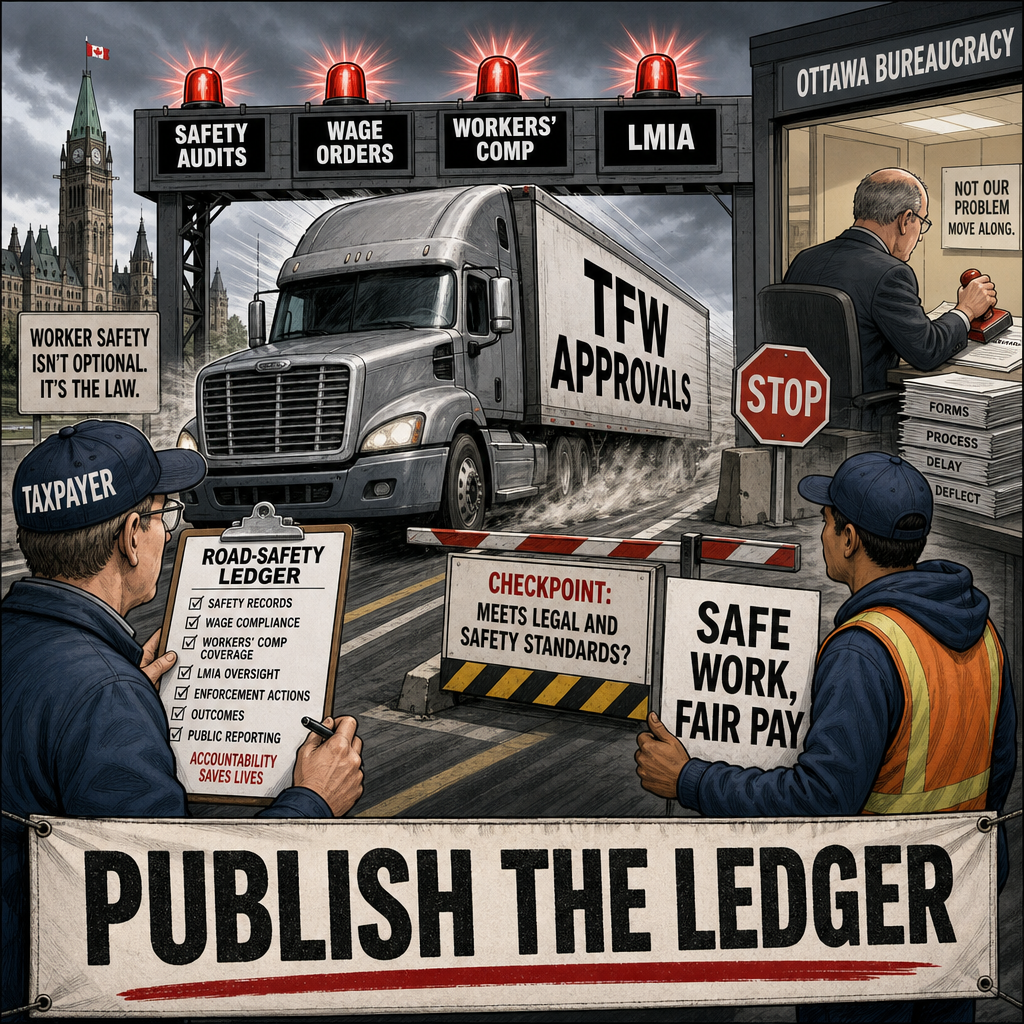
Temporary Foreign Worker approvals for truck drivers should never be a paperwork shortcut around road safety. Yet the Ontario Trucking Association and the Canadian Trucking Alliance say a new Globe and Mail investigation found nearly 100 trucking companies received TFW approvals despite regulatory concerns and violations. The concerns reported by the industry groups include failed safety audits, suspended safety certificates, wage-theft orders, workers’ compensation violations and allegations of forged documents.
That is not an anti-immigration story. It is an accountability story. A foreign driver can be exploited by a bad operator. A Canadian driver has to share the road with that operator. A family on the highway has no idea whether Ottawa checked provincial safety data before approving the labour stream. If the federal government wants the public to trust the Temporary Foreign Worker Program, it should prove the approvals are tied to real safety and labour compliance.
The scale matters. The Canadian Trucking Alliance says federal approvals for truck-driver positions rose from roughly 1,000 in 2016 to 8,500 in 2024. When a program grows that quickly in a safety-sensitive sector, “trust us” is not a control system. It is an invitation for weak operators to treat the LMIA process as a business model.
Ottawa’s own July 9 release shows enforcement is not theoretical. Employment and Social Development Canada says it completed 1,488 TFW Program inspections in 2025–26, found 12 per cent of employers non-compliant, and assessed $10.2 million in administrative monetary penalties — more than double the previous fiscal year. The same release cites a long-haul trucking employer in Manitoba fined $240,000 and banned from the program for five years for failing to provide proper working conditions, failing to comply with labour laws and failing to provide required documents to inspectors.
Conservatives should be clear: Canada needs lawful immigration, fair work and safe supply chains. What it does not need is a federal program that rewards companies with cheap, vulnerable labour while hiding the risk profile from workers, competitors and the public. Good trucking firms that follow the rules should not be undercut by operators carrying safety and labour violations into a federal approval stream.
Carney’s government says it is tightening compliance. Fine. Publish the ledger. If a company is safe, compliant and genuinely unable to hire domestically, the record should show it. If a company has failed audits, wage orders or repeated inspection problems, Canadians deserve to know why Ottawa approved it anyway. Road safety should not depend on a press release after the damage is done.
- Ontario Trucking Association: New G&M investigation echoes OTA warnings over labour abuse and lawlessness in trucking
- Canadian Trucking Alliance: New G&M investigation echoes CTA warnings over labour abuse and lawlessness in trucking
- Employment and Social Development Canada: Government highlights doubling of compliance monetary penalties under the TFW Program
This article does not argue against lawful foreign workers. It argues for transparent safety, labour and inspection receipts before Ottawa approves safety-sensitive trucking positions through the Temporary Foreign Worker Program.