Before Phoenix 2.0, Publish the Dayforce Payroll Risk Ledger
Public servants should not be test subjects for another rushed federal pay-system transition.
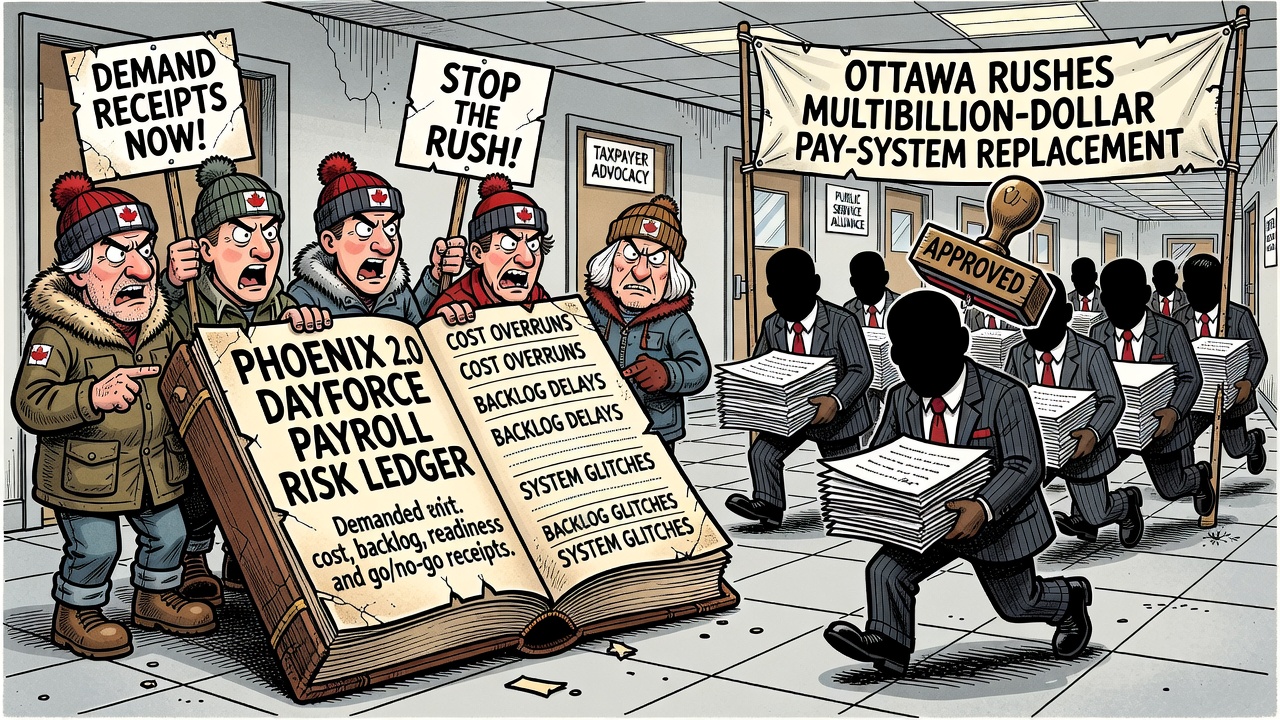
The federal government’s Phoenix payroll disaster should have taught Ottawa one lesson above all others: do not launch a pay system until the rules, data, departments, budgets and fallback plans are ready. Now the Liberal government is replacing Phoenix with Dayforce, and the Auditor General has already put warning lights on the dashboard.
The March 23 Auditor General report says Public Services and Procurement Canada and the Treasury Board Secretariat were still in the planning phase for pay-system modernization. The original schedule did not expect that planning phase to finish until June 2027. After the audit period, however, PSPC shortened the transition schedule by about three years. That may sound like action. It can also become exactly how governments turn a known risk into another national embarrassment.
The backlog alone should stop any victory lap. As of September 30, 2025, more than 233,000 pay transactions remained outstanding, affecting more than 133,000 employees. The Auditor General warned that unresolved errors could be carried into the new system. In plain English: if Ottawa migrates bad data and unresolved cases into Dayforce, it risks preserving Phoenix’s damage under a new brand name.
There is a cost issue, too. PSPC’s preliminary estimate for Dayforce is more than $4.2 billion, and the Auditor General found that this figure does not include important transition costs for departments and agencies. The audit also says Ottawa had not yet determined how to measure the savings it claims modernization will produce. That is not a business case; it is a multibillion-dollar promise with missing columns.
Conservatives should not oppose modernization for the sake of it. Phoenix has hurt too many public servants for too long. A replacement is necessary. But competence means proving readiness before spending billions and changing the calendar. If simplified pay rules are not finished, if departments are not ready, if legacy errors remain unresolved and if savings cannot be measured, then acceleration is not reform. It is political theatre with payroll consequences.
Carney’s government likes to advertise execution. Fine. Execute transparently. Put the Dayforce risk ledger online. Show which departments are clean, which are not, and who signs the go/no-go decision. Show how much customization is being created because Ottawa could not simplify its own pay rules. Show unions and employees the testing results before their paycheques are moved.
No private employer would accept a payroll migration with a six-figure transaction backlog, incomplete transition costs and unclear savings metrics. Taxpayers should not accept it from Ottawa. Before Phoenix 2.0 becomes another federal procurement cautionary tale, publish the ledger.
- Office of the Auditor General of Canada: Modernizing the Pay System — March 23, 2026
- House of Commons Public Accounts Committee / OpenParliament: Auditor General testimony and opening statement — March 23, 2026
- iNFOnews / The Canadian Press: Auditor general to study modernization of the federal pay system
This article supports replacing Phoenix with a functional payroll system. The accountability issue is whether Ottawa can prove Dayforce is ready, fully costed and protected from inherited errors before accelerating the transition.