A One-Quarter Population Dip Is Not an Immigration Capacity Plan
Ottawa still plans 380,000 permanent residents a year. Before ministers call the system controlled, Canadians deserve the housing, health-care, school, court and asylum receipts.
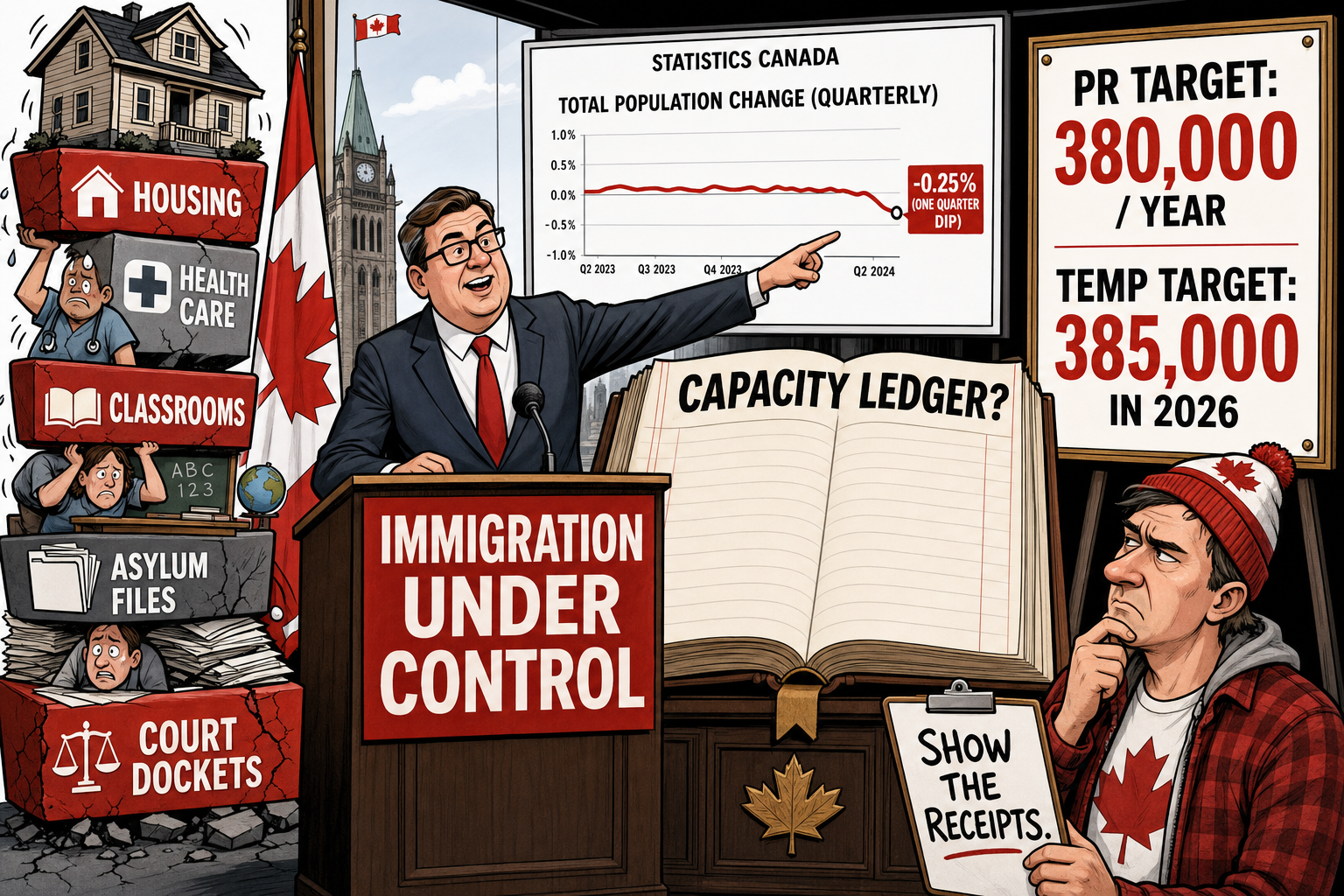
Statistics Canada’s latest population estimate gives Ottawa one tempting talking point and a much bigger accountability problem. Canada’s population was estimated at 41,417,056 on April 1, 2026, down 55,025 people, or 0.1%, from January 1 to April 1. The preliminary number of non-permanent residents fell by 117,879 in the quarter.
That is a real data point. It is not a governing plan. Statistics Canada explicitly warns that these first-quarter estimates are preliminary and will be updated in September 2026. It also says larger-than-usual updates to non-permanent-resident estimates are expected because permit extensions have increased and processing times have lengthened. In plain English: the headline may change when the administrative data catches up.
Meanwhile, Ottawa’s own immigration plan remains large. IRCC says the government is committed to reducing Canada’s temporary population to less than 5% of the total population by the end of 2027. It also sets new temporary resident arrival targets at 385,000 in 2026 and 370,000 in each of 2027 and 2028. At the same time, overall permanent resident admissions are slated to stabilize at 380,000 every year from 2026 through 2028.
The public should not accept a Liberal victory lap built on one quarter of preliminary population data while the capacity ledger stays blank. A lower temporary-resident count helps only if the exits are real, the records are clean, and the permanent stream is tied to services Canadians can actually use. Housing starts do not appear because a minister announces an intake target. Doctors do not materialize because a spreadsheet says “economic immigration.” Court backlogs do not clear because Ottawa rebrands a pressure point as sustainability.
IRCC committee material says the 2026–2028 plan is meant to balance labour-market needs with housing and health-care pressures. Good. Then show the balance sheet. How many net new residents can each province absorb without worsening rents, ER waits, classroom crowding or asylum delays? How many temporary residents are transitioning to permanent residence rather than leaving the country? How many are out of status? What is the monthly enforcement and processing plan?
Conservatives should be precise here. The argument is not that immigration should stop, or that every newcomer is the problem. The argument is that Ottawa broke public trust by running population policy faster than public capacity, then asking Canadians to treat vague “sustainability” language as proof of control.
A serious government would publish the ledger before the spin. If Carney wants Canadians to believe immigration is now under control, his ministers can start with the receipts: province by province, month by month, measured against homes, doctors, schools, courts and wages. Until then, a one-quarter dip is not accountability. It is a talking point looking for a dashboard.
- Statistics Canada: Canada’s population estimates, first quarter 2026
- IRCC: Supplementary information for the 2026–2028 Immigration Levels Plan
- IRCC committee material: 2026–2028 Immigration Levels Plan, December 4, 2025
- IRCC committee material: Permanent resident targets, December 4, 2025
This article relies on official Statistics Canada and IRCC material. It argues for capacity transparency and does not claim the preliminary Q1 estimate is final.