Publish the Gordie Howe Toll Deal Before Calling It a Win
Canada financed the bridge. Washington delayed the opening. Now taxpayers need the signed toll agreement, not another victory-lap press release.
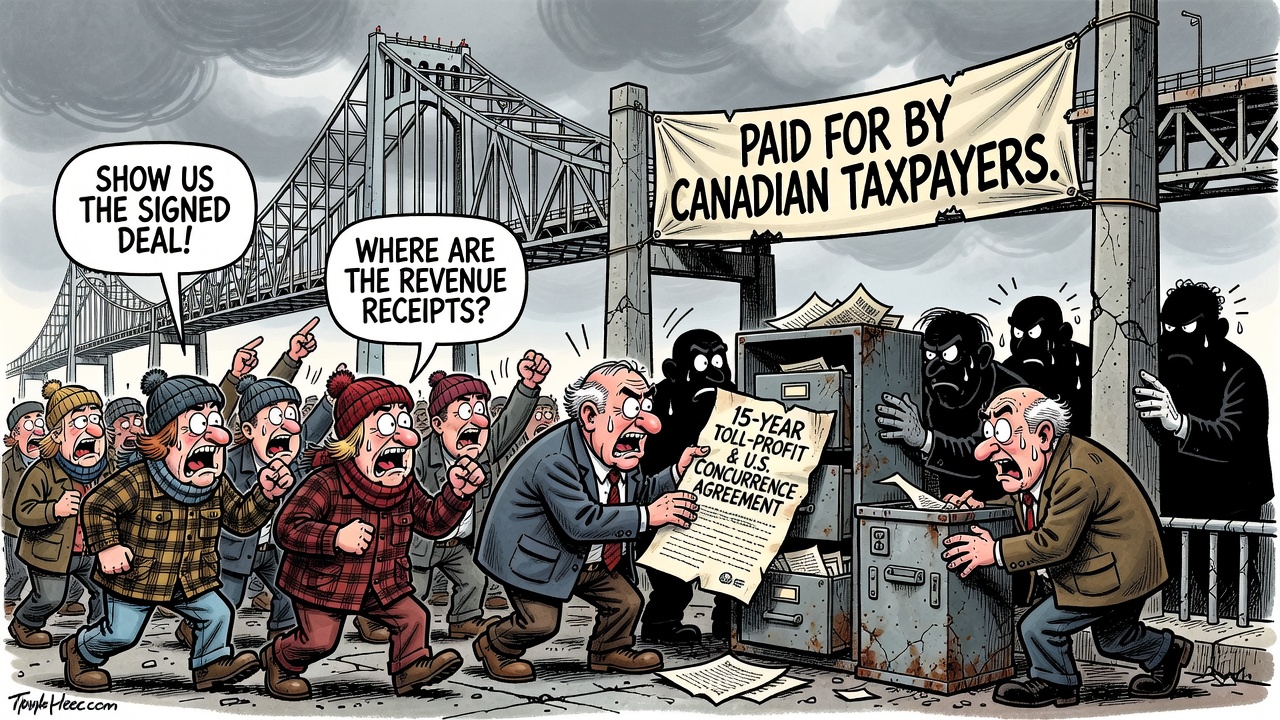
The Gordie Howe International Bridge is finally scheduled to open on July 27. That should be good news for Windsor, Detroit, manufacturers, farmers, truckers and anyone who understands how much Canada depends on the Windsor-Detroit trade corridor.
But useful infrastructure does not cancel the need for receipts. The federal government’s July 10 release says Canada and Michigan agreed to open the bridge with U.S. government support, and that Canada and the United States agreed to measures on toll governance, transparency and a 15-year economic development fund tied to a portion of bridge-operation profits. It also says the Windsor-Detroit Bridge Authority will seek U.S. concurrence for certain non-market toll changes.
That is a major accountability flag. Canadian taxpayers were told for years that Canada was fronting the construction costs and recovering them through tolls. Now, after a delayed opening and U.S. pressure, Ottawa is describing a new governance arrangement while withholding the most important document: the deal itself.
The Canadian Press, published by Global News, reports that a source familiar with the negotiations said Canada would receive 50 per cent of toll profits after operating expenses, while the other half would go to a U.S.-run regional development project for 15 years. The same report says the agreement requires consultation with the U.S. on toll changes greater than 10 per cent, or on lowering tolls below comparable regional averages.
If accurate, that is not a minor clarification. It could affect how quickly Canadian taxpayers are repaid, who controls pricing flexibility, and whether a Canada-financed project has become a bargaining chip in U.S. domestic politics. The government should not ask Canadians to applaud before it shows the revenue table.
Conservatives should not pretend the bridge has no value. It plainly does. The official release says the crossing includes a six-lane cable-stayed bridge, modern ports of entry and one of North America’s busiest trade corridors. The issue is whether Mark Carney’s government protected Canadian taxpayers when the opening became a pressure point.
There is a responsible way to settle this: disclose the agreement. Show how much money is expected to flow to Canada each year. Show how much is diverted to the U.S.-linked fund. Show who governs that fund, what projects qualify, and whether Canadian representatives have veto rights. Show whether toll decisions can be slowed, blocked or politicized by Washington.
A bridge can strengthen trade and still expose weak negotiating. Canada paid. The United States squeezed. Before Ottawa brands this as competent diplomacy, taxpayers deserve the full toll ledger.
- Housing, Infrastructure and Communities Canada: The Gordie Howe International Bridge will open on July 27 — July 10, 2026
- Global News / The Canadian Press: Gordie Howe International Bridge to open July 27 after delay — July 10, 2026
- Associated Press: U.S.-Canada bridge expected to open by late July after dispute
- Gordie Howe International Bridge / WDBA: The Canada-Michigan Crossing Agreement
This article supports trade-enabling infrastructure where justified; the accountability issue is whether Ottawa’s updated toll-governance deal protects Canadian taxpayers and discloses the 15-year revenue consequences.