Carney’s $70B UAE Investment Photo-Op Needs a Project Ledger
Ottawa sold the UAE commitment as historic confidence in Canada. Canadians now deserve proof the government had real projects, real safeguards and real readiness behind the headline.
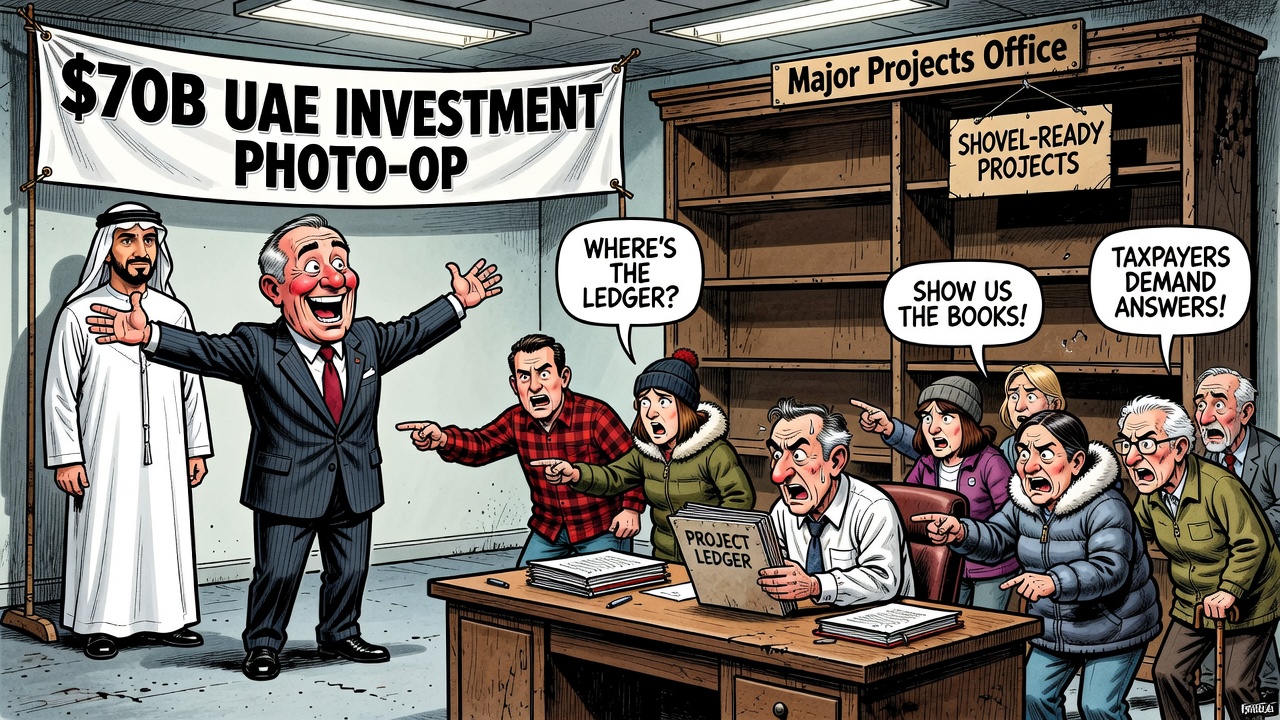
In November 2025, Prime Minister Mark Carney’s office welcomed the United Arab Emirates’ decision to invest $70 billion, or US$50 billion, in Canada. Ottawa called it a historic vote of confidence and a major step in the Canada–UAE strategic partnership. Days later, Carney described the commitment as the largest foreign direct investment commitment in Canadian history.
That is the kind of announcement governments love: big number, global stage, instant validation. But a foreign-investment promise is not the same as a buildable project list. Before taxpayers are asked to applaud, Parliament should see the ledger behind the photo-op.
The government’s own Major Projects Office was created to close regulatory and permitting gaps, coordinate across governments, and make financing plans credible enough for proponents to make investment decisions. That mandate matters because Juno News, citing Financial Times reporting based on anonymous government officials, says the office told a UAE delegation in mid-June that Canada had “nowhere to put your money” because projects were not ready for investment. National Newswatch also listed the Financial Times story under the same core frame: Canada was reportedly not ready for the C$70 billion commitment.
Ottawa can dispute details if it believes the reporting is wrong. What it cannot do is keep selling the announcement while hiding the readiness test. If the projects exist, publish them. If the bottlenecks are permits, name them. If the obstacle is Indigenous consultation, financing structure, provincial approval, grid capacity, port access or national-security screening, Canadians should know that before foreign capital is routed into critical assets.
A Conservative accountability view does not require rejecting foreign capital. Canada needs investment. But serious countries do not confuse a press release with an industrial strategy. A $70 billion pledge can become new mines, energy infrastructure, ports, data centres or manufacturing capacity. It can also become political leverage, asset-shopping, public subsidies, and rushed approvals if government chases the headline after failing to prepare the pipeline.
Carney’s government wants to be judged as competent, technocratic and investment-ready. Fine. Then publish the project ledger. Show Canadians which projects were actually ready when the UAE commitment was promoted, which ones were not, and what public concessions Ottawa is considering to make the numbers work. Until then, the $70 billion story looks less like proof of confidence in Canada and more like proof that this government is still better at announcing capital than deploying it responsibly.
- Prime Minister of Canada: Prime Minister Carney secures new agreements with the United Arab Emirates
- Prime Minister of Canada: Prime Minister Carney announces Canada and Alberta strike new partnership
- Prime Minister of Canada: Prime Minister Carney announces first projects to be reviewed by the new Major Projects Office
- Juno News: Ottawa told UAE Canada was ready for $70B investment — now officials say it wasn’t
- National Newswatch: Listing of Financial Times report on Canada and the UAE investment commitment
This article focuses on public project-readiness, security-screening and taxpayer-risk questions raised by the announced UAE investment commitment and subsequent reporting about the Major Projects Office.